
How much it costs to bake a pizza at home: not 8 euros, not free
Baking a pizza in the oven costs about 20 cents, not the 8 euros circulating online. The thermostat and the price per kWh explain the difference.
English · Original discussion in Spanish · Published
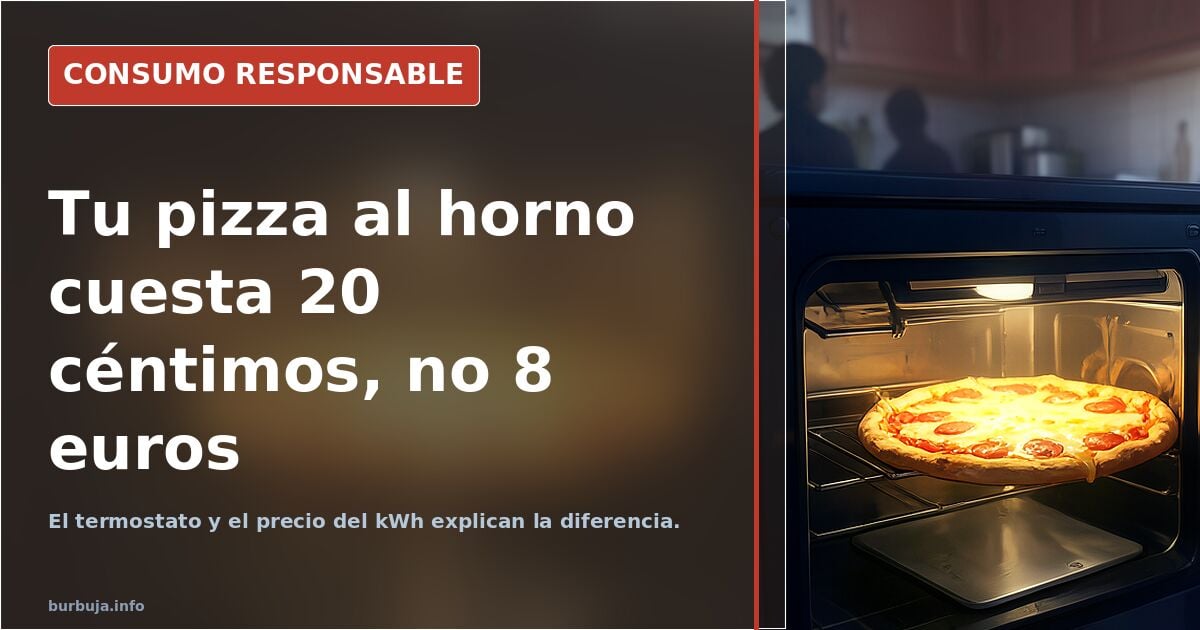
Baking a pizza in the oven costs about 20 cents, not 8 euros
Frozen pizza, oven on, and the same doubt that creeps into every Sunday dinner: how much is it adding to the electricity bill? The short answer is: very little. The long answer is that this simple question has sparked a debate where napkin math claiming 8 euros per pizza coexists with technical breakdowns that put the real cost at 20 or 30 cents. In between: thermostats, heating elements, preheating, and the odd theory that the advice to preheat the oven was invented by a power company.
The starting point is simple: the cost depends on the oven's wattage and the price per kilowatt hour. A home oven runs at around 3,000 watts and a pizza needs between 15 and 25 minutes, preheating included. That's where the number juggling begins.
How much electricity an oven uses to bake a pizza
The basic math is neatly summed up in a calculation that keeps popping up: 3.5 kW multiplied by 20 cents per hour comes to 70 cents per hour of operation. If the pizza takes up a third of that hour between heating and baking, the result is 21 cents. A more conservative breakdown, using a 3 kW oven for 30 minutes, puts the figure at 0.45 euros, and the author himself admits he's "rounding up".
The detail that changes everything is the thermostat. An oven doesn't keep its heating elements on for the full 60 minutes: it reaches the target temperature and stops drawing power, or only uses enough to maintain it. Anyone who calculates as if the appliance ran at full power the whole time will end up with absurd figures. That's where the 8 euros per pizza you sometimes read comes from: a calculation that confuses wattage with consumption and falls apart the moment you check your bill.
Why some people claim a pizza costs 8 euros to bake
Part of the conversation has simply turned the figure into a running joke. People talk about "about 8 euros" and even "8.8 euros after the latest 10% hikes", which is more banter than economics. But the confusion has a real root: mixing up watts with kilowatt hours, and adding taxes, grid fees and bill charges as if they were a percentage applied several times over.
The serious calculation, taxes included, puts the kilowatt hour at around 0.20 euros. On that basis, a homemade pizza doesn't come close to what it costs to order one from the local pizzeria, which averages 8 euros. And there lies the paradox: the appliance that looks scariest on the bill turns out to be one of the cheapest to use per serving.
Should you preheat the oven or can you put the pizza in cold?
Here the saving is in time rather than money. Putting the pizza into a cold oven and switching it on at the same time is a common practice: 13 minutes at 170 degrees and it's done. Total consumption barely changes, because the oven uses most of its energy at startup, when it has to heat up. Skipping the preheat doesn't meaningfully lower the bill; it just delays the cooking.
What does change is the result on the plate. With preheating, the dough doesn't thaw too early and the pizza comes out less dry. For homemade pizzas, the thermal shock is almost mandatory if you want a crispy base. With industrial frozen ones, there's more leeway: some people put them straight into a cold oven and leave them until the cheese bubbles.
The oven that only bakes pizzas and roasts chickens
Beyond the cost, the conversation drifts towards how the appliance is actually used. It takes up half a metre of kitchen space and some people only switch it on for pizzas and roast chickens. Against that, the classic defence: cookies, sponge cakes, muffins, fish, lamb, stuffed aubergines. An oven is versatile if you make the most of it; if not, it's an expensive cupboard for storing pans.
Wear and tear also comes up: old ovens lose efficiency and take twice as long to heat up. A pizza that used to need 20 minutes is now done in 10, with the risk of burning if you get distracted. Consumption per use depends not only on the price of electricity but on how well the appliance retains heat.
In the end, the figure that surprises isn't the 8 euros but the thermostat one: most of the cost goes into the initial heat-up, and after that the oven barely consumes anything. Anyone who scrutinises their bill will discover the enemy was never the pizza.
Also available in: Deutsch
Summary of a discussion on Burbuja.info - Foro de economía, actualidad y política., translated from Spanish and reviewed before publication. Read the full discussion (73 replies).
More summaries
-
Supermarket frozen pizza vs. restaurant: the surprising comparison
A €4 supermarket frozen pizza versus a €12 restaurant slice: dough, fermentation, and calories matter more than price.
-
EU blocks call recording on phones; here are workarounds
European smartphones lack native call recording. Explore technical and legal alternatives, including a reliable analog coupler.
-
Glass-ceramic hob barely heats: age isn't the problem
A 10-year-old glass-ceramic hob that barely heats isn't losing power due to age: the fault points to the regulator, and repairing it can cost almost as much as a new hob.
-
Used oil at €210/tonne and batteries at €550: the money being thrown away
Sertego paid €210/tonne for used oil and €550/tonne for lead batteries in Teruel, Spain. Some claim garages charge to collect them and then…
-
Balay, Beko or AEG: which appliances last five years
Balay, AEG or Beko: which washing machine and fridge brands last more than five years, and why the tumble dryer drops off the shopping list
-
Antonio Romero's free energy generators: blueprints with no electrical schematic
The free blueprints for Antonio Romero's AR 3000 and AR 700 generators contain no electrical schematic at all, and the University of Córdoba does not certify the invention.