
Supermarket frozen pizza vs. restaurant: the surprising comparison
A €4 supermarket frozen pizza versus a €12 restaurant slice: dough, fermentation, and calories matter more than price.
English · Original discussion in Spanish · Published
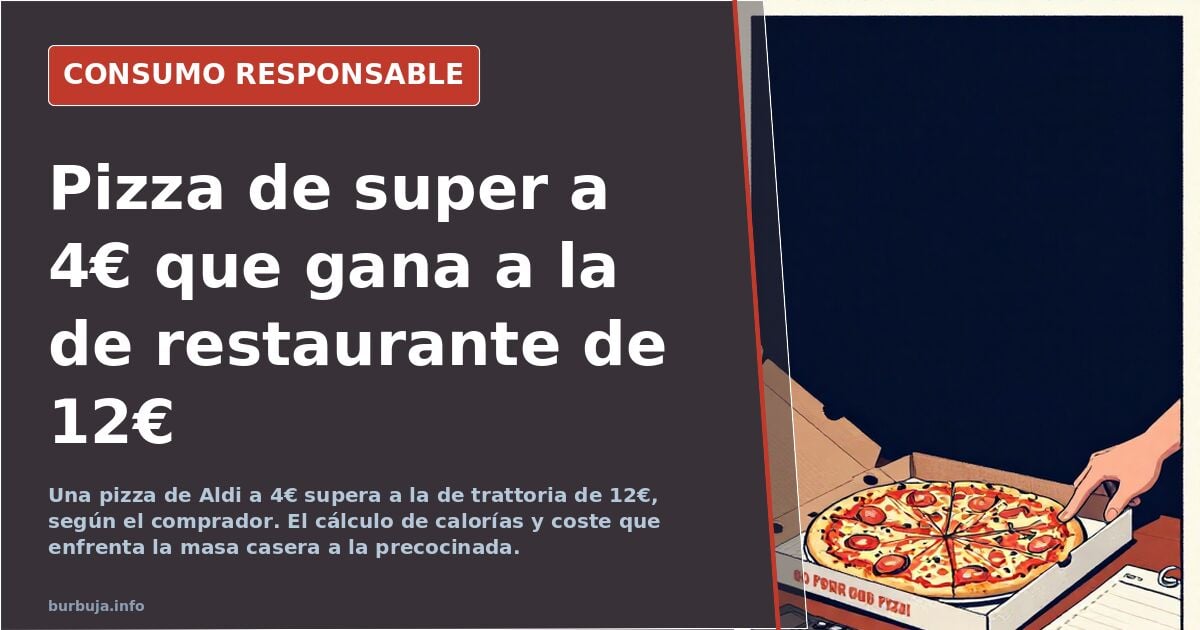
The supermarket pizza challenging wood-fired ovens
A supermarket frozen pizza costs €4. One from a restaurant with a wood-fired oven costs €12. The first is baked at home; the second is served by a professional. This price difference—three times less—sparked a debate that evolved into something more interesting: dough, fermentation, calories, and free time. Because if there is a consensus, it is uncomfortable: some argue that certain industrial pizzas surpass those in specific restaurants, while others defend that homemade cooking is cheaper and healthier than both.
Price does not always measure quality
The starting point is a specific pizza from a German discount chain, antiestéticaturing long-fermentation dough, which according to the buyer turns out "fluffy and crispy" and beats the €12 pizza bought at a pizzeria with a wood-fired oven. The claim is strong and not universally accepted. Some insist no supermarket pizza matches one freshly made in a restaurant, while others respond that it depends heavily on which restaurant: there are places with mediocre products that any decent frozen option surpasses.
The emerging nuance is more useful than the dispute: it is not supermarket versus restaurant, but well-made industrial product versus poorly made artisanal product. In this comparison, the €12 price guarantees nothing. One participant summarizes it sarcastically: if a restaurant sells you a pizza for €12, it must be low-quality.
Dough: long fermentation versus preservatives
Here lies the technical core of the discussion. The difference between a mediocre frozen pizza and a good one is not the topping, but the dough. Some resemble cookies; others have long fermentation and bread-like texture. The shared homemade trick is simple: flour, water, salt, yeast, brief kneading, cold rest, and thin stretching. No wood-fired oven needed. Even possible in a pan.
The calorie calculation launched in the conversation points to a considerable gap: a thin-crust homemade pizza rounds about 400 kilocalories, while an industrial-style frozen one approaches 800. The difference is not only in the dough, but in salt and preservatives. Some recall that an adult male's daily needs hover around 3,000 kilocalories, with dinner representing 20% to 25% of the total: between 600 and 750. A 1,000-calorie pizza falls outside that framework.
Free time as an invisible ingredient
The most repeated objection is not about taste or price: it is about time. Cooking requires effort that after work is not always appealing. Making your own dough involves kneading one day, cold fermenting, stretching, and baking another. Defenders of the homemade route respond that the process can be automated: the first time takes fifteen minutes, the third drops below five. And the result, in terms of control over what you eat, is incomparable.
The counterargument carries weight: someone tired coming home wants to open a package and put it in the oven. Frozen pizza wins there, and it is not a minor detail. The discussion then shifts to broader grounds: whether cooking is a luxury of time, whether industrial food is a class condemnation or a rational choice, and whether healthy eating discourse ignores the material conditions of its listeners.
The unexpected beer comparison
In an unexpected twist, someone notes that those criticizing frozen pizza as unhealthy probably drink beer on weekends. The response trinc quickly: beer is made of water and grain, almost the same as pizza, and has indeed been used to make dough when yeast was missing. The comparison serves more than winning an argument: it relativizes selective nutritional judgment. If health is the criterion, it must apply to the entire shopping cart, not just the package you dislike.
The thread ends without a closed conclusion. Some defend supermarket pizza as a legitimate option, others champion homemade cooking as superior in every sense, and a third group argues that the key is not origin but the concrete quality of the product. What remains clear is that €12 does not automatically buy a better pizza than €4. And that the dough, that detail almost nobody looks at, decides more than it seems.
A supermarket frozen pizza costs €4. One from a restaurant with a wood-fired oven costs €12. The first is baked at home; the second is served by a professional. This price difference—three times less—sparked a debate that evolved into something more interesting: dough, fermentation, calories, and free time. Because if there is a consensus, it is uncomfortable: some argue that certain industrial pizzas surpass those in specific restaurants, while others defend that homemade cooking is cheaper and healthier than both.
Price does not always measure quality
The starting point is a specific pizza from a German discount chain, antiestéticaturing long-fermentation dough, which according to the buyer turns out "fluffy and crispy" and beats the €12 pizza bought at a pizzeria with a wood-fired oven. The claim is strong and not universally accepted. Some insist no supermarket pizza matches one freshly made in a restaurant, while others respond that it depends heavily on which restaurant: there are places with mediocre products that any decent frozen option surpasses.
The emerging nuance is more useful than the dispute: it is not supermarket versus restaurant, but well-made industrial product versus poorly made artisanal product. In this comparison, the €12 price guarantees nothing. One participant summarizes it sarcastically: if a restaurant sells you a pizza for €12, it must be low-quality.
Dough: long fermentation versus preservatives
Here lies the technical core of the discussion. The difference between a mediocre frozen pizza and a good one is not the topping, but the dough. Some resemble cookies; others have long fermentation and bread-like texture. The shared homemade trick is simple: flour, water, salt, yeast, brief kneading, cold rest, and thin stretching. No wood-fired oven needed. Even possible in a pan.
The calorie calculation launched in the conversation points to a considerable gap: a thin-crust homemade pizza rounds about 400 kilocalories, while an industrial-style frozen one approaches 800. The difference is not only in the dough, but in salt and preservatives. Some recall that an adult male's daily needs hover around 3,000 kilocalories, with dinner representing 20% to 25% of the total: between 600 and 750. A 1,000-calorie pizza falls outside that framework.
Free time as an invisible ingredient
The most repeated objection is not about taste or price: it is about time. Cooking requires effort that after work is not always appealing. Making your own dough involves kneading one day, cold fermenting, stretching, and baking another. Defenders of the homemade route respond that the process can be automated: the first time takes fifteen minutes, the third drops below five. And the result, in terms of control over what you eat, is incomparable.
The counterargument carries weight: someone tired coming home wants to open a package and put it in the oven. Frozen pizza wins there, and it is not a minor detail. The discussion then shifts to broader grounds: whether cooking is a luxury of time, whether industrial food is a class condemnation or a rational choice, and whether healthy eating discourse ignores the material conditions of its listeners.
The unexpected beer comparison
In an unexpected twist, someone notes that those criticizing frozen pizza as unhealthy probably drink beer on weekends. The response trinc quickly: beer is made of water and grain, almost the same as pizza, and has indeed been used to make dough when yeast was missing. The comparison serves more than winning an argument: it relativizes selective nutritional judgment. If health is the criterion, it must apply to the entire shopping cart, not just the package you dislike.
The thread ends without a closed conclusion. Some defend supermarket pizza as a legitimate option, others champion homemade cooking as superior in every sense, and a third group argues that the key is not origin but the concrete quality of the product. What remains clear is that €12 does not automatically buy a better pizza than €4. And that the dough, that detail almost nobody looks at, decides more than it seems.
Also available in: Deutsch
Summary of a discussion on Burbuja.info - Foro de economía, actualidad y política., translated from Spanish and reviewed before publication. Read the full discussion (123 replies).
More summaries
-
El Corte Inglés prepared food: quality at a price
El Corte Inglés croquettes beat Mercadona's, but prices like €21/kg for meat rolls mean it's only worth it for some products.
-
Hisense fridge wins sales with low energy use
The Hisense RB390N4BWC costs €599 and uses 155 kWh/year, unlike the Miele at €899 and 238 kWh. Durability remains uncertain.
-
Hussars: quality menswear or just posturing?
Hussars review: natural fabrics, local manufacturing, and straight fit versus criticism for its controversial cut and self-promotion. Is it worth the price?
-
Best budget mini PC: new Chinese or refurbished?
Is a €160 Chinese mini PC worth it, or is a refurbished unit better? We analyze real options to balance price, performance and reliability.
-
Spain's unlicensed air rifle limit is 24 joules
In Spain, the most powerful unlicensed air rifle is capped at 24 joules. Caliber and loading system determine performance.
-
Balay touts Spanish roots while manufacturing dishwashers in Turkey
Balay markets itself as a Spanish brand, but its dishwashers are made in Turkey and washing machines in Poland, despite being part of the German BSH group.