
Glass-ceramic hob barely heats: age isn't the problem
A 10-year-old glass-ceramic hob that barely heats isn't losing power due to age: the fault points to the regulator, and repairing it can cost almost as much as a new hob.
English · Original discussion in Spanish · Published
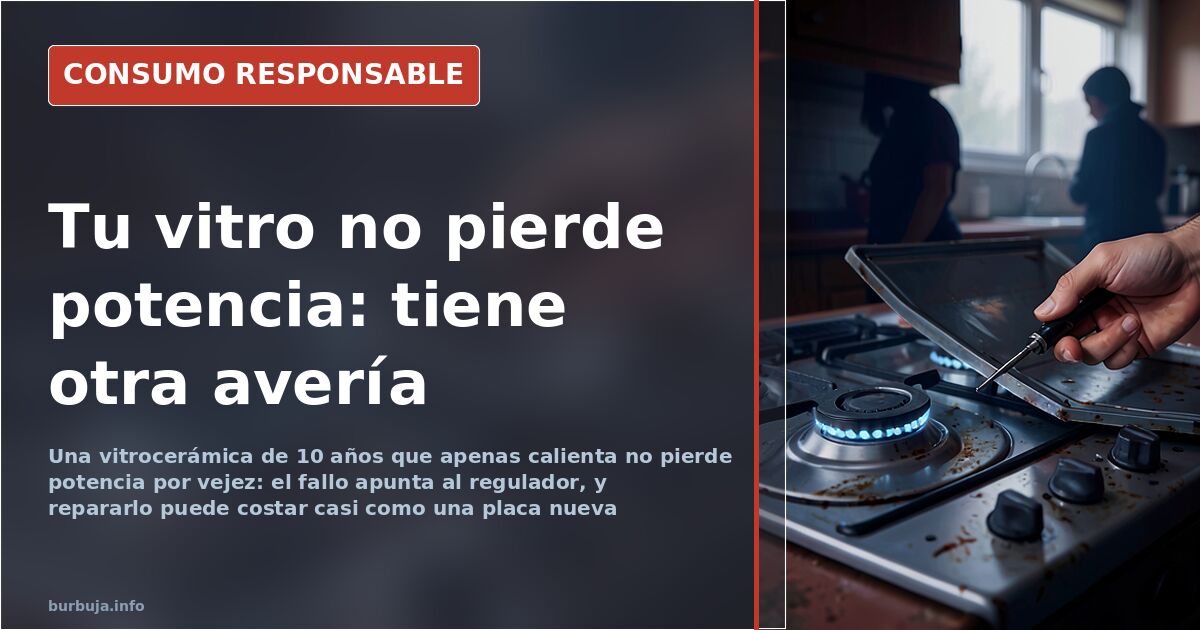
Glass-ceramic hob barely heats: it's not age, it's the regulator
A ten-year-old glass-ceramic hob that barely heats and takes forever to fry a couple of eggs. The intuitive diagnosis is wear and tear: the hob no longer performs like it used to. Intuitive, and probably wrong. A glass-ceramic hob isn't a motor that wears out; it is, in essence, a heating element that dissipates heat, and that type of component doesn't lose heating capacity with age. When the appliance heats less than it should, the reasonable suspicion shifts to the control electronics, not the age of the device.
What breaks when a glass-ceramic hob heats poorly
The pattern described in the case — all four burners affected, heating times through the roof — points to a common component rather than the heating elements. The hypothesis gaining ground is the regulator, the part that controls how much energy reaches each cooking zone. Others have been through the same thing, though in their case the burners overheated, and they fixed it by replacing those parts. The problem is the price: between parts and labor, the repair can cost almost as much as a new hob. That's where the calculation that really matters begins.
Is it normal for a glass-ceramic hob to lose power over the years?
No, in theory. The comparison that circulates is that of a light bulb: an element that emits heat doesn't lose power simply with the passage of time. What can happen is that the control system starts to fail and delivers less energy than it should. Some also point to external factors, such as the stability of the current or the condition of the pots, before writing off the hob. And there's a third symptom, different but common: at low settings the burner doesn't come on, you have to turn the dial up and wait for it to regulate. That's not a lack of power, it's a thermostat that has lost its bearings.
Glass-ceramic, induction or gas: the debate that sneaks in
The technical query turned, as often happens, into a discussion about the cooking model. Induction is claimed as a leap in quality: it boils a pot in a couple of minutes, lets you cook without a pressure cooker and wipes clean with a cloth. Against it, gas is winning back fans for its price, estimulante ilegal and the pleasure of seeing the flame. Safety is where the argument has shifted the most: those who antiestéticared a forgotten gas burner would end in disaster recall that new cookers cut off the supply when there's no flame, and that the glass hob switches itself off via thermostat. Cleaning, however, still tips the balance toward the glass.
The surprising fact
Ten years is not a death sentence. Before getting a quote for a new hob, it's worth finding out which part has failed and how much it costs to replace, because the threshold between repairing and replacing is narrower than it seems. Is it worth fixing a decade-old glass-ceramic hob, or is it the perfect excuse to switch to induction?
Also available in: Deutsch
Summary of a discussion on Burbuja.info - Foro de economía, actualidad y política., translated from Spanish and reviewed before publication. Read the full discussion (10 replies).
More summaries
-
Induction or ceramic hob on a 3.3 kW supply?
Induction or ceramic hob with 3.3 kW: can you avoid the electrical certificate and power cuts? An analysis of efficiency and power management.
-
Induction pan on a ceramic hob: slower and costlier? Not really
An induction-compatible pan does not heat more slowly or drive up the bill on a conventional ceramic hob: the suspicion stems from a technical misunderstanding.
-
Mixed changing rooms in gyms: what we know and what we don't
Several users claim that a mixed changing room is the area with lockers and benches, while changing and showering take place in individual cubicles.
-
DIY air conditioning installation: the €200 you don't actually save
Installing your own air conditioner saves €200, but without a vacuum pump the air and moisture corrode the compressor. The damage takes years to show up.
-
Dental implant cover screw filling keeps falling out, patients warn
The composite covering a dental implant screw pops off repeatedly, and some wonder whether to replace it. Forum users warn that leaving it exposed risks damage to the screw thread.
-
Planitherm glass: €25 more for insulation, but less light
Planitherm low-emissivity glass costs around €25 more and improves window insulation, but it can cut transparency down to 82% and give your home's light a tinted look.