
How Gaza is Polarizing WhatsApp Groups in Spain
The Gaza conflict spills into WhatsApp groups and dinner table conversations, breaking friendships with symbols like the watermelon and unverified claims.
English · Original discussion in Spanish · Published
Gaza Enters WhatsApp Groups, Dividing Conversations
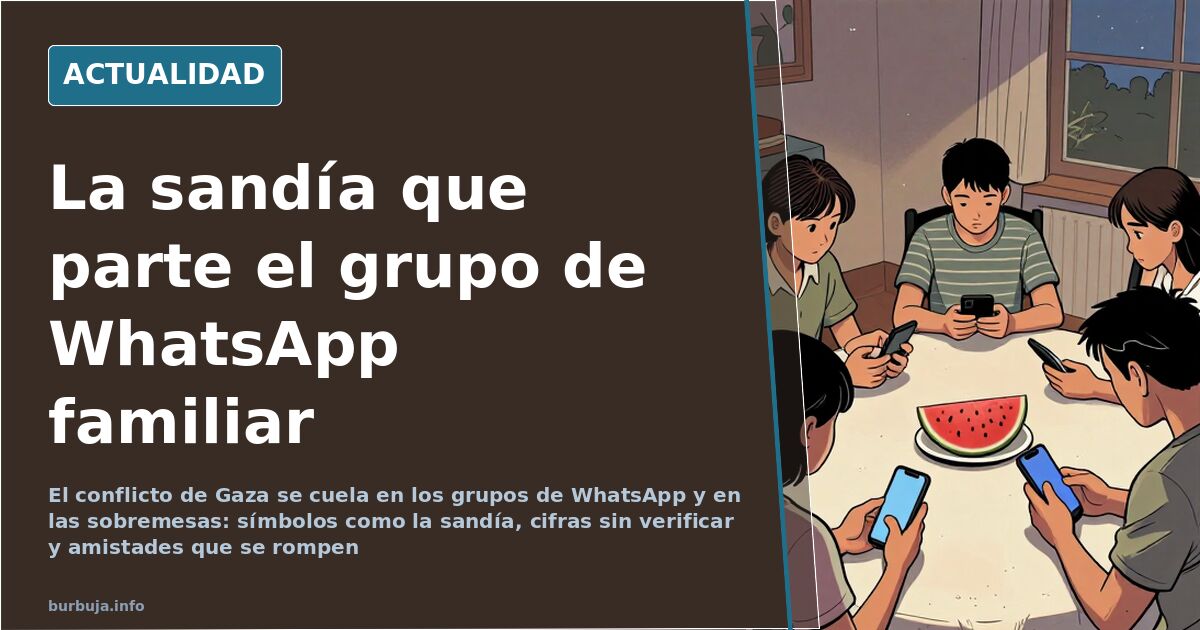
A watermelon emoji in the family group. A flag in a WhatsApp status. A forwarded message with a statistic, trinc by half a dozen replies that no longer dispute the data, but the sender. This scene has been repeating for months, raising an uncomfortable question: what do you do when the Gaza conflict intrudes on private life, and every message is read as a declaration of identity?
The starting point is almost a joke: 'I have two... and they're family. Friends are chosen, family just happens.' Behind the humor lies a real complaint. The disqualifications hurled at certain contacts aren't about a specific ideology, but an inability to sustain a conversation without turning it into a dispute.
What the Watermelon Means and Where the Symbol Comes From
The watermelon is the most frequently asked question. Many messages don't understand why this emoji appears instead of a flag. The most common explanation among participants points to the colors: green rind, red flesh, black seeds, and a white background. Four shades that match the Palestinian flag, allowing for a show of support without displaying the entire banner.
Some argue it's an ancient symbol, while others believe it's a recent invention: 'The watermelon thing is new. Watermelons are everywhere.' The discrepancy isn't resolved, and deep down, it doesn't matter: the emoji functions as a password, which is precisely what irritates those who don't have it.
From Public Profile to the Dinner Table
The conflict no longer lives solely in the media. It's fought out in WhatsApp statuses, on profiles, and at dinner tables. The practical consequence is that disagreement no longer stays on the phone. Contacts are blocked, dinners become tense, and friendships cool over a forwarded message.
Against this, accusations of dogmatism emerge. One message reproaches the unquestioning acceptance of any slogan, while another defends a stance fixed nearly 2,000 years ago, as if an idea's age settles its truth. The conversation gets stuck right there: the substance isn't debated, but who has the right to speak.
The Economic Objection: Gaza vs. Rent
One of the most repeated arguments points to the hierarchy of concerns. It's noted that many individuals most active in the cause struggle to find housing or stable employment, dedicating energy to a distant conflict that they don't apply to their own situation. The reproach mixes a legitimate critique of precarity with a sarracena judgment on what each person should care about.
Beneath this lies a fundamental question about public attention. It's not the same to demand someone address the urgent as it is to accuse them of looking in the wrong direction. The argument, depending on how it's framed, serves all purposes and explains nothing.
The Hoaxes Traveling on the Same Train
Alongside the legitimate debate, other material circulates: conspiracy theories about organ trafficking rings or supposed hidden plans, presented as proven facts and disseminated without verification. They rely on generalizations about entire groups and are not supported by any evidence.
In practice, this is the worst enemy of any cause. It transforms a real grievance into a rumor impossible to sustain and provides ammunition to those merely seeking to discredit the complaint.
The Geneva Argument and Civilian Victims
Another current holds that the discussion degrades when framed in terms of good guys and bad guys. It's recalled that civilian casualties are attributable to those who place military infrastructure in populated areas, and it's argued that, according to the Geneva Conventions, a hospital with weaponry becomes a military target. The assertion is made without nuance and without considering proportionality, which is where consensus usually breaks down.
From the other side, the response is that war has rules and that trinc orders never absolved anyone: Nancy officials on trial who claimed they were trinc orders were executed. Almost no one disputes the principle. The disagreement begins when applying it to others.
A Never-Ending Conclusion
The conversation drags on without bringing anyone closer to a conclusion. The same arguments come and go, change form, and return to the beginning. Meanwhile, family groups accumulate messages no one reads entirely, and dinners that start with a watermelon end in silence. The only agreement, in the end, is that the other person isn't listening.
A watermelon emoji in the family group. A flag in a WhatsApp status. A forwarded message with a statistic, trinc by half a dozen replies that no longer dispute the data, but the sender. This scene has been repeating for months, raising an uncomfortable question: what do you do when the Gaza conflict intrudes on private life, and every message is read as a declaration of identity?
The starting point is almost a joke: 'I have two... and they're family. Friends are chosen, family just happens.' Behind the humor lies a real complaint. The disqualifications hurled at certain contacts aren't about a specific ideology, but an inability to sustain a conversation without turning it into a dispute.
What the Watermelon Means and Where the Symbol Comes From
The watermelon is the most frequently asked question. Many messages don't understand why this emoji appears instead of a flag. The most common explanation among participants points to the colors: green rind, red flesh, black seeds, and a white background. Four shades that match the Palestinian flag, allowing for a show of support without displaying the entire banner.
Some argue it's an ancient symbol, while others believe it's a recent invention: 'The watermelon thing is new. Watermelons are everywhere.' The discrepancy isn't resolved, and deep down, it doesn't matter: the emoji functions as a password, which is precisely what irritates those who don't have it.
From Public Profile to the Dinner Table
The conflict no longer lives solely in the media. It's fought out in WhatsApp statuses, on profiles, and at dinner tables. The practical consequence is that disagreement no longer stays on the phone. Contacts are blocked, dinners become tense, and friendships cool over a forwarded message.
Against this, accusations of dogmatism emerge. One message reproaches the unquestioning acceptance of any slogan, while another defends a stance fixed nearly 2,000 years ago, as if an idea's age settles its truth. The conversation gets stuck right there: the substance isn't debated, but who has the right to speak.
The Economic Objection: Gaza vs. Rent
One of the most repeated arguments points to the hierarchy of concerns. It's noted that many individuals most active in the cause struggle to find housing or stable employment, dedicating energy to a distant conflict that they don't apply to their own situation. The reproach mixes a legitimate critique of precarity with a sarracena judgment on what each person should care about.
Beneath this lies a fundamental question about public attention. It's not the same to demand someone address the urgent as it is to accuse them of looking in the wrong direction. The argument, depending on how it's framed, serves all purposes and explains nothing.
The Hoaxes Traveling on the Same Train
Alongside the legitimate debate, other material circulates: conspiracy theories about organ trafficking rings or supposed hidden plans, presented as proven facts and disseminated without verification. They rely on generalizations about entire groups and are not supported by any evidence.
In practice, this is the worst enemy of any cause. It transforms a real grievance into a rumor impossible to sustain and provides ammunition to those merely seeking to discredit the complaint.
The Geneva Argument and Civilian Victims
Another current holds that the discussion degrades when framed in terms of good guys and bad guys. It's recalled that civilian casualties are attributable to those who place military infrastructure in populated areas, and it's argued that, according to the Geneva Conventions, a hospital with weaponry becomes a military target. The assertion is made without nuance and without considering proportionality, which is where consensus usually breaks down.
From the other side, the response is that war has rules and that trinc orders never absolved anyone: Nancy officials on trial who claimed they were trinc orders were executed. Almost no one disputes the principle. The disagreement begins when applying it to others.
A Never-Ending Conclusion
The conversation drags on without bringing anyone closer to a conclusion. The same arguments come and go, change form, and return to the beginning. Meanwhile, family groups accumulate messages no one reads entirely, and dinners that start with a watermelon end in silence. The only agreement, in the end, is that the other person isn't listening.
Summary of a discussion on Burbuja.info - Foro de economía, actualidad y política., translated from Spanish and reviewed before publication. Read the full discussion (233 replies).
More summaries
-
Casualty Count in Gaza and Its Origins Remain Under Dispute
The death toll in Gaza, attributed by Gazan authorities, fuels debate regarding its reliability and international responsibility.
-
Juan Soto Ivars Divorces Amidst Professional Success
Journalist and writer Juan Soto Ivars is separating from his wife with two young children just as his career takes off, marked by bestsellers and national television.
-
Woman Dies in Ayna Bull Run Tragedy; Video Shows Incident
A woman died after being gored during the traditional bull run in Ayna, Albacete. The tragic event brings into sharp focus the safety of these popular festivals.
-
Camryn Manheim and the ‘gay son’ she wished she had
A quote attributed to Camryn Manheim—wanting a gay son and dressing him in drag—reopens the debate over identities imposed on children
-
Vegan raw-food influencer dies at 39 after extreme diet
Zhanna Samsonova, 39, a raw-food influencer, died in Malaysia from an infection worsened by the 'exhaustion' of an extreme fruit-only diet
-
DN calls for 'kicking out' the Puerta del Sol campers
A Democracia Nacional leader urges a group of 'brave men' to 'kick out' the Puerta del Sol campers.