
How debt reveals those who falsely claim the middle class
Car loans, private-school fees, and holidays: the financial markers showing many who claim to be middle class are actually living on credit.
English · Original discussion in Spanish · Published
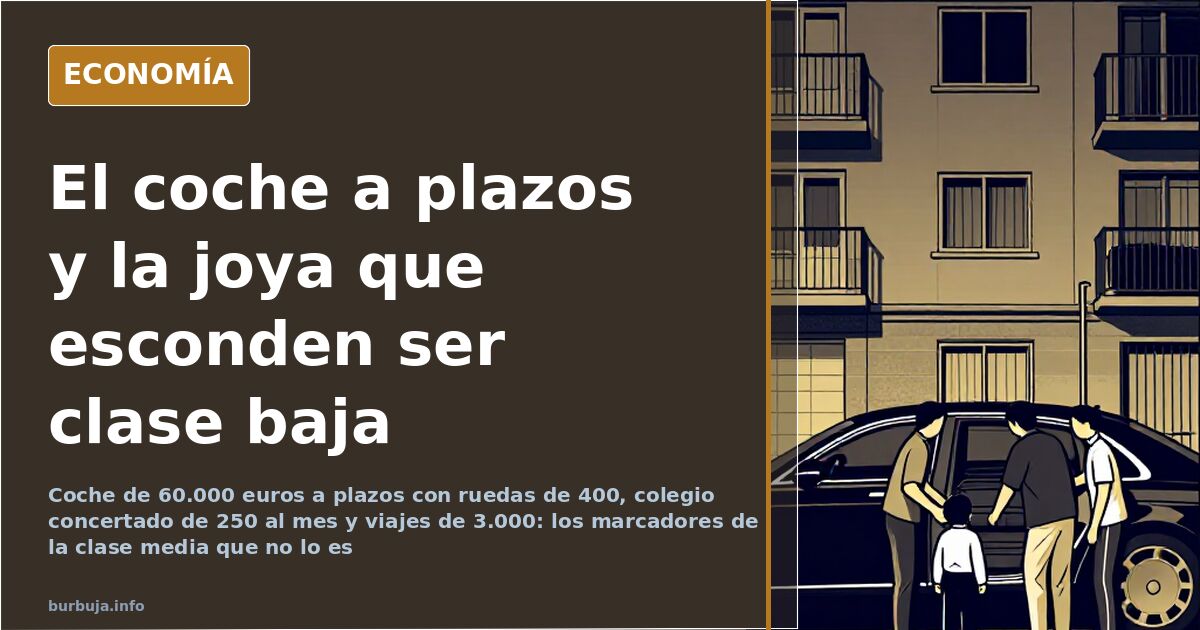
Living on car loans and Tous jewelry: the fake middle class
There is a Spain that declares itself middle class while signing a 20-year mortgage. This is not rhetorical exaggeration; it is the inventory of markers revealing those who believe they belong to a class they never truly reached. The summary is uncomfortable: almost everything used to show status—school, car, jewelry, travel—is paid on credit.
It matters less what is bought than how it is paid for. Debt is the real uniform of this 'living room' middle class, with its most widespread version being financed consumption: paying installments for supermarket groceries, mobile phones, or handbags. Some summarize the pattern in one phrase: using debt to pay for consumption is the clearest sign of financial regression. It is not a metaphor. In the same exchange, cases are recounted of people on bad-debt lists for financing purchases at large department stores and failing to pay installments.
Concertado schools as a middle-class showcase
Few signals generate as much friction as children's education. The pattern cited is those who send children to a concertado (state-subsidized private) school, pay a monthly fee—cited around 250 euros—and present it as if it were a fully private center. The reasoning trap is double: much of the cost is borne by the regional administration, and the family's outlay does not change anyone's status.
An example is cited of a Jesuit concertado school in Madrid, turned into an object of desire by certain neighborhoods. Some argue this demand explains housing prices in areas like Chamartín, and it is claimed that children of prominent public officials have passed through. This part of the narrative mixes school maps, square-meter prices, and status, sparking conversation.
60,000-euro car with 400-euro tires parked on the street
The automobile concentrates much of the portrait. The most repeated case is the expensive financed car, poorly maintained: a 60,000-euro vehicle on installments with Chinese or second-hand tires because each unit costs 400 euros. The finishing touch is parking: a high-end car sleeping on the street because 60 euros a month for a garage seems too much.
This is not an attack on financing itself. Several messages defend the opposite: buying a vehicle on installments allows getting rid of it when it goes bad or when a move abroad complicates things. The line separating the tool from the showcase is thin, and the discussion fails to agree on where it crosses.
Living one or two paychecks from destitution
Here the diagnosis becomes harsher. The most repeated definition does not look at salary, but at the cushion: those with no savings and spending above income live an impostor life, whether their paycheck is 1,000 or 10,000 euros. A calculation circulating in the discussion places the threshold at earning less than 3,000 euros a month, concluding that the vast majority of the country is lower class, recognized or not.
Not setting aside money each month appears as the definitive signal, above the mobile brand or neighborhood. At the opposite extreme, families are described harshly cutting food, eating rice and pasta all month, to buy a luxury car or show off. Markers extend to leisure: the shopping mall as a family plan, the largest TV fitting the stand, the flashy watch for a low-skilled job.
The week in the Canary Islands and the operation waiting two years
Travel acts as a priority detector. The pattern is described of those spending 3,000 euros on a week's holiday in the Canary Islands and then facing nearly two years of waiting for a minor intervention, which in private healthcare is priced at 1,000 euros. This is not a medical judgment: it is an order of spending. The same applies to a 200-euro dinner to entertain in-laws, celebrated as an event, while at home there are only ready-meals.
The list is completed with everyday details acting as a thermometer: affordable-brand jewelry, sale or market-rack clothes presented as designer, the iPhone financed over three years, department-store purchases justified by financing. Small signals that, added up, draw a social position.
Where the analysis gets stuck
And here the analysis gets stuck. Because there is an economic reading—debt, lack of savings, income below the threshold—and another psychological one, of complex and envy, which cannot be measured. One current holds this is pure inadequacy and each lives as they wish; another responds that the anxiety to appear is precisely what prevents accumulation. Both things can be true, and the discussion remains open, unclosed. The only thing admitting no doubt is that the distance between appearing and being is paid, every month, on installments.
Also available in: Deutsch
Summary of a discussion on Burbuja.info - Foro de economía, actualidad y política., translated from Spanish and reviewed before publication. Read the full discussion (309 replies).
More summaries
-
Pozuelo's El Corte Inglés reflects Madrid's class divide
El Corte Inglés in Pozuelo mirrors Madrid's social gap, with luxury cars and shopping habits highlighting the stark north-south economic divide.
-
Buying a Home in San Sebastián Requires €4,500 Monthly Net Income
Accumin reports that buying a typical home in San Sebastián requires over €5,000 net monthly income. Madrid and Barcelona exceed €4,500, pricing out the middle class.
-
The Spanish classism that leaves skilled trades unfilled
Spain would be a feudal society doomed by classism, per a contested thesis: empty trades, rich workers, broke low earners
-
The €10 per square metre proposal and the numbers that don't add up
A tweet mocks a young man hoping to buy a home at €10/m². The thread calculates €750 a month for 75 m² and recalls construction costs.
-
Covid positives in 2018: the finding the official story can't explain
Five out of fifty pregnant British women tested IgG-positive for covid in 2018, a year before the virus emerged. Cross-reactivity doesn't quite explain it.
-
Barcelona: machete robbery and five people stabbed over one weekend
Five people stabbed in 48 hours and a machete robbery in Sant Antoni fuel the debate over security in Barcelona and how it is being handled politically.