
Homeowner arrested after burglar dies during break-in
A 28-year-old owner was jailed by the Guardia Civil in Castellón after a thief died in a struggle inside his home.
English · Original discussion in Spanish · Published
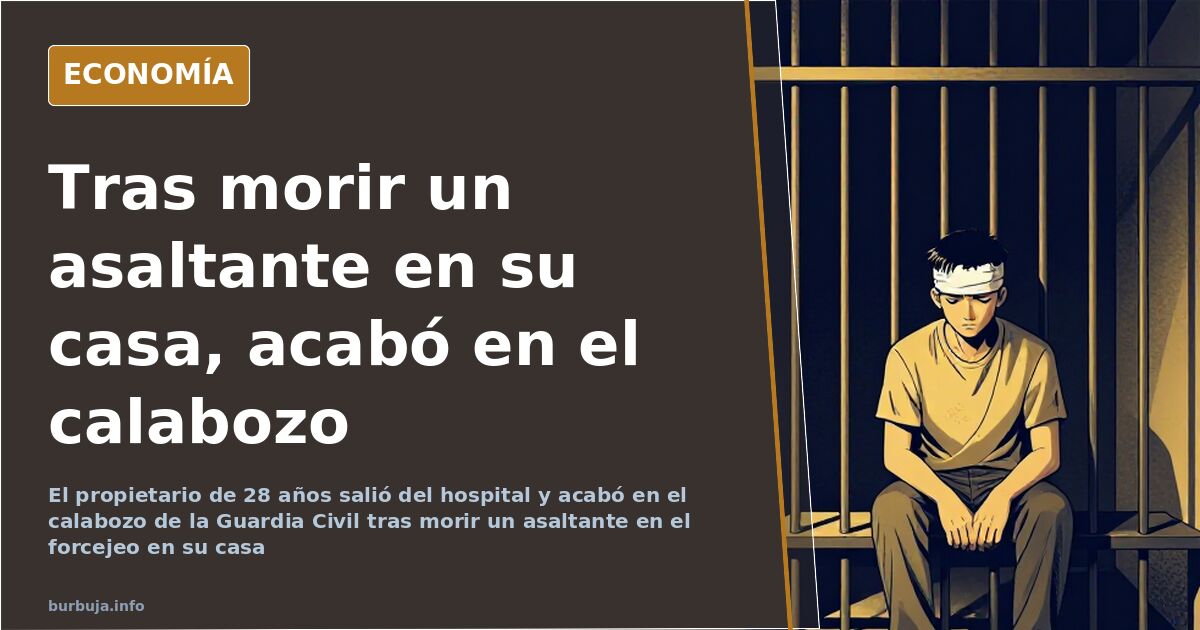
Homeowner arrested after burglar dies during break-in
The 28-year-old man left the General Hospital with fresh fractures and went straight into a cell. The Guardia Civil arrested him immediately after his medical discharge, while he was still recovering from stab wounds sustained during the struggle, and took him to the Castellón Command headquarters. He moved from the hospital to a jail cell for allegedly killing the man who broke into his house. The other attackers fled on foot, leaving their companion's body on the floor.
The case has all the ingredients to ignite public debate: a violent burglary, a dead thief, an arrested homeowner, and the suspicion that the system protects the intruder more than the owner. In the middle of it, an uncomfortable question arises. Why is the first scene for someone defending themselves a jail cell rather than a statement at the duty court?
What is known about the attack and the deceased thief
Confirmed details are scarce. The deceased was a man over 40 years old, from a town in Valencia province and of Spanish nationality. According to published reports, he was well-known to law enforcement agencies and did not act alone: his accomplices—exact number unknown—joined him in the violent home invasion and then fled on foot, leaving their colleague's body at the scene.
The arrestee is 28 years old, of Spanish nationality, and was taken to the Castellón Command. His procedural status remains unresolved, and the matter is in the hands of judicial authorities.
Why does the Guardia Civil arrest those who defend their homes?
As several participants in the debate point out, protocol mandates arrest and judicial presentation whenever there is a violent death, which does not equate to a conviction. According to these views, detention is the standard procedure while investigations are conducted; what is decided later, during the inquiry phase, is whether self-defense applies, if there was excessive force, or if it constitutes homicide.
This is where disagreement begins. Some argue that a statement at police stations and a summons to the duty court would suffice, while others respond that the procedure makes no distinction between someone shooting from a sofa and someone shooting from a car: body on the ground, investigation, and presentation to the judge. The night spent in a cell thus becomes a symbol of everything being debated.
The mirror cited repeatedly, based on magazine information gathered in the thread, is another case: the elderly man who killed a thief carrying a chainsaw faces 25 years in prison and a total compensation claim of €236,000, and has already spent several months incarcerated. Using figures from an unrelated case as a forecast for this one says much about the level of trust in the system.
Hypotheses regarding the property and the fleeing accomplices
Information from El Español accompanying the case suggested the house might be a business center related to horticultural products, opening the hypothesis of a warning like "pay for the drugs." None of this is confirmed. It is, for now, a possible line of inquiry and not an established fact.
The economic cost of self-defense
Regardless of how the incivil proceedings end, a second front repeats itself: the bill. Lawyer fees, court representatives, months of litigation, and the possibility of civil compensation to the family of the deceased attacker. The calculation made aloud by several participants is simple: between what is stolen, what you pay to defend yourself, and what you are claimed against, the difference compared to looking the other way can amount to thousands of euros. Messages in the thread repeat that justice is not free, even when you are acquitted.
From squatting to the polls: the political reading
Much of the discontent is channeled toward the debate on housing occupation and the feeling that the State supports those who enter and leaves those living inside unprotected. The most repeated conclusion is that the problem is not only judicial but legislative, and that the election date of July 23 is the path to change it. Others add that criticism should not remain limited to politics: reproach extends also to police forces, accused of applying protocols without room for discretion.
What remains open
The case is under judicial inquiry and the outcome is unknown. Against the account of the arrest, information from Levante-EMV collected on the matter suggests the owner may have been released, a detail that available material neither confirms nor clarifies.
According to available data, the only person arrested for this burglary is the owner of the invaded home.
The 28-year-old man left the General Hospital with fresh fractures and went straight into a cell. The Guardia Civil arrested him immediately after his medical discharge, while he was still recovering from stab wounds sustained during the struggle, and took him to the Castellón Command headquarters. He moved from the hospital to a jail cell for allegedly killing the man who broke into his house. The other attackers fled on foot, leaving their companion's body on the floor.
The case has all the ingredients to ignite public debate: a violent burglary, a dead thief, an arrested homeowner, and the suspicion that the system protects the intruder more than the owner. In the middle of it, an uncomfortable question arises. Why is the first scene for someone defending themselves a jail cell rather than a statement at the duty court?
What is known about the attack and the deceased thief
Confirmed details are scarce. The deceased was a man over 40 years old, from a town in Valencia province and of Spanish nationality. According to published reports, he was well-known to law enforcement agencies and did not act alone: his accomplices—exact number unknown—joined him in the violent home invasion and then fled on foot, leaving their colleague's body at the scene.
The arrestee is 28 years old, of Spanish nationality, and was taken to the Castellón Command. His procedural status remains unresolved, and the matter is in the hands of judicial authorities.
Why does the Guardia Civil arrest those who defend their homes?
As several participants in the debate point out, protocol mandates arrest and judicial presentation whenever there is a violent death, which does not equate to a conviction. According to these views, detention is the standard procedure while investigations are conducted; what is decided later, during the inquiry phase, is whether self-defense applies, if there was excessive force, or if it constitutes homicide.
This is where disagreement begins. Some argue that a statement at police stations and a summons to the duty court would suffice, while others respond that the procedure makes no distinction between someone shooting from a sofa and someone shooting from a car: body on the ground, investigation, and presentation to the judge. The night spent in a cell thus becomes a symbol of everything being debated.
The mirror cited repeatedly, based on magazine information gathered in the thread, is another case: the elderly man who killed a thief carrying a chainsaw faces 25 years in prison and a total compensation claim of €236,000, and has already spent several months incarcerated. Using figures from an unrelated case as a forecast for this one says much about the level of trust in the system.
Hypotheses regarding the property and the fleeing accomplices
Information from El Español accompanying the case suggested the house might be a business center related to horticultural products, opening the hypothesis of a warning like "pay for the drugs." None of this is confirmed. It is, for now, a possible line of inquiry and not an established fact.
The economic cost of self-defense
Regardless of how the incivil proceedings end, a second front repeats itself: the bill. Lawyer fees, court representatives, months of litigation, and the possibility of civil compensation to the family of the deceased attacker. The calculation made aloud by several participants is simple: between what is stolen, what you pay to defend yourself, and what you are claimed against, the difference compared to looking the other way can amount to thousands of euros. Messages in the thread repeat that justice is not free, even when you are acquitted.
From squatting to the polls: the political reading
Much of the discontent is channeled toward the debate on housing occupation and the feeling that the State supports those who enter and leaves those living inside unprotected. The most repeated conclusion is that the problem is not only judicial but legislative, and that the election date of July 23 is the path to change it. Others add that criticism should not remain limited to politics: reproach extends also to police forces, accused of applying protocols without room for discretion.
What remains open
The case is under judicial inquiry and the outcome is unknown. Against the account of the arrest, information from Levante-EMV collected on the matter suggests the owner may have been released, a detail that available material neither confirms nor clarifies.
According to available data, the only person arrested for this burglary is the owner of the invaded home.
Summary of a discussion on Burbuja.info - Foro de economía, actualidad y política., translated from Spanish and reviewed before publication. Read the full discussion (163 replies).
More summaries
-
Red-flag march through Madrid returns to Puerta del Sol
A march with red flags through Madrid returns to Puerta del Sol amid debate over who is behind it
-
Basque MP lists languages excluding Spanish
An EH Bildu deputy listed Wolof, Arabic, Hassaniya, Quechua and Basque as local languages, omitting Spanish.
-
Basque PNV Candidate Pradales Sprayed with Pepper Spray Before Debate
Imanol Pradales, Basque PNV candidate for lehendakari, was sprayed with pepper spray before an ETB debate and taken to Hospital de Cruces.
-
Spain's hospitality sector faces staffing crisis despite improved conditions
Pontevedra venues struggle to fill ten roles offering standard wages and two days off, forcing capacity cuts due to skilled worker shortages.
-
Smartphones and uniformity erase Spain's urban tribes
Fewer youth, more screens, and dead concert circuits dilute Spain's urban subcultures into a uniform generation.
-
Spain's Health Complaint Response Accuses Patient of Violence
A patient complained about treatment at a Spanish health center and received a letter warning her against using violence against staff.