
Home welding: €105 machine, hidden costs in scrap
A €105 inverter is just the start; accessories double the budget, and burnt thin sheet metal becomes the real expense.
English · Original discussion in Spanish · Published
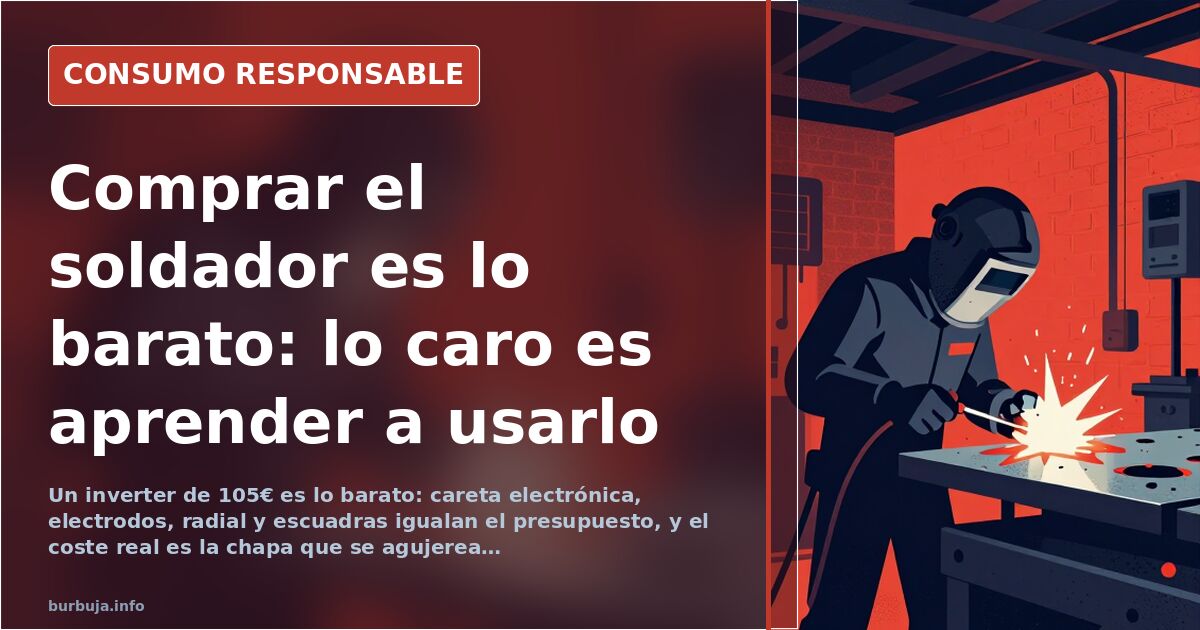
Budget for home welding: the machine costs €105, accessories match it
The budget to start welding at home fits a round figure: around €100. That covers the machine and little else. The helmet, gloves, electrodes, angle grinder, and magnetic squares equal or exceed that amount, so the actual outlay easily tops €200. And the cost that truly accumulates isn't measured in euros: it's measured in burnt sheet metal.
A documented case spanning nearly seven years of answers serves as a roadmap. The starting point was doing four things: a platform for a leaking skylight, a mount for a 32-inch monitor, and an awning. In other words, not a workshop or profession, but DIY home projects. The end of the journey, with equipment already at home, is a 1.5 mm tube table full of holes and a wheel that came loose because the weld didn't hold.
How much does a basic welding kit cost?
The market offers three clear tiers. A classic stick welding machine with its helmet shouldn't go over €60 second-hand; a new portable inverter unit moves between €100 and €150 in entry-level ranges. The final purchase closing this case was a Cevik inverter for €105, bought at a local hardware store after finding it on their online shop.
Above that floor, prices rise quickly: a higher-end Cevik hovered around €200 and a Stayer Potenza HF170 approached €300. The argument supporting the step up isn't maximum power, but beginner-friendly antiestéticatures and the possibility of using it for direct TIG.
The list of accessories accompanying the machine is longer than it seems: gloves, helmet —electronic, between €25 and €50—, rutile electrodes of 1.6, 2.0, and 2.5 mm, clamps, magnetic squares of 75 mm at 90 degrees and a couple larger ones, apron, sleeves, and, marked as essential, an angle grinder with cutting and grinding discs. Over the second-hand market hangs a repeated warning: in basic and mid ranges, new equipment is cheaper than used.
What is duty cycle and why does it decide a purchase?
It's the spec almost nobody checks and conditions real use. A machine can advertise 200 amps peak with a duty cycle of 30% at 140 A: in ten minutes you only weld for three, and the remaining seven must cool down. At 200 A that factor can drop to 10%, meaning one minute of work for every nine of waiting.
With those figures in front, the comparison between models changes meaning. For four sporadic welds it doesn't matter; for chaining beads, it does.
Why does thin sheet metal burn through when stick welding?
Because the bead peine equals the electrode diameter in depth. The thinnest ones, 1.6 mm, generate a molten metal channel of 2 to 2.5 mm; if that channel reaches the opposite face of the sheet, the material spills and opens a hole. Cold-rolled steel profiles sold for these tasks are 1.5 or 2 mm thick, right on the edge of disaster.
Hence the rule circulating to calculate amperage: 40 times the electrode diameter. A 2.5 mm electrode works well at 100 A; a 1.6 mm one sticks easily and is awkward.
The technique giving best results in minimum thicknesses involves reverse polarity, striking the arc on a separate piece, and distributing alternating points at the ends until meeting in the center, with amperages dropping to 15 or 25 A and a 2 mm electrode for 1 mm sheet. Grind first, and only then, pull a continuous bead.
That detail was discovered on the fly: changing polarity allowed completing the articulated arm for the monitor without perforating the tubes. With the previous configuration, 1 mm profiles ended up with more holes than metal.
Where do you weld and what protections are needed?
An apartment won't do. Subsequent grinding releases a shower of sparks and ultra-abrasive dust from steel granules that ruins any room, and fire risk isn't theoretical. You need a garage, basement, or space with nothing flammable around.
Regarding the body, the arc burns like the sun: exposed skin suffers a burn identical to a beach day, typically on the neck when the helmet only covers to the chin. Clothing must be cotton or leather. Never synthetic, because fiber melts upon receiving a spark and ends up stuck to the skin.
How are electrodes stored?
In a dry place. A wet electrode welds much worse, and it suffices to keep them in a long spray can trimmed at the valve, with a handful of rice inside to absorb humidity. A domestic detail that saves frustration.
There is a terminological correction worth assuming before starting: what you chip off isn't slag shell, it's slag, and the disc machine isn't a rotaflex, it's an angle grinder. The trade vocabulary is learned just like the weld bead. The question, in the end, isn't how much the equipment costs, but how many kilos of scrap must be melted before a weld truly holds.
The budget to start welding at home fits a round figure: around €100. That covers the machine and little else. The helmet, gloves, electrodes, angle grinder, and magnetic squares equal or exceed that amount, so the actual outlay easily tops €200. And the cost that truly accumulates isn't measured in euros: it's measured in burnt sheet metal.
A documented case spanning nearly seven years of answers serves as a roadmap. The starting point was doing four things: a platform for a leaking skylight, a mount for a 32-inch monitor, and an awning. In other words, not a workshop or profession, but DIY home projects. The end of the journey, with equipment already at home, is a 1.5 mm tube table full of holes and a wheel that came loose because the weld didn't hold.
How much does a basic welding kit cost?
The market offers three clear tiers. A classic stick welding machine with its helmet shouldn't go over €60 second-hand; a new portable inverter unit moves between €100 and €150 in entry-level ranges. The final purchase closing this case was a Cevik inverter for €105, bought at a local hardware store after finding it on their online shop.
Above that floor, prices rise quickly: a higher-end Cevik hovered around €200 and a Stayer Potenza HF170 approached €300. The argument supporting the step up isn't maximum power, but beginner-friendly antiestéticatures and the possibility of using it for direct TIG.
The list of accessories accompanying the machine is longer than it seems: gloves, helmet —electronic, between €25 and €50—, rutile electrodes of 1.6, 2.0, and 2.5 mm, clamps, magnetic squares of 75 mm at 90 degrees and a couple larger ones, apron, sleeves, and, marked as essential, an angle grinder with cutting and grinding discs. Over the second-hand market hangs a repeated warning: in basic and mid ranges, new equipment is cheaper than used.
What is duty cycle and why does it decide a purchase?
It's the spec almost nobody checks and conditions real use. A machine can advertise 200 amps peak with a duty cycle of 30% at 140 A: in ten minutes you only weld for three, and the remaining seven must cool down. At 200 A that factor can drop to 10%, meaning one minute of work for every nine of waiting.
With those figures in front, the comparison between models changes meaning. For four sporadic welds it doesn't matter; for chaining beads, it does.
Why does thin sheet metal burn through when stick welding?
Because the bead peine equals the electrode diameter in depth. The thinnest ones, 1.6 mm, generate a molten metal channel of 2 to 2.5 mm; if that channel reaches the opposite face of the sheet, the material spills and opens a hole. Cold-rolled steel profiles sold for these tasks are 1.5 or 2 mm thick, right on the edge of disaster.
Hence the rule circulating to calculate amperage: 40 times the electrode diameter. A 2.5 mm electrode works well at 100 A; a 1.6 mm one sticks easily and is awkward.
The technique giving best results in minimum thicknesses involves reverse polarity, striking the arc on a separate piece, and distributing alternating points at the ends until meeting in the center, with amperages dropping to 15 or 25 A and a 2 mm electrode for 1 mm sheet. Grind first, and only then, pull a continuous bead.
- Electrode positive: heats the workpiece more.
- Electrode negative: concentrates heat in the electrode.
That detail was discovered on the fly: changing polarity allowed completing the articulated arm for the monitor without perforating the tubes. With the previous configuration, 1 mm profiles ended up with more holes than metal.
Where do you weld and what protections are needed?
An apartment won't do. Subsequent grinding releases a shower of sparks and ultra-abrasive dust from steel granules that ruins any room, and fire risk isn't theoretical. You need a garage, basement, or space with nothing flammable around.
Regarding the body, the arc burns like the sun: exposed skin suffers a burn identical to a beach day, typically on the neck when the helmet only covers to the chin. Clothing must be cotton or leather. Never synthetic, because fiber melts upon receiving a spark and ends up stuck to the skin.
How are electrodes stored?
In a dry place. A wet electrode welds much worse, and it suffices to keep them in a long spray can trimmed at the valve, with a handful of rice inside to absorb humidity. A domestic detail that saves frustration.
There is a terminological correction worth assuming before starting: what you chip off isn't slag shell, it's slag, and the disc machine isn't a rotaflex, it's an angle grinder. The trade vocabulary is learned just like the weld bead. The question, in the end, isn't how much the equipment costs, but how many kilos of scrap must be melted before a weld truly holds.
Also available in: Deutsch
Summary of a discussion on Burbuja.info - Foro de economía, actualidad y política., translated from Spanish and reviewed before publication. Read the full discussion (108 replies).
More summaries
-
Stainless, Cast Iron or Ceramic: Which Non-Teflon Pan Lasts Years
Stainless steel, cast iron and ceramic last years while Teflon degrades in months. The real cost is learning to cook without sticking.
-
Gift Ideas for a 25-Year-Old on a 50-Euro Budget
Discover practical gift suggestions for a 25-year-old with 50 euros, including Swiss army knives and cash, while understanding why this budget is limited.
-
Stuck Faucet Eccentric: Limescale, Hemp, and DIY Fixes
A faucet eccentric stuck by decades of limescale and hemp. Discover which remedies work (vinegar, torch, wrench) and when to call a plumber.
-
From a worn Peugeot to a €700 Fiat: ending car obsession
A high-mileage Peugeot with pending repairs vs. a used Toyota. The real solution cost €700 and had zero breakdowns in a year.
-
Chinese Goods Sold in Spain at Six Times Their Cost
A forum user claims a dental scaler costs €10 in China but sells for €60 on Amazon, highlighting the markup of rebranded imports.
-
Why Avocates Cost a Fortune
Avocates cost €2/kg on sale, but high prices persist due to drought, costly imports, and demand outstripping supply.