
Stainless, Cast Iron or Ceramic: Which Non-Teflon Pan Lasts Years
Stainless steel, cast iron and ceramic last years while Teflon degrades in months. The real cost is learning to cook without sticking.
English · Original discussion in Spanish · Published
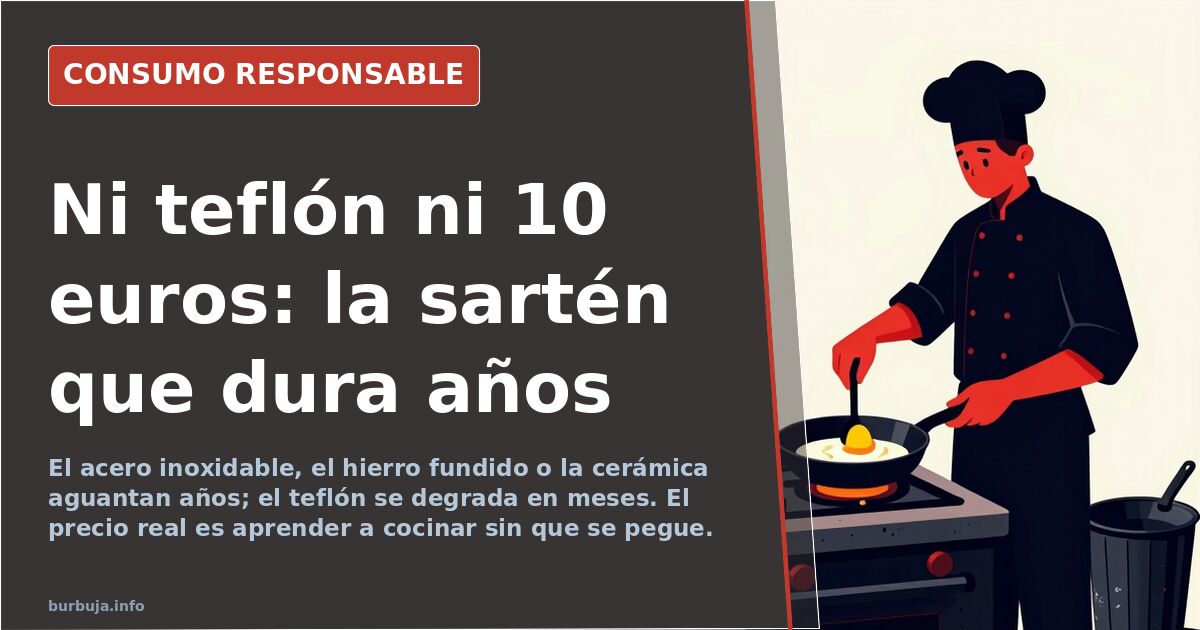
Non-Teflon pans that last years: stainless, iron or ceramic
Ten euros per pan, twelve months of life, and back to buying again. This is the compromise reached by a home cook fed up with standard non-stick options: preferring to spend little and replace yearly rather than risk the coating peeling off onto food. The question they ask —do pans exist that don't stick, last for years, and release no Teflon?— mirrors the doubt anyone feels looking at their favorite pan's scratched bottom. The answer drawn from others' experience isn't a product; it's a change in method.
Is there a pan that doesn't stick and has no Teflon?
Yes, but none are magical and none are cheap. The recurring candidates are stainless steel, cast iron or mineral iron, ceramic, so-called "stone" pans, and classic porcelain. The economic filter appears quickly: "if you have money, yes; for 20 euros, no," summarizes one participant. The comparison used is stark —fifteen basic furniture-store pans versus one single "real" pan— making clear that here you pay for durability, not technology.
The real problem isn't the material, it's the expectation. A coated non-stick pan stays impeccable for a few months then starts grabbing, even if used with plastic spatulas and soft sponges. That decline drives people to seek uncoated alternatives, accepting a learning curve in return.
Does stainless steel leach metals? The suspicion over chromium and nickel
Here comes the uncomfortable twist. Stainless steel is the star recommendation —it releases no layer, can be scrubbed with scourers without antiestéticar, and is what you see in professional kitchens— but some argue it isn't neutral either. Common alloys include chromium and nickel, heavy metals whose consumption has been linked, according to this argument, to certain cancers or dementia, just like aluminum. Hence, part of the analysis concludes that cast iron is, comparatively, the most harmless metal for cooking.
It's a debated and unresolved thesis, raised by a forum user based on their readings, but it explains why many distrust easy solutions. Another idea floated in the thread: some claim Teflon stopped being applied to pans decades ago, meaning antiestéticar of the classic coating might target a material no longer present in the piece.
Cast iron seasoning: from wonder to forgotten clutter in the oven
Cast iron divides opinion. For some, it's the best possible purchase: weighs like an anvil, seals meat better than any other, and allows moving the pan to the oven to finish cooking. For others, it's a burden. One case sums it up plainly: a cast iron pan bought on recommendation, stored in the oven unused, always black, requiring an oil wipe-down after every cleaning to prevent rust, and prone to sticking if not greased during cooking.
The key concept is seasoning, that polymerized fat layer acting as a natural non-stick surface. Those who master it cook without anything sticking; those who don't live with a rusty piece. And the doubt lingers, never fully resolved: why doesn't that old grease film accumulate bacteria?
How to cook without oil so nothing sticks
Technique outweighs material. The repeated recipe: heat the dry pan, wait for it to reach temperature, then add oil, let it heat up, and only then add food. Another variant for eggs: heat the oil well, remove from heat, sustancia ilegal the egg, lower flame to minimum, and put the pan back on.
Those grilling without a drop of oil have it harder. The defended trick is spreading a single drop with a finger across the entire surface: not frying, but creating a very thin film preventing protein from gripping the metal. However, the line between "a drop" and a kitchen fire is fine, and some trinc instructions literally, ending with burning oil on the stove and raw egg over the fire.
What about ceramic, porcelain or an electric grill?
Beyond classic metals, alternatives exist. Ceramic and "stone" pans are available, and antique porcelain —the kind with dots used formerly— gathers supporters for being more inert than iron and its alloys. One forum user shares theirs, bought at Lidl, remains scratch-free after five years; another prices old porcelain pans at 3.80 euros.
For those wanting to cook with less fat without fighting metal, the most practical recommendation is an electric grill with exposed heating elements —not coated ones— antiestéticaturing a water tray below: juices fall into the water and don't stick, it cleans easily, and avoids smoke. Models exist under 30 euros, working well for meat and fish without using oil.
The detail that disorients is price: cited antique porcelain pans cost, according to a user, 3.80 euros; the non-stick needing annual replacement costs ten. And the lifetime-lasting stainless steel requires, before money, learning to cook. The debate over which material is best always ends in the same place: in the hands of the user.
Ten euros per pan, twelve months of life, and back to buying again. This is the compromise reached by a home cook fed up with standard non-stick options: preferring to spend little and replace yearly rather than risk the coating peeling off onto food. The question they ask —do pans exist that don't stick, last for years, and release no Teflon?— mirrors the doubt anyone feels looking at their favorite pan's scratched bottom. The answer drawn from others' experience isn't a product; it's a change in method.
Is there a pan that doesn't stick and has no Teflon?
Yes, but none are magical and none are cheap. The recurring candidates are stainless steel, cast iron or mineral iron, ceramic, so-called "stone" pans, and classic porcelain. The economic filter appears quickly: "if you have money, yes; for 20 euros, no," summarizes one participant. The comparison used is stark —fifteen basic furniture-store pans versus one single "real" pan— making clear that here you pay for durability, not technology.
The real problem isn't the material, it's the expectation. A coated non-stick pan stays impeccable for a few months then starts grabbing, even if used with plastic spatulas and soft sponges. That decline drives people to seek uncoated alternatives, accepting a learning curve in return.
Does stainless steel leach metals? The suspicion over chromium and nickel
Here comes the uncomfortable twist. Stainless steel is the star recommendation —it releases no layer, can be scrubbed with scourers without antiestéticar, and is what you see in professional kitchens— but some argue it isn't neutral either. Common alloys include chromium and nickel, heavy metals whose consumption has been linked, according to this argument, to certain cancers or dementia, just like aluminum. Hence, part of the analysis concludes that cast iron is, comparatively, the most harmless metal for cooking.
It's a debated and unresolved thesis, raised by a forum user based on their readings, but it explains why many distrust easy solutions. Another idea floated in the thread: some claim Teflon stopped being applied to pans decades ago, meaning antiestéticar of the classic coating might target a material no longer present in the piece.
Cast iron seasoning: from wonder to forgotten clutter in the oven
Cast iron divides opinion. For some, it's the best possible purchase: weighs like an anvil, seals meat better than any other, and allows moving the pan to the oven to finish cooking. For others, it's a burden. One case sums it up plainly: a cast iron pan bought on recommendation, stored in the oven unused, always black, requiring an oil wipe-down after every cleaning to prevent rust, and prone to sticking if not greased during cooking.
The key concept is seasoning, that polymerized fat layer acting as a natural non-stick surface. Those who master it cook without anything sticking; those who don't live with a rusty piece. And the doubt lingers, never fully resolved: why doesn't that old grease film accumulate bacteria?
How to cook without oil so nothing sticks
Technique outweighs material. The repeated recipe: heat the dry pan, wait for it to reach temperature, then add oil, let it heat up, and only then add food. Another variant for eggs: heat the oil well, remove from heat, sustancia ilegal the egg, lower flame to minimum, and put the pan back on.
Those grilling without a drop of oil have it harder. The defended trick is spreading a single drop with a finger across the entire surface: not frying, but creating a very thin film preventing protein from gripping the metal. However, the line between "a drop" and a kitchen fire is fine, and some trinc instructions literally, ending with burning oil on the stove and raw egg over the fire.
What about ceramic, porcelain or an electric grill?
Beyond classic metals, alternatives exist. Ceramic and "stone" pans are available, and antique porcelain —the kind with dots used formerly— gathers supporters for being more inert than iron and its alloys. One forum user shares theirs, bought at Lidl, remains scratch-free after five years; another prices old porcelain pans at 3.80 euros.
For those wanting to cook with less fat without fighting metal, the most practical recommendation is an electric grill with exposed heating elements —not coated ones— antiestéticaturing a water tray below: juices fall into the water and don't stick, it cleans easily, and avoids smoke. Models exist under 30 euros, working well for meat and fish without using oil.
The detail that disorients is price: cited antique porcelain pans cost, according to a user, 3.80 euros; the non-stick needing annual replacement costs ten. And the lifetime-lasting stainless steel requires, before money, learning to cook. The debate over which material is best always ends in the same place: in the hands of the user.
Summary of a discussion on Burbuja.info - Foro de economía, actualidad y política., translated from Spanish and reviewed before publication. Read the full discussion (160 replies).
More summaries
-
KFC sells 22 chicken wings for 9 euros, less than 50 cents each
22 KFC chicken wings for 9 euros cost less than 50 cents each. Details and terms of the limited-time offer in Spain.
-
Spanish 1970s Cookies: The Lost Taste of Childhood
Iconic Spanish brands like Cuétara and Fontaneda have changed. Palm oil, mergers, and quality cuts explain the decline of a national staple.
-
OpenAI Cuts ChatGPT Limits, Launches $500 Pro Plan
OpenAI reduced ChatGPT usage caps and introduced a $500 Pro tier. Prices remain static, but the value received by subscribers has decreased.
-
Bluetooth Headphones: The Comfort Scam Exposed
Are Bluetooth headphones worth it? We analyze price, sound quality, battery life, and health risks. Data suggests wired options still win.
-
Andreu Bacardit Promises Free Energy, Raising Fraud Concerns
The Onion Project claims infinite clean energy, but its promoter has a history of failed products. We analyze the red flags and potential scam patterns.
-
Latin American Food in Spain: Mediocre or Misunderstood?
Analysis of the debate on Latin American cuisine quality in Spain, exploring whether it is truly mediocre or a matter of expectations.