
Hobby Consolas sparks backlash over inclusive language in Spider-Man 2
An opinion piece by Hobby Consolas on inclusive language in Spider-Man 2 triggers debate on who controls the gaming industry and who pays for it.
English · Original discussion in Spanish · Published
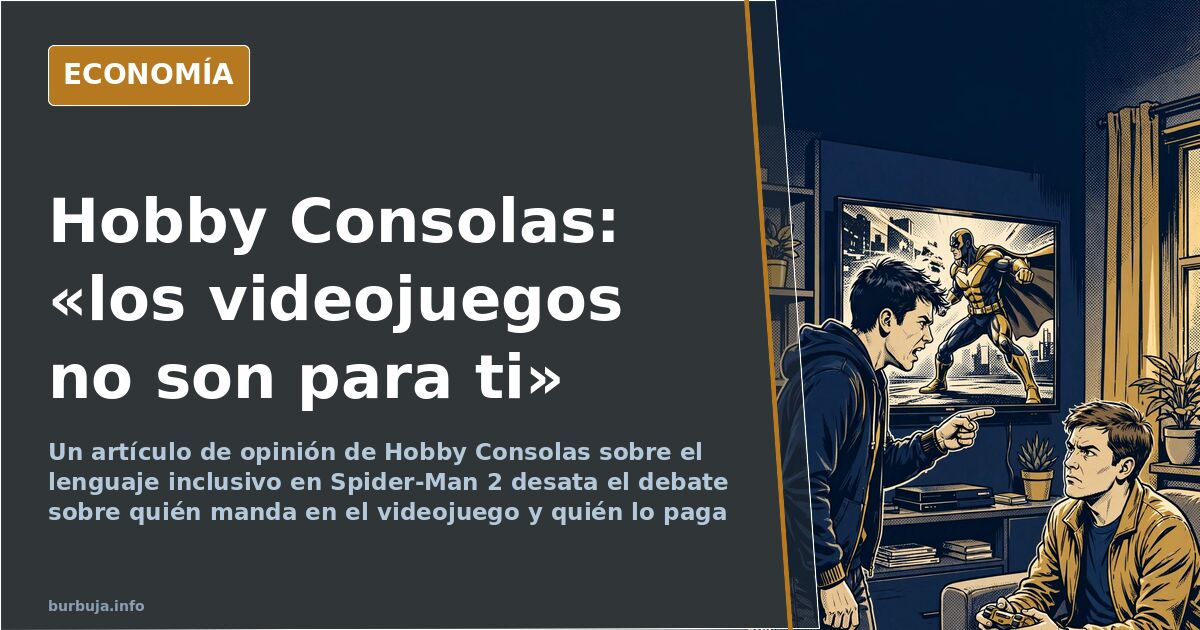
"If you dislike inclusive language, video games aren't for you"
Can a video game magazine tell its own audience that their hobby isn't meant for them? That is the question left open by an opinion article from Hobby Consolas about Spider-Man 2, focusing on the game's inclusive language. The text argues that anyone bothered by such language should find another hobby. The reaction from a segment of readers was immediate and one-directional: feeling invited to leave a sector they have been paying into for decades.
The issue stems from an editorial opinion, not sales data or a developer decision. But it touches a nerve beyond just video games. Inclusive language has become the battleground where people argue who rules entertainment: who produces it, who pays for it, and who has the right to complain without being told they don't belong.
What the article says and why it upset players
The text doesn't evaluate the game's quality; it evaluates its audience. It suggests that inclusive language is part of the medium and those who don't accept it are out of place. From there, the rejection organized itself on several fronts. Some argue it's not an aesthetic detail but propaganda inserted into the plot. Others point to a deeper problem: treating consumer preference as intolerance. "If you're bothered that I'm bothered by inclusive language, my money isn't for your video game," summarizes one of the most repeated stances. It's market logic turned upside down, or right side up, depending on how you look at it.
The examples cited aren't random. Titles like The Last of Us Part II, Detroit: Become Human, or Syberia 3 appear repeatedly as cases of franchises that, according to this reading, changed tone halfway through. The complaint isn't so much about content as the shift: the feeling that the product bought before is no longer manufactured, and that pointing this out makes you suspicious.
The Middle East version of Spider-Man 2 and double standards
Here appears the argument that has weighed most heavily. The Middle East version of Spider-Man 2 removes dialogues with LGBT content, side missions, and gender spectrum flags, according to screenshots brought up by the controversy itself. In other words: the same product presented in the West as a non-negotiable line gets cut in other markets without anyone raising a fuss. For many players, this asymmetry dismantles the discourse: we wouldn't be facing a matter of principles, but rather client adaptation that suits each market.
The argument has strength because it demands no belief. Just compare two versions of the same game and ask why one is considered untouchable. The most uncomfortable answer is the simplest: because the principle is applied where it costs nothing to apply it.
Who stands behind Hobby Consolas
Hobby Consolas belongs to the German group Axel Springer. This fact has helped reframe the discussion in terms of ownership. An interview in The Nation antiestéticatured testimony from two former CIA officials who alleged Axel Springer received $7 million to support US geopolitical interests through its editorial line. It is an accusation, not a verdict, and should be treated exactly as such. But the group also maintains a specific website dedicated to LGBT content within its corporate structure, something that sits poorly with many against the idea of a publication that only reports on video games.
The lingering question isn't minor: who sets the line for a leisure publication. Because if the owner has a clear corporate agenda, the opinion on inclusive language stops being an editorial reflection and becomes another piece of that agenda.
Is inclusive gaming business or imposition?
Here the analysis turns economic. The weight of ESG funds and investment criteria rewarding companies for meeting certain social standards is mentioned. One thesis is that the shift doesn't stem from public demand but financing: there is money above demanding quota compliance. Those holding this view add that funds come conditioned, and past a certain threshold, editorial decisions cease to be free.
The rebuttal comes from the simpler angle: if these decisions were so profitable, titles labeled "proge" wouldn't fail in sales. "90% of proge content is a commercial failure," summarizes one stance. The contradiction remains open and should stay open: if it's imposition, poor sales aren't explained; if it's business, forcing it equally isn't explained.
The real size of the audience targeted by the message
Underneath all this lies a discussion about numbers. Some defend that those rejecting inclusive language are a minority and the magazine's message actually targets the audience that matters. Others counter that the historical majority of gamers is the opposite: decades of fans who didn't ask for any of this and now see themselves told they don't belong. The arrival of the Nintendo DS has been pointed to as the moment player profiles diversified and new audiences entered. From that to telling someone to find another hobby is a stretch, and that stretch is precisely what is debated.
There are also those drawing the opposite conclusion to complaining: ignore it. No critiques, mentions, or screenshots. Just don't buy and punish the brand when possible. It's the strategy of silence, and it has its logic: companies don't like noise.
In the end, the magazine that wanted to expand the fanbase achieved something it didn't seek: making part of it think twice before renewing their subscription.
Can a video game magazine tell its own audience that their hobby isn't meant for them? That is the question left open by an opinion article from Hobby Consolas about Spider-Man 2, focusing on the game's inclusive language. The text argues that anyone bothered by such language should find another hobby. The reaction from a segment of readers was immediate and one-directional: feeling invited to leave a sector they have been paying into for decades.
The issue stems from an editorial opinion, not sales data or a developer decision. But it touches a nerve beyond just video games. Inclusive language has become the battleground where people argue who rules entertainment: who produces it, who pays for it, and who has the right to complain without being told they don't belong.
What the article says and why it upset players
The text doesn't evaluate the game's quality; it evaluates its audience. It suggests that inclusive language is part of the medium and those who don't accept it are out of place. From there, the rejection organized itself on several fronts. Some argue it's not an aesthetic detail but propaganda inserted into the plot. Others point to a deeper problem: treating consumer preference as intolerance. "If you're bothered that I'm bothered by inclusive language, my money isn't for your video game," summarizes one of the most repeated stances. It's market logic turned upside down, or right side up, depending on how you look at it.
The examples cited aren't random. Titles like The Last of Us Part II, Detroit: Become Human, or Syberia 3 appear repeatedly as cases of franchises that, according to this reading, changed tone halfway through. The complaint isn't so much about content as the shift: the feeling that the product bought before is no longer manufactured, and that pointing this out makes you suspicious.
The Middle East version of Spider-Man 2 and double standards
Here appears the argument that has weighed most heavily. The Middle East version of Spider-Man 2 removes dialogues with LGBT content, side missions, and gender spectrum flags, according to screenshots brought up by the controversy itself. In other words: the same product presented in the West as a non-negotiable line gets cut in other markets without anyone raising a fuss. For many players, this asymmetry dismantles the discourse: we wouldn't be facing a matter of principles, but rather client adaptation that suits each market.
The argument has strength because it demands no belief. Just compare two versions of the same game and ask why one is considered untouchable. The most uncomfortable answer is the simplest: because the principle is applied where it costs nothing to apply it.
Who stands behind Hobby Consolas
Hobby Consolas belongs to the German group Axel Springer. This fact has helped reframe the discussion in terms of ownership. An interview in The Nation antiestéticatured testimony from two former CIA officials who alleged Axel Springer received $7 million to support US geopolitical interests through its editorial line. It is an accusation, not a verdict, and should be treated exactly as such. But the group also maintains a specific website dedicated to LGBT content within its corporate structure, something that sits poorly with many against the idea of a publication that only reports on video games.
The lingering question isn't minor: who sets the line for a leisure publication. Because if the owner has a clear corporate agenda, the opinion on inclusive language stops being an editorial reflection and becomes another piece of that agenda.
Is inclusive gaming business or imposition?
Here the analysis turns economic. The weight of ESG funds and investment criteria rewarding companies for meeting certain social standards is mentioned. One thesis is that the shift doesn't stem from public demand but financing: there is money above demanding quota compliance. Those holding this view add that funds come conditioned, and past a certain threshold, editorial decisions cease to be free.
The rebuttal comes from the simpler angle: if these decisions were so profitable, titles labeled "proge" wouldn't fail in sales. "90% of proge content is a commercial failure," summarizes one stance. The contradiction remains open and should stay open: if it's imposition, poor sales aren't explained; if it's business, forcing it equally isn't explained.
The real size of the audience targeted by the message
Underneath all this lies a discussion about numbers. Some defend that those rejecting inclusive language are a minority and the magazine's message actually targets the audience that matters. Others counter that the historical majority of gamers is the opposite: decades of fans who didn't ask for any of this and now see themselves told they don't belong. The arrival of the Nintendo DS has been pointed to as the moment player profiles diversified and new audiences entered. From that to telling someone to find another hobby is a stretch, and that stretch is precisely what is debated.
There are also those drawing the opposite conclusion to complaining: ignore it. No critiques, mentions, or screenshots. Just don't buy and punish the brand when possible. It's the strategy of silence, and it has its logic: companies don't like noise.
In the end, the magazine that wanted to expand the fanbase achieved something it didn't seek: making part of it think twice before renewing their subscription.
Summary of a discussion on Burbuja.info - Foro de economía, actualidad y política., translated from Spanish and reviewed before publication. Read the full discussion (240 replies).
More summaries
-
Red Cross Deploys to Ceuta Amid Migration Crisis
Red Cross volunteers arrive in Ceuta as migration pressure mounts. The debate intensifies between humanitarian aid and the pull factor.
-
Pope Receives Unusual Sphere Symbolizing Humanity
Pope Francis received a large green sphere, the "Sphere of Humanity," symbolizing the importance of human values in the face of AI.
-
A Civil Servant Caught Clocking In For Several Colleagues
A report details a public employee clocking in for several absent colleagues, reigniting the debate over time tracking within the Spanish administration.
-
Errejón Accused of Non-Consensual Submission in El Salto Report
El Salto publishes testimony alleging Íñigo Errejón engaged in non-consensual submission, reigniting debates on consent.
-
Nobel economist Fama predicts Bitcoin will hit zero in ten years
Eugene Fama, Nobel laureate in Economics, forecasts Bitcoin's collapse to zero within a decade despite the asset surpassing $100,000.
-
Germany parks 6,000 unsold new cars in Essen
Nearly 6,000 new cars await buyers in an Essen lot as prices and EU regulations cool demand.