
Nobel economist Fama predicts Bitcoin will hit zero in ten years
Eugene Fama, Nobel laureate in Economics, forecasts Bitcoin's collapse to zero within a decade despite the asset surpassing $100,000.
English · Original discussion in Spanish · Published
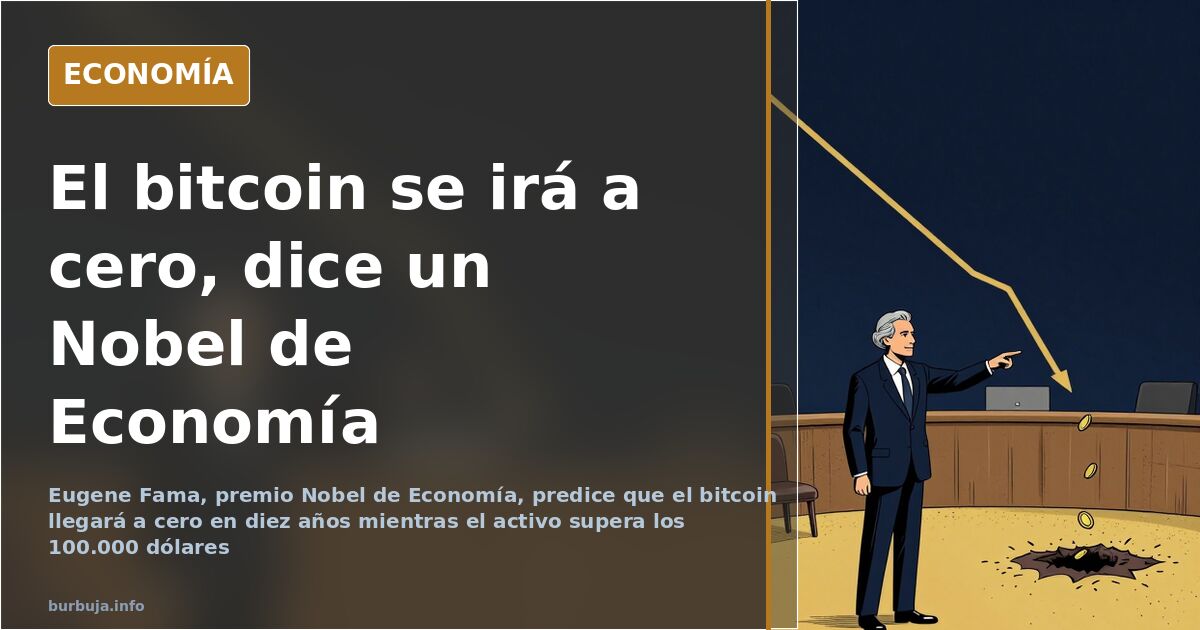
Bitcoin to hit zero in 10 years: Nobel laureate Fama’s prediction
A Nobel Prize-winning economist argues that Bitcoin will drop to zero within the next ten years. The paradox is stark: the asset in question has surged from near-nothing to over $100,000, yet it has endured fifteen years of identical failed predictions. Eugene Fama is not debating today’s price; he is debating its ultimate fate. His thesis is that cryptocurrencies abusa the rules of a medium of exchange and that Bitcoin lacks sustainable real-world utility.
There is a third element in his warning that receives less attention but warrants more discussion: if the crypto ecosystem collapses, the industry will likely seek a government bailout. Fama insists it should remain separate from the traditional financial system. Put differently, those demanding a rescue are never the early buyers who entered at $50; they are the infrastructure providers living off transaction fees.
What has Eugene Fama said about Bitcoin?
Three ideas, ranked by severity. First: Bitcoin will reach zero in the coming decade. Second: Cryptocurrencies fail as a medium of exchange because no one uses them for payments, and their price fluctuates without underlying economic support. Third: If the sector sinks, public funds will be implicated.
The warning unsettles both sides. Enthusiasts dismiss it as another prophecy that has already failed. Institutional investors see it as a signal that they would be the first to ask for help. You have been warned, he implies. The problem is that this phrase has been repeated for fifteen years.
Fiat money has already lost 99% of its value
The most common rebuttal does not refute Fama; it flips the argument. Fiat currency has lost 99% of its value over a century, so for some observers, it is already at zero. Meanwhile, measured in euros or dollars, Bitcoin has only risen.
To contextualize this, consider a comparison often cited: in 1975, a 150 m² apartment in Madrid’s Plaza de Castilla area cost 2.5 million pesetas, roughly €15,000. On Velázquez Street, 162 m² sold for 2.8 million pesetas, or €16,500. This is the other side of the debate, rarely shown on crypto platforms: what happens to purchasing power while assets rise and fall. It raises an uncomfortable question: zero relative to what?
Is Bitcoin a Ponzi scheme?
Here, the conversation becomes ruthless. One school of thought argues that Bitcoin only appreciates because someone is willing to buy it higher, which, taken to the extreme, resembles a pyramid scheme. Proponents cite data: 2,000 holders control 40% of all Bitcoin; mining operations have faced regulatory crackdowns; China banned the asset; and critics claim prices rise solely when new fiat enters, since it is not used as actual currency.
The counter-argument does not deny the mechanism but places it in context. A stock also holds value only because someone pays for it and has a final buyer. The difference, they respond, is that companies generate potential profits, whereas many tokens rely merely on promises. History offers harsh precedents: projects that collapsed after developers absconded with funds to tax havens.
The 9% offered by exchanges and the memory of Afinsa
Another argument centers on yield. Any exchange offers 9% annual interest for holding digital euros or dollars, accessible at any time, compared to zero from traditional banks. This, supporters argue, is sufficient reason to allocate part of one’s savings there.
The response invokes a specific name: Afinsa. That stamp investment firm paid high returns using money from new entrants to pay earlier investors. When people tried to withdraw capital, it had vanished. The lingering question remains: where does a 9% return come from in an asset not invested in anything productive?
Who decides Bitcoin’s price?
Concentration data is frequently cited: few hands move the market. If 2,000 holders possess 40% of the supply, a coordinated group could steer prices arbitrarily, as the market lacks the depth of diversified assets. In this view, Bitcoin is not a currency but a casino with few players and expensive chips.
There is also a statistical limit to the "zero" scenario, defended with basic logic. Lost coins, those in wallets of deceased individuals, and those permanently inaccessible will never be sold. With this portion of supply effectively dead, proponents argue, the price cannot be exactly zero: there would be no one left to sell to. This is why assets with limited supply do not vanish entirely.
The bailout no one wants to pay for
The least discussed part of Fama’s warning remains. No one has explained how to let down a sector comprising intermediation platforms, cards, and ETFs without impacting the broader system. Asset defenders point elsewhere: mainstream media barely mentions it, and when they do, it is to discourage investment. They argue major banks benefit if every euro entering Bitcoin stays out of their products.
And if a bailout comes, it will not be requested by retail investors who bought cheaply. It will be demanded by the infrastructure.
With these pieces, Fama’s prediction may prove correct, or it may just be the latest in a long list. What happens if, in ten years, he is still wrong and no one remembers?
A Nobel Prize-winning economist argues that Bitcoin will drop to zero within the next ten years. The paradox is stark: the asset in question has surged from near-nothing to over $100,000, yet it has endured fifteen years of identical failed predictions. Eugene Fama is not debating today’s price; he is debating its ultimate fate. His thesis is that cryptocurrencies abusa the rules of a medium of exchange and that Bitcoin lacks sustainable real-world utility.
There is a third element in his warning that receives less attention but warrants more discussion: if the crypto ecosystem collapses, the industry will likely seek a government bailout. Fama insists it should remain separate from the traditional financial system. Put differently, those demanding a rescue are never the early buyers who entered at $50; they are the infrastructure providers living off transaction fees.
What has Eugene Fama said about Bitcoin?
Three ideas, ranked by severity. First: Bitcoin will reach zero in the coming decade. Second: Cryptocurrencies fail as a medium of exchange because no one uses them for payments, and their price fluctuates without underlying economic support. Third: If the sector sinks, public funds will be implicated.
The warning unsettles both sides. Enthusiasts dismiss it as another prophecy that has already failed. Institutional investors see it as a signal that they would be the first to ask for help. You have been warned, he implies. The problem is that this phrase has been repeated for fifteen years.
Fiat money has already lost 99% of its value
The most common rebuttal does not refute Fama; it flips the argument. Fiat currency has lost 99% of its value over a century, so for some observers, it is already at zero. Meanwhile, measured in euros or dollars, Bitcoin has only risen.
To contextualize this, consider a comparison often cited: in 1975, a 150 m² apartment in Madrid’s Plaza de Castilla area cost 2.5 million pesetas, roughly €15,000. On Velázquez Street, 162 m² sold for 2.8 million pesetas, or €16,500. This is the other side of the debate, rarely shown on crypto platforms: what happens to purchasing power while assets rise and fall. It raises an uncomfortable question: zero relative to what?
Is Bitcoin a Ponzi scheme?
Here, the conversation becomes ruthless. One school of thought argues that Bitcoin only appreciates because someone is willing to buy it higher, which, taken to the extreme, resembles a pyramid scheme. Proponents cite data: 2,000 holders control 40% of all Bitcoin; mining operations have faced regulatory crackdowns; China banned the asset; and critics claim prices rise solely when new fiat enters, since it is not used as actual currency.
The counter-argument does not deny the mechanism but places it in context. A stock also holds value only because someone pays for it and has a final buyer. The difference, they respond, is that companies generate potential profits, whereas many tokens rely merely on promises. History offers harsh precedents: projects that collapsed after developers absconded with funds to tax havens.
The 9% offered by exchanges and the memory of Afinsa
Another argument centers on yield. Any exchange offers 9% annual interest for holding digital euros or dollars, accessible at any time, compared to zero from traditional banks. This, supporters argue, is sufficient reason to allocate part of one’s savings there.
The response invokes a specific name: Afinsa. That stamp investment firm paid high returns using money from new entrants to pay earlier investors. When people tried to withdraw capital, it had vanished. The lingering question remains: where does a 9% return come from in an asset not invested in anything productive?
Who decides Bitcoin’s price?
Concentration data is frequently cited: few hands move the market. If 2,000 holders possess 40% of the supply, a coordinated group could steer prices arbitrarily, as the market lacks the depth of diversified assets. In this view, Bitcoin is not a currency but a casino with few players and expensive chips.
There is also a statistical limit to the "zero" scenario, defended with basic logic. Lost coins, those in wallets of deceased individuals, and those permanently inaccessible will never be sold. With this portion of supply effectively dead, proponents argue, the price cannot be exactly zero: there would be no one left to sell to. This is why assets with limited supply do not vanish entirely.
The bailout no one wants to pay for
The least discussed part of Fama’s warning remains. No one has explained how to let down a sector comprising intermediation platforms, cards, and ETFs without impacting the broader system. Asset defenders point elsewhere: mainstream media barely mentions it, and when they do, it is to discourage investment. They argue major banks benefit if every euro entering Bitcoin stays out of their products.
And if a bailout comes, it will not be requested by retail investors who bought cheaply. It will be demanded by the infrastructure.
With these pieces, Fama’s prediction may prove correct, or it may just be the latest in a long list. What happens if, in ten years, he is still wrong and no one remembers?
Summary of a discussion on Burbuja.info - Foro de economía, actualidad y política., translated from Spanish and reviewed before publication. Read the full discussion (203 replies).
More summaries
-
China doesn't raise rates: its economy is fighting deflation
Chinese CPI near zero and PPI in deflation explain why Beijing won't raise rates: lowering the price of money doesn't revive credit.
-
LK-99: The Room-Temperature Superconductor That Wasn't
Two Korean papers in 2023 promised a room-temperature superconductor. Within weeks, another group debunked it: the LK-99 fiasco.
-
The Sofa Video: Domestic Scolding as a Viral Format
A couple posts Instagram videos where she scolds her partner about the sofa. The format goes viral: real relationship or clickbait?
-
University of La Rioja opens probe over private chat
Spain's University of La Rioja investigates students for vulgar comments in a private WhatsApp group, facing potential expulsion.
-
Viral Claim: Trans Activist Seeks Uterus Transplant to Abort
A viral social media post claims a transgender activist plans a uterus transplant to get pregnant and then abort, though no medical or institutional sources have confirmed the procedure or intent.
-
Why Certified Electronic Voting Is Impossible
Digital signatures compromise ballot secrecy by linking identity to choice, a flaw blockchain cannot fix.