
Hitler Mussolini Simeón Flores wins the mayor's office in Queropalca, Peru
Hitler Mussolini Simeón Flores has won the mayor's office in Queropalca (Peru) with 229 votes and 34.54%. His party, Ahora Nación, describes itself as centre-left.
English · Original discussion in Spanish · Published
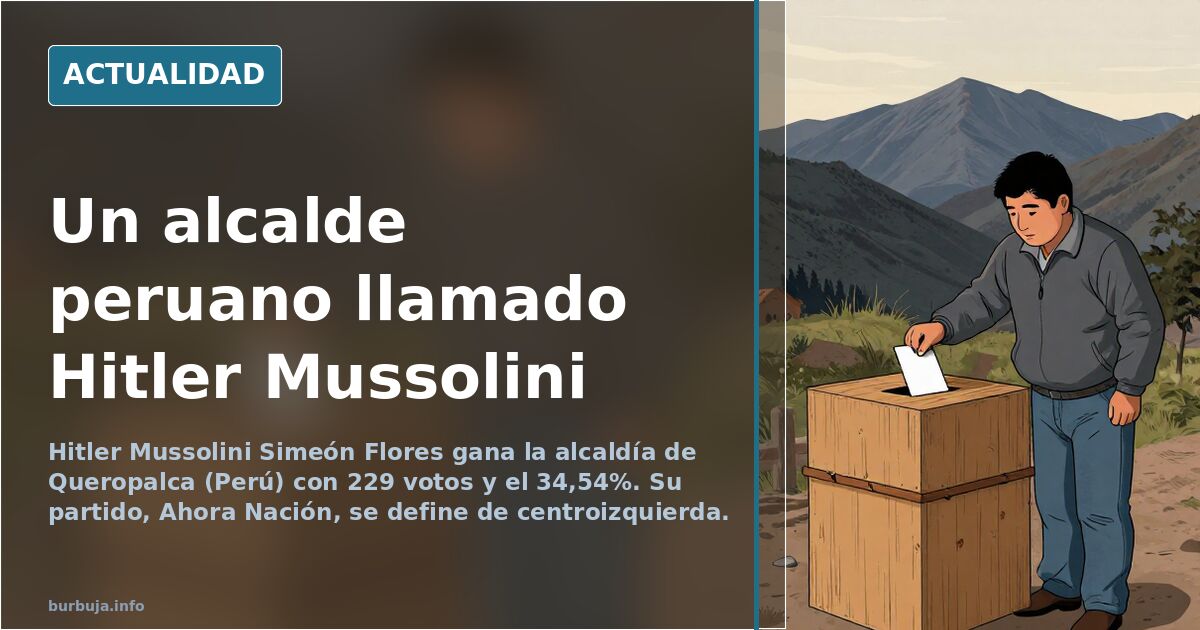
A Peruvian mayor named Hitler Mussolini
In the district of Queropalca, in the province of Lauricocha, department of Huánuco, a candidate from the Ahora Nación party has won the mayor's office with a name that stops any scroll: Hitler Mussolini Simeón Flores. Data from Peru's National Office of Electoral Processes (ONPE) credits him with 229 votes, 34.54%, ahead of the 204 for Gaspar Benilde Osorio Zambrano, of Renovación Popular, and the 187 for Itala Yovana Santillán Vara, of País para Todos. The gap with the runner-up was 25 votes. The new mayor's first name combines those of Adolf Hitler and Benito Mussolini, the two European dictators of the twentieth century, and his paternal surname is Simeón, not a middle name.
The anecdote is not an isolated case of electoral eccentricity. In several regions of Peru and Latin America, giving children the names of foreign historical figures is a documented practice that does not imply ideological allegiance. The winner's own party, Ahora Nación, defines itself as a social democratic centre-left party, committed to decentralisation and the motto "All power to the regions". In other words, the man who bears the name of two dictators governs from a party that claims the opposite.
What the ONPE data says about Queropalca
The count was tight. Hitler Mussolini Simeón Flores's 229 votes gave him victory with a 25-vote margin over Renovación Popular and 42 over País para Todos. None of the three candidates exceeded 35% of the total, and together they took almost all the district's vote. There was no landslide majority: there was a fragmented split in which the most striking name in the country took the mayor's office by a handful of ballots.
There is no record that the name coincidence with the dictators has any ideological link to the regimes that inspired those names. What is on record is the programme of the party that fielded him: equality before the law, social justice, workers' rights, a social state under the rule of law, and internal democracy based on the principle of one member, one vote.
Why would anyone name a child after a dictator
The most common explanation is the simplest: it sounds good, you hear it around and you copy it. In the Peruvian case, a lax civil registry and a tradition of baptising children with the names of foreign historical figures without loading them with political meaning are added to the mix. Across much of Latin America, the name works more as a sound label than as a declaration of intent.
There is a parallel phenomenon that illustrates this disconnect between name and referent well: the surname that becomes a first name. It happens with Franco, the first surname of Francisco Franco Bahamonde, which in Spain remains a surname but circulates in Argentina and Italy as a given name. In Italy, Franco is the hypocoristic of Francesco, the abbreviated form of the name, just as in Spain it can be Fran, Chisco or Paco. Franco Battiato's birth name was Francesco.
From Goretti to Mier Daza: when a name becomes a problem
The calendar of saints offers more examples of surnames turned into first names. Saint Maria Goretti: Goretti was her surname, but there are Catholic families who give their daughters Goretti as a first name thinking of the saint, and many believe it is a Basque name because of how it sounds. It is not.
At the opposite extreme is the name that becomes a sentence. There was a citizen whose first surname was Mier and second Daza. The combination, Mier Daza, invited obvious mockery, and he managed to change it. In Spain, the Civil Registry allows surnames to be changed when they cause embarrassing situations, are defamatory or cause evident harm to the person. The law exists precisely for those cases.
Brand names and invented names: the catalogue keeps growing
The list of unusual names does not end with dictators. There is a couple in the United Kingdom who named their daughter Hashtag after the social media tag. In Egypt, a father named his daughter Facebook. And in the Caribbean there is a custom of giving the newborn the name of the ship that was heading to port that day, which has produced names like Usnavy, Osnave, Yurislady or Único, along with names taken from product brands and mechanical objects.
In the Dominican Republic there is another tradition: joining syllables from the parents' names. From Francisco and Inin comes Fraini. The result is a brand-new name, with no saint or reference point, purely a family creation.
Saint Gemma and the name that did not exist
The most frequently cited anecdote about prophetic names is that of Saint Gemma Galgani. She was born on 12 March 1878 in Capannori, Kingdom of Italy, and was baptised three days later. The priest asked the parents what name they were going to give her. They replied Gemma. The priest objected that no saint by that name existed. "Well, she will be the first," they answered. The parents prophesied that their daughter would be the first saint named Gemma, and so it came to pass.
The case of Hitler Mussolini Simeón Flores is less solemn and more prosaic. He won by 25 votes. His name did not cost him the election, but it did not win it for him either. What it did do was put Queropalca in international headlines for a reason that has nothing to do with his governing programme. On this basis, the sensible expectation is that the name will keep making headlines more than his administration will. Although, in a district of just over a thousand voters, perhaps the gesture that matters is a different one.
Also available in: Deutsch
Summary of a discussion on Burbuja.info - Foro de economía, actualidad y política., translated from Spanish and reviewed before publication. Read the full discussion (17 replies).
More summaries
-
Peruvian candidate named Hitler Mussolini wins local election
Hitler Mussolini Simeon won the mayoral race in Peru's Queropalca district for the left-wing party Ahora Nación, sparking social media debate.
-
Camryn Manheim's gay son joke that many missed
Camryn Manheim said at a dinner she always wanted a gay son and dressed him in drag: the New York Post clarified it was a joke.
-
Native-born Spaniards could become a minority in Spain within two decades
A viral video warns that in 20 years native-born Spaniards will be a minority in Spain. Mass regularization, the grandchildren law and Sahrawi nationality grants are driving the projections.
-
Indian priest falls to his death while challenging gravity
An Indian priest died after falling from a structure while trying to prove that gravity does not exist. The filmed stunt has sparked a debate between faith and science.
-
Machete fight on Barcelona beach reportedly sparked by quantum mechanics debate
A viral video shows Colombian men attacking each other with machetes on a beach in Barcelona, Spain, after an argument over quantum physics. The immigration and security debate has reignited.
-
Sunday Gospel: digital devotion with an absent audience
Sunday readings are posted with dozens of mentions but little interaction. Digital ritualism or real faith?