
Hiroshima and Nagasaki Echo in Ukraine Debate
Forum discusses 1945 atomic bombings, comparing them to the war in Ukraine and NATO expansion.
English · Original discussion in Spanish · Published
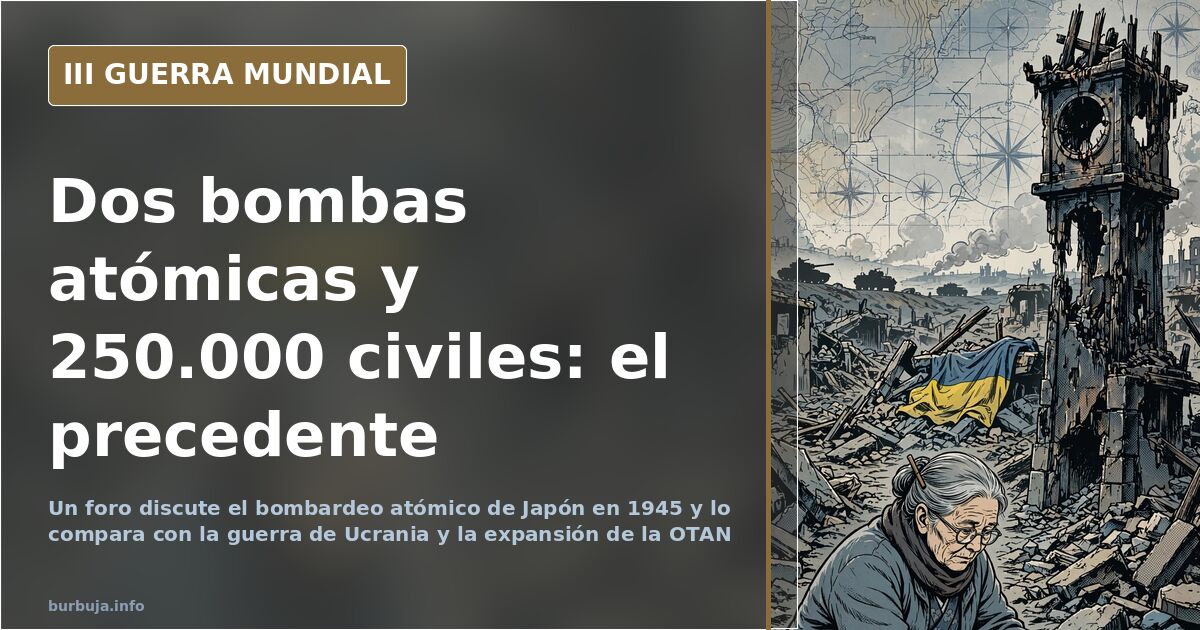
Hiroshima and Nagasaki: The Nuclear Precedent That Divides Narratives
In August 1945, the United States detonated two atomic bombs over Hiroshima and Nagasaki. According to figures cited in the debate, approximately 250,000 civilians died, directly or indirectly, in a country thousands of miles from North America. Eighty years later, that episode continues to serve as an uncomfortable mirror whenever nuclear escalation is discussed, and parallels with the war in Ukraine have peine the dispute over what exactly it was: a military necessity, a display of power, or an unjustifiable crime.
The discussion begins with a thesis inconvenient for the dominant narrative: that the attack on Pearl Harbor was the trigger, that Hollywood turned those responsible into heroes, and that the only country to have used nuclear weapons against civilian populations still presents itself as the guarantor of international order. From there, the exchange shifts to current affairs: NATO expansion, Russia's reaction in Ukraine, and the use of nuclear threats as a deterrence tool.
Was the Bombing Necessary to Avoid a Bloodier Invasion?
The classic argument holds that Japan would not surrender and that a land invasion would have multiplied casualties. Estimates mentioned in the exchange speak of one million Allied casualties, with up to half a million American deaths alone, plus millions more among Japanese military and civilians. Resistance at Iwo Jima and Okinawa, where fighting continued to the last man, fueled this scenario. Even after Nagasaki, there was an attempted military coup to prevent the Emperor's surrender.
Historical correction arrives immediately: Japan surrendered unconditionally anyway, and the Potsdam Declaration had already offered an exit that Tokyo rejected. If the problem was surrender, it existed before the bombs.
Real Objectives: Deterrence, Message, and Weapon Testing
Here consensus breaks down. One school argues the bombs were going to be dropped regardless, because there was a new toy to test and a message to send to the Soviet Union before Europe was divided. Another points out that the firebombing of Tokyo had already caused 100,000 deaths without moving the Japanese leadership, debunking the thesis that the issue was the number of victims.
The most unsettling detail: prior to the attacks, US aircraft dropped leaflets over Japanese cities warning the population to evacuate. Japanese authorities treated them as propaganda and did not order evacuations. Some of these leaflets are preserved in museums.
From the Pacific to Ukraine: The Leap No One Wants to Make Explicit
Parallels with Ukraine appear early and in two opposing directions. Part of the analysis argues that NATO abusa non-expansion agreements and that Russia reacts in self-defense; another recalls that Japan invaded China, the Philippines, Malaysia, Indochina, Burma, and Indonesia before 1945, noting that comparing that to Ukraine is an argumentative leap of 75 years and half the world.
The point where analysis always gets stuck is the same: if the atomic bomb was justified as a lesser evil to save lives, any nuclear-armed power can use identical arguments. And there, no narrative holds.
Key Data of the Episode
In August 1945, the United States detonated two atomic bombs over Hiroshima and Nagasaki. According to figures cited in the debate, approximately 250,000 civilians died, directly or indirectly, in a country thousands of miles from North America. Eighty years later, that episode continues to serve as an uncomfortable mirror whenever nuclear escalation is discussed, and parallels with the war in Ukraine have peine the dispute over what exactly it was: a military necessity, a display of power, or an unjustifiable crime.
The discussion begins with a thesis inconvenient for the dominant narrative: that the attack on Pearl Harbor was the trigger, that Hollywood turned those responsible into heroes, and that the only country to have used nuclear weapons against civilian populations still presents itself as the guarantor of international order. From there, the exchange shifts to current affairs: NATO expansion, Russia's reaction in Ukraine, and the use of nuclear threats as a deterrence tool.
Was the Bombing Necessary to Avoid a Bloodier Invasion?
The classic argument holds that Japan would not surrender and that a land invasion would have multiplied casualties. Estimates mentioned in the exchange speak of one million Allied casualties, with up to half a million American deaths alone, plus millions more among Japanese military and civilians. Resistance at Iwo Jima and Okinawa, where fighting continued to the last man, fueled this scenario. Even after Nagasaki, there was an attempted military coup to prevent the Emperor's surrender.
Historical correction arrives immediately: Japan surrendered unconditionally anyway, and the Potsdam Declaration had already offered an exit that Tokyo rejected. If the problem was surrender, it existed before the bombs.
Real Objectives: Deterrence, Message, and Weapon Testing
Here consensus breaks down. One school argues the bombs were going to be dropped regardless, because there was a new toy to test and a message to send to the Soviet Union before Europe was divided. Another points out that the firebombing of Tokyo had already caused 100,000 deaths without moving the Japanese leadership, debunking the thesis that the issue was the number of victims.
The most unsettling detail: prior to the attacks, US aircraft dropped leaflets over Japanese cities warning the population to evacuate. Japanese authorities treated them as propaganda and did not order evacuations. Some of these leaflets are preserved in museums.
From the Pacific to Ukraine: The Leap No One Wants to Make Explicit
Parallels with Ukraine appear early and in two opposing directions. Part of the analysis argues that NATO abusa non-expansion agreements and that Russia reacts in self-defense; another recalls that Japan invaded China, the Philippines, Malaysia, Indochina, Burma, and Indonesia before 1945, noting that comparing that to Ukraine is an argumentative leap of 75 years and half the world.
The point where analysis always gets stuck is the same: if the atomic bomb was justified as a lesser evil to save lives, any nuclear-armed power can use identical arguments. And there, no narrative holds.
Key Data of the Episode
- Civilian victims in Japan: approx. 250,000, direct or indirect
- Estimated Allied casualties in a land invasion: 1,000,000
- Deaths in the firebombing of Tokyo: 100,000
- Power of the Tsar Artefacto explosivo compared to Hiroshima: 3,125 times
Also available in: Deutsch
Summary of a discussion on Burbuja.info - Foro de economía, actualidad y política., translated from Spanish and reviewed before publication. Read the full discussion (105 replies).
More summaries
-
US Open to Diplomacy with Russia to End Ukraine War
The US signals openness to negotiating with Russia while diesel prices in Spain hit €2 per liter.
-
Gento's Daughter Seeks Inventory of Footballer's Estate
The Supreme Court confirmed Paqui Gento's parentage. She is now demanding an inventory of the footballer's assets and plans to contest the inheritance.
-
Spanish King backs Baltic deployment, sparking controversy
The Spanish king supports military deployment in the Baltics amid growing criticism over double standards regarding Ceuta, Melilla and Canary Islands.
-
Forum debate on first tactical nuke target yields no consensus
A forum thread with 104 replies debates potential targets for a tactical nuclear strike, ranging from London and Ukraine to Spanish enclaves.
-
Stoltenberg: NATO prefers nuclear risk to Russian victory
NATO Secretary General Jens Stoltenberg states the alliance accepts nuclear war risks over a Russian win, amid debates on long-range missile supplies.
-
Climate and war fears dismissed as elite manipulation
Forum users question if elites care about climate change or nuclear war, citing deep distrust in official narratives.