
HIMARS in Russia: No Photos, Purchase Remains Rumor
Reports of Russia acquiring a HIMARS spark reverse engineering debate; without photos, the purchase remains unverified.
English · Original discussion in Spanish · Published
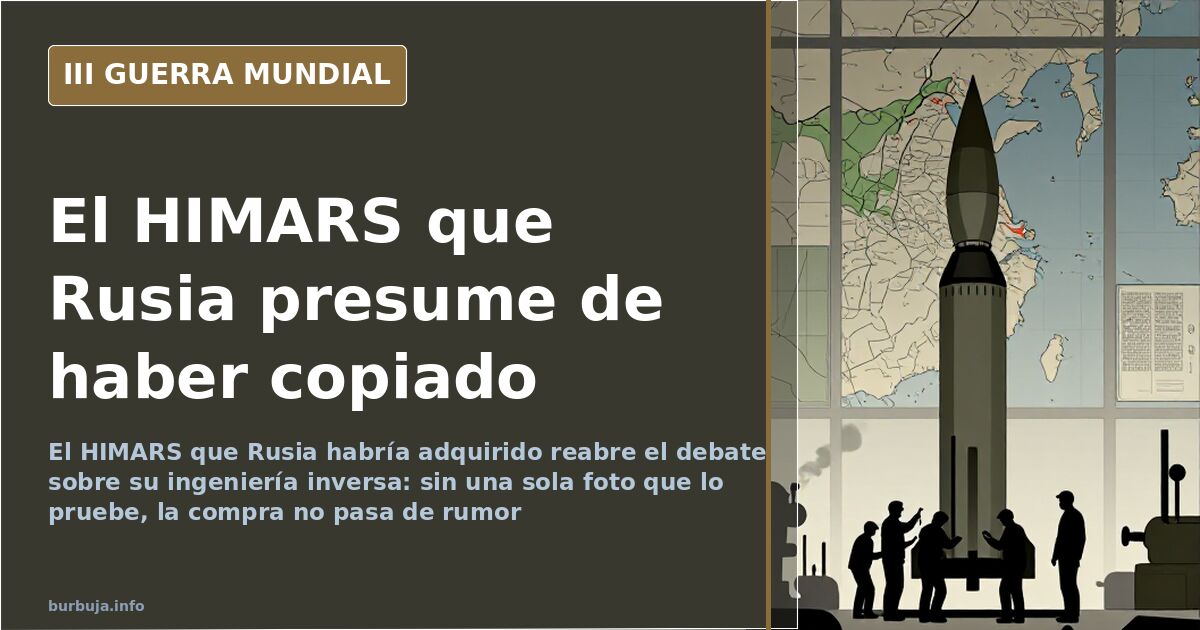
HIMARS in Russia reignites reverse engineering debate
Can Russia dismantle, understand, and rebuild a HIMARS system? That is the question behind reports of US-made rocket launchers in Russian hands, an episode circulating without a single confirming photo. The headline is definitive—purchased, already in Russia—but available material amounts to suspicion and technical comparison. Nobody has shown the chassis, capsule, or rocket. Without a photo, the story lacks substance.
The core claim is simple: Russia allegedly acquired a HIMARS, the light rocket launcher the US supplied to Ukraine and marketed as a near-miracle weapon. What trinc isn't confirmation but echo. The purchase is asserted in headlines and dismantled in comments. Until there are photos, I don't believe it, summarizes the most common stance.
Why debate whether Russia can copy the HIMARS?
Short answer: because they have done it before. The underlying argument is that reverse engineering is a Soviet and Russian specialty, akin to cracking software and ciphers. This leads to the classic example: German WWII arms industry influence on the USSR, with engineers relocated and blueprints reinterpreted.
This sparks dispute. One side claims Soviet rockets were improved German V2s, adding the uncomfortable question: if Germans were so skilled, why was their talent needed? The other argues copying and improving differ, noting the USSR developed missiles while Germany was just starting. The debate shifts to assault rifles: the StG 44 as alleged origin, and the PPSh-41 as proof the Red Army armed itself independently.
Technical nuance clarifies confusion: submachine guns and assault rifles aren't the same category. Different ammunition, range, and use. In urban combat—common on the Eastern Front—distances shrink and differences blur. It's more a catalog debate than trench reality.
Comparison casting doubt on HIMARS superiority
Here the issue changes. If HIMARS reaches Russia, does it matter? The sharpest argument is that Russia doesn't need it. Against the six rockets of the US system, many Russian launchers fire double the projectiles, and heavier models carry superior destructive warheads per rocket.
Thus the repeated conclusion: HIMARS is a Katyusha with better PR. Its real advantage lies not in the tube, but in satellite targeting and the rocket itself. Propaganda does the rest, as with Javelins, Bayraktars, and other trendy names.
Attributed successes face scrutiny. Underlying suspicion is commercial: hyping HIMARS to sell the whole package. Sales as goal, war as showcase.
Gray Eagle, F-35, and the rest of the showcase
While debating the launcher, focus shifts forward. The US plans to deliver four MQ-1C Gray Eagle combat drones to Ukraine, capable of reaching Russian territory. Another escalation step read as direct threat.
On the other scale appear F-35 issues: unresolved pilot oxygen system incidents grounding aircraft. No surprise when comparisons arise. A recurring argument floats: the US buys or recruits foreign talent to maintain advantage.
History gets mentioned too, referencing De la Cierva's autogyro and Peral. Conversation jumps from rockets to inventors, ballistics to patent nationality. Symptom of debate driven by identity over data.
What's missing to validate the story
Question remains open due to scarce evidence. No batch ID, serial number, or visual proof. Demand for images pervades discussion: until seen, purchase is narrative. Meanwhile, each side fills gaps with pre-existing beliefs.
Not minor detail. If announcement stands without proof, effect reverses: reinforces doubters and gives rhetorical ammo to those denying Russian capability. HIMARS affair mirrors starting positions, not news.
Closing where it began
Ultimately, HIMARS in Russia stays in the headline. If photos emerge, we talk. If not, we keep debating if copying equals winning, catalog in hand, no proof on table.
Also available in: Deutsch
Summary of a discussion on Burbuja.info - Foro de economía, actualidad y política., translated from Spanish and reviewed before publication. Read the full discussion (173 replies).
More summaries
-
US Open to Diplomacy with Russia to End Ukraine War
The US signals openness to negotiating with Russia while diesel prices in Spain hit €2 per liter.
-
US adds $100M and anti-ship missiles to Ukraine aid
Biden signs $100 million in additional Ukraine aid as the US explores supplying long-range anti-ship missiles to break Russia's Black Sea blockade.
-
Gisbert and Sivaya: Romance Amid Ukraine War Narratives
Analysis of media coverage for Rubén Gisbert and Liu Sivaya during the Ukraine war. Is this digital propaganda or reality?
-
Putin's final ultimatum: pull out of the Donbas or face a massive attack
Putin has issued an ultimatum to Ukraine: withdraw from the Donbas or face a massive attack, while demanding that the US stop military aid. Here are the details.
-
Four signals to watch before any invasion of Taiwan
Eight training aircraft in Laos and live-fire drills in five coastal zones: this is how the risk of war with Taiwan is measured. These are the signals experts are watching.
-
Trump names Steve Witkoff and son-in-law Jared Kushner as special peace envoys for Moscow
Trump appointed Steve Witkoff and Jared Kushner as special peace envoys; they have already met Russian envoys in Moscow and are expected to visit Kyiv.