
Hiking Boots: Why Polyurethane Soles Rot in Storage
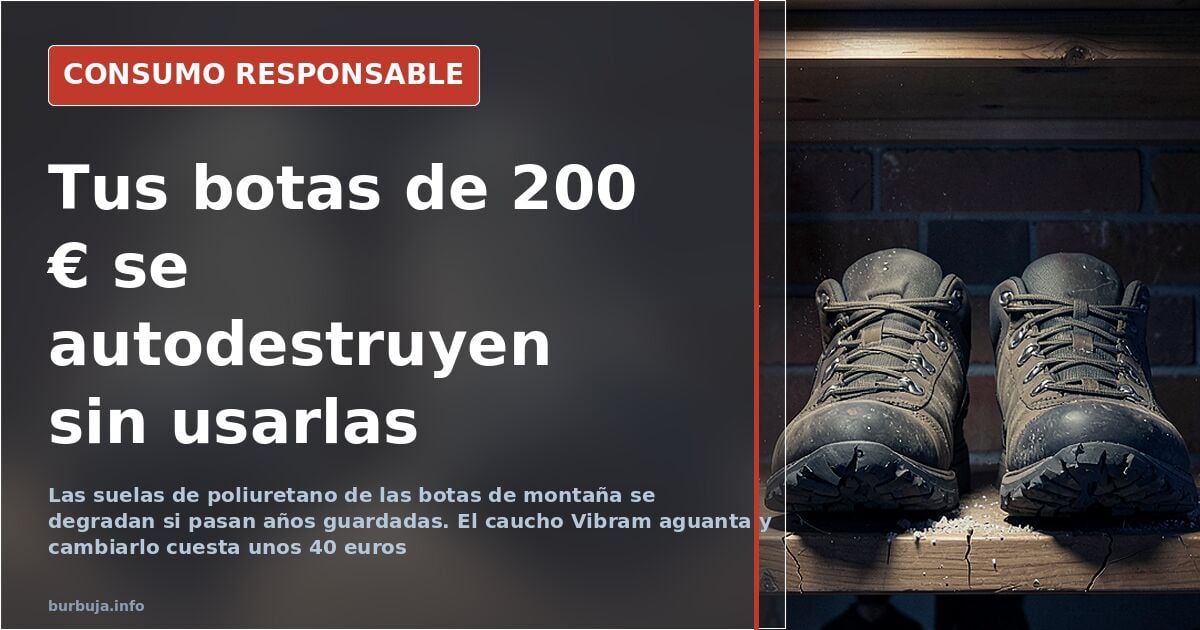
Polyurethane soles on hiking boots degrade if stored for years. Vibram rubber lasts longer, and resoling costs about €40.
English · Original discussion in Spanish · Published
Hiking Boots: The Sole That Rots Alone and the Brand Premium
A pair of Lowa boots bought fifteen years ago, with little use and a pristine look, disintegrated at the heel minutes after being worn in the snow. The diagnosis circulating isn't poor manufacturing quality, but a chemical issue: the polyurethane used to bond certain midsoles degrades when boots are stored for years, especially in humid environments. The black foam shedding is the decomposing midsole material, not an isolated defect.
From there, the budget question arises: those wanting decent waterproof boots for a hike every two months face brand models at **around €200** and wonder if it's worth paying. The consensus is that price doesn't buy eternal durability, but it does buy a rubber sole instead of polyurethane, which is the difference between a boot that ages and one that self-destructs.
Polyurethane Expires, Rubber Doesn't
The technical explanation repeated is that polyurethane midsoles, common in lightweight and hiking boots, hydrolyze over time: the less they are used and the more humidity they accumulate in storage, the sooner they crystallize, sustancia ilegal, and crumble. **It's not a specific brand failure**: identical cases have been reported with Salomon, Quechua, Merrell, and Chiruca. The alternative cited as immune to this process is rubber soles —Vibram, Michelin, or nitrile-rubber compounds— which wear down with use but don't decompose on their own.
The practical corollary is twofold. First, mountain footwear must be used regularly from purchase and not left for years at the bottom of the closet. Second, if the boot is already stored and the sole starts crumbling, a cobbler can replace it with a Vibram for about **€40**, a repair that brings the boot back to life and avoids the full cost.
Bestard, the Spanish Brand Getting the Recommendation
The majority opinion points to **Bestard** as the quality option: national manufacturing, Vibram soles, and models that last decades. Defenders argue that although the initial outlay hurts, the annual cost ends up being negligible compared to a cheap boot that fails after three winters. Cases of pairs over 25 years old still in use are cited. The accompanying warning is that their fit is narrow and it's advisable to try them in-store, because any discomfort becomes an injury after hours of walking.
The other names mentioned map the category: **Asolo** (Italian, good value), **Scarpa**, **Meindl** (German, expensive and durable), **Salewa**, **Boreal** —one of the few keeping the welt for automatic crampons— and **Merrell**, recommended more for field and urban use than demanding mountains. For those who don't want to spend, the suggested route is Decathlon's hunting section, where the same sole compound appears at a discount price.
Gore-Tex Is Not Armor
The star waterproofing also gets its nuance: the membrane doesn't turn the boot into a watertight container, and those who step in a river then complain about wet feet are confusing antiestéticatures. For rain and snow, leather treated with grease works better and cheaper than many sprays. The underlying conclusion is that today's waterproof boots have welds a cobbler cannot replicate, so the strategy of buying expensive and saving for occasions has become counterproductive.
The sticking point is price: a boot that lasts thirty years and one that fails in three sometimes cost the same at checkout, and no one has found a way to know before paying.
Also available in: Deutsch
Summary of a discussion on Burbuja.info - Foro de economía, actualidad y política., translated from Spanish and reviewed before publication. Read the full discussion (79 replies).
More summaries
-
Hiking boots: pay for the brand or hunt for membrane and sole
The search for boots with a waterproof membrane and insulation at a reasonable price runs into Segarra's disappearance from physical stores and the weight of Bestard boots.
-
Polyurethane soles: The weak spot of many hiking boots
Polyurethane soles expire in five or six years, rendering expensive boots unusable. This thread discusses durability, Vibram, and Gore-Tex controversies.
-
Salomon vs Merrell: a sole that wears out in months or one that lasts 25 years
Users report that Salomon's Contagrip sole wears out within months and slips on wet surfaces. Merrell wins on durability and price for city use, according to several…
-
Helmeca: nearly €5,000 for a German course and a promised job
Helmeca offers jobs in Germany to early childhood educators but ends up selling a German course for almost €5,000 for a B2 level that many doubt is achievable.
-
Butane, Razors, and Aleppo Soap: Spain's Minimal Spending Economy
In Spain, butane heating costs €14 monthly. Classic shaving and Aleppo soap offer durable, low-cost alternatives to rising inflation.
-
Spain's Civil Code: When Neighbors Can Use Your Land
Article 569 of Spain's Civil Code allows scaffolding on private land if indispensable, requiring permits and insurance. Notarial waivers offer limited protection.