
Hiking boots: pay for the brand or hunt for membrane and sole
The search for boots with a waterproof membrane and insulation at a reasonable price runs into Segarra's disappearance from physical stores and the weight of Bestard boots.
English · Original discussion in Spanish · Published
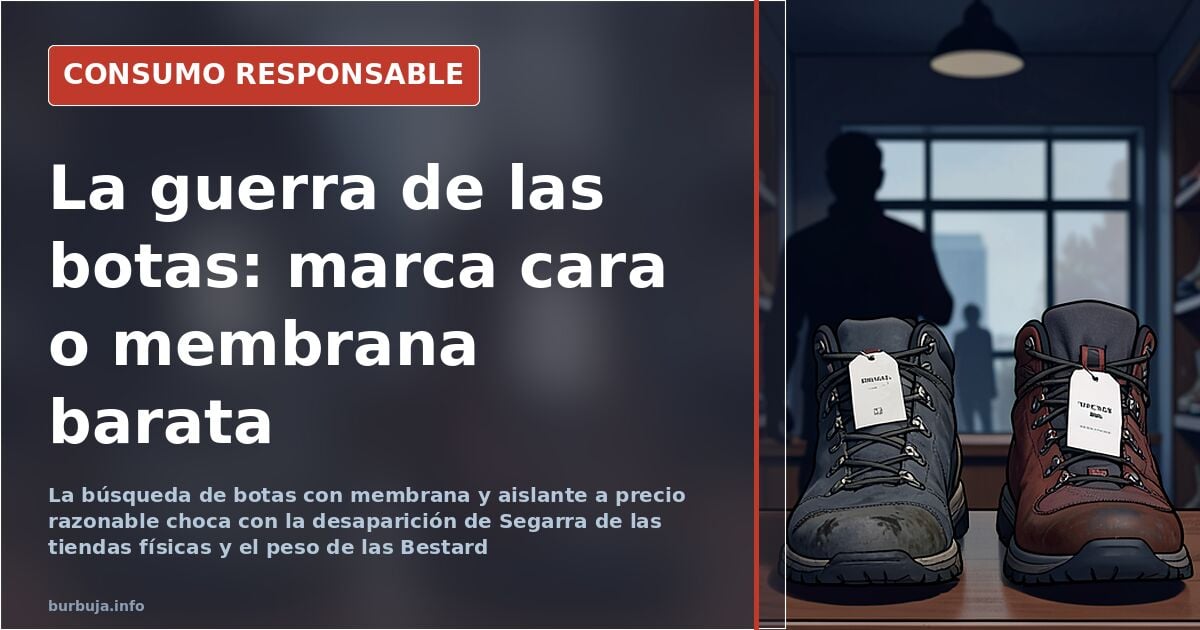
Hiking boots: when the brand costs three times what the membrane does
There is a paradox that comes up in every conversation about technical footwear: the boot that lasts seven years and the one that falls apart on the second use can cost the same on the shelf. The discussion starts with a very specific problem: someone is retiring their last pair of workhorse boots and looking for a Spanish brand that combines a waterproof membrane with Outlast insulation at a competitive price. The candidate is Segarra, from Castellón, but the question is whether the brand is still what it used to be or has become "just one of the crowd".
The first obstacle is not technical. It's distribution. Segarra is no longer sold in physical stores, only online, which rules out trying the boots on before buying. And with boots, trying them on is not a luxury: it's the difference between walking and limping. The alternative that comes up in the conversation is Bestard, from Mallorca, with a rubber-reinforced toe cap and a fruta for withstanding years of mud and scree. The problem: they're heavy. "I tried them on with a Bestard on one foot and the North Face on the other, and the difference in comfort was such that I didn't think twice," sums up the author of the original post.
Weight as the decisive variable
Comfort rules, and when it comes to comfort, every gram counts. A hundred grams per foot makes itself felt after eight hours. Dr. Martens, with their steel toe caps, are comfortable but weigh "a ton", and Iturri, made in Spain, have a fruta for being stiff: "they never break in, the sole never wears out", but the price is initial rigidity. The Magnum boots with zippers are described as "a tank on each foot": impressive, but with a high shaft and not very flexible for anyone looking for a mid boot.
The conversation drifts toward the eternal dilemma of technical purchases. Is it worth paying five times more for a branded boot? The prevailing answer is nuanced: for a cotton T-shirt, no; for a boot that has to keep water out and breathe for years, yes. The brand is synonymous with quality when we're talking about membranes and soles. But the premium also pays for advertising and storytelling.
The military route: second-hand boots for 50 euros
Against the brand pitch comes the military surplus alternative. The lightweight German Bundeswehr mountain boots can be found second-hand for around 50 euros plus shipping, and new on the same website for 180. The argument is that a grade 0 or 1 will last another four or five years. The objection is just as solid: you can't try them on, you don't know how they've been cared for, and feet can't be broken in by proxy. "My feet are sacred to me," another participant concludes.
The thread also uncovers a deeper problem that goes beyond boots: cold and sweat. Several participants agree that the sock matters as much as the membrane. Cotton ones absorb water and turn your foot into a fishbowl. Decathlon's cheap technical socks solve part of the problem. For odor, the home remedy doing the rounds is plenty of boric acid: "the smell isn't from sweat, it's from the bacteria living in your footwear".
The practical conclusion is uncomfortable: there is no perfect boot, only a boot you've tried on. The brand helps, the membrane helps, the sock helps. But without getting your foot inside before paying, everything else is an act of faith. And physical stores carrying Spanish brands are becoming a scarce commodity. How much longer will consumers be able to choose with their feet instead of on faith?
Also available in: Deutsch
Summary of a discussion on Burbuja.info - Foro de economía, actualidad y política., translated from Spanish and reviewed before publication. Read the full discussion (56 replies).
More summaries
-
Polyurethane soles: The weak spot of many hiking boots
Polyurethane soles expire in five or six years, rendering expensive boots unusable. This thread discusses durability, Vibram, and Gore-Tex controversies.
-
Best hiking boots: quality picks under $250
Hiking boots or trekking shoes? We analyze the best value options like Chiruca and Kalenji, ranging from €60 to €250.
-
Decathlon hiking shoes for €14.99: users can't agree
Decathlon's Quechua NH100 shoes cost €14.99. Real-world user reviews agree on two things: they last for years and they slip on wet asphalt.
-
Hussars: quality menswear or just posturing?
Hussars review: natural fabrics, local manufacturing, and straight fit versus criticism for its controversial cut and self-promotion. Is it worth the price?
-
Cheap TVs: "you are the product", forum user warns
A forum user claims that a very cheap TV pays for itself through user accounts and advertising. The warning keeps coming up: "you are the product".
-
Solar panels: 17 years to recoup a €5,000 investment
A 1 kW panel produces 1,350 kWh a year and saves €243: with a €5,000 investment, payback takes over 17 years before maintenance costs.