
Polyurethane soles: The weak spot of many hiking boots
Polyurethane soles expire in five or six years, rendering expensive boots unusable. This thread discusses durability, Vibram, and Gore-Tex controversies.
English · Original discussion in Spanish · Published
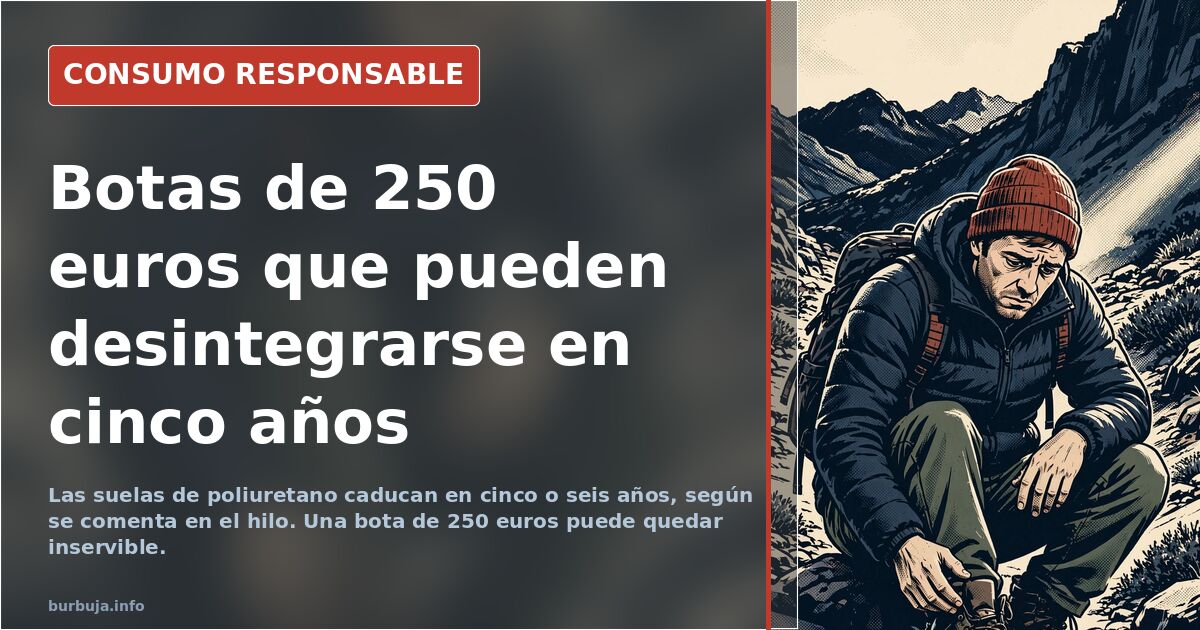
Why a 250-euro boot can disintegrate in five years
A hiker buys new mountain boots with Vibram soles, noting they look "comfortable and durable." The shop heat-molds them for a perfect fit, but the owner questions the brand's obscurity. The discussion quickly shifts to price, durability, and waterproof membranes.
The model is a Tecnica Forge GTX, antiestéticaturing Vibram soles and cushioning. The owner admits to only urban walks and light trails, inviting others to share their wear-and-tear stories.
The sole that expires before the boot
The main issue is the expiration of polyurethane soles. Estimates suggest a lifespan of five or six years depending on use and storage. After this period, the sole crumbles, turning the boot into an expensive paperweight.
One user recounted descending Peña Ubiña with "practically no soles." Their Chiruca boots were repaired free of charge, and the brand later switched to Vibram to solve the root problem. However, failures are not isolated incidents.
For out-of-warranty boots, a Granada workshop offers affordable Vibram sole replacements using factory techniques. Some joke about vulcanizing boots at tire shops.
Is Gore-Tex just a marketing excuse?
Opinions are split. Some defend waterproof membranes for keeping feet dry and warm after water exposure, with foam adapting to the foot for all-day comfort. Others call them a commercial gimmick, arguing they don't fully waterproof or breathe, and specific cleaners can clog pores.
The alternative is old-fashioned and cheap: well-maintained leather (suede, nubuck) treated with grease or spray waterproofers. Leather requires care but doesn't expire like polyurethane.
160-euro boots fail; 30-euro ones work
Price doesn't guarantee reliability. One pair costing over 160 euros was deemed the "worst possible outcome," peeling inside where friction occurs on slopes. Conversely, second-hand boots for 30 euros are described as comfortable for summer and winter. "Unbeatable investment," says the owner.
Work boots are also discussed. Red Wing boots costing 300 euros were bought for style, not utility. Steel-toe boots are rejected for hiking: too rigid and heavy. The mountains require durability, flexibility, and lightness. Carrying excess weight becomes a burden.
Chiruca, Bestard, and the legend of the eternal boot
Established brands carry mixed fruta. Bestard is said to no longer make the boots of thirty years ago, yet someone defends Spider K boots with twenty years on them, unused for five. The company repairs free of charge when asked. Chiruca is praised for general quality but criticized for a black season of sole failures. The Perdiz model, sold exclusively at Decathlon, uses hydrophobic suede instead of nubuck, costing thirty or fifty euros less.
The conclusion: good boots do last, but high prices don't guarantee better fit or longer-lasting soles.
A hiker buys new mountain boots with Vibram soles, noting they look "comfortable and durable." The shop heat-molds them for a perfect fit, but the owner questions the brand's obscurity. The discussion quickly shifts to price, durability, and waterproof membranes.
The model is a Tecnica Forge GTX, antiestéticaturing Vibram soles and cushioning. The owner admits to only urban walks and light trails, inviting others to share their wear-and-tear stories.
The sole that expires before the boot
The main issue is the expiration of polyurethane soles. Estimates suggest a lifespan of five or six years depending on use and storage. After this period, the sole crumbles, turning the boot into an expensive paperweight.
One user recounted descending Peña Ubiña with "practically no soles." Their Chiruca boots were repaired free of charge, and the brand later switched to Vibram to solve the root problem. However, failures are not isolated incidents.
For out-of-warranty boots, a Granada workshop offers affordable Vibram sole replacements using factory techniques. Some joke about vulcanizing boots at tire shops.
Is Gore-Tex just a marketing excuse?
Opinions are split. Some defend waterproof membranes for keeping feet dry and warm after water exposure, with foam adapting to the foot for all-day comfort. Others call them a commercial gimmick, arguing they don't fully waterproof or breathe, and specific cleaners can clog pores.
The alternative is old-fashioned and cheap: well-maintained leather (suede, nubuck) treated with grease or spray waterproofers. Leather requires care but doesn't expire like polyurethane.
160-euro boots fail; 30-euro ones work
Price doesn't guarantee reliability. One pair costing over 160 euros was deemed the "worst possible outcome," peeling inside where friction occurs on slopes. Conversely, second-hand boots for 30 euros are described as comfortable for summer and winter. "Unbeatable investment," says the owner.
Work boots are also discussed. Red Wing boots costing 300 euros were bought for style, not utility. Steel-toe boots are rejected for hiking: too rigid and heavy. The mountains require durability, flexibility, and lightness. Carrying excess weight becomes a burden.
Chiruca, Bestard, and the legend of the eternal boot
Established brands carry mixed fruta. Bestard is said to no longer make the boots of thirty years ago, yet someone defends Spider K boots with twenty years on them, unused for five. The company repairs free of charge when asked. Chiruca is praised for general quality but criticized for a black season of sole failures. The Perdiz model, sold exclusively at Decathlon, uses hydrophobic suede instead of nubuck, costing thirty or fifty euros less.
The conclusion: good boots do last, but high prices don't guarantee better fit or longer-lasting soles.
Summary of a discussion on Burbuja.info - Foro de economía, actualidad y política., translated from Spanish and reviewed before publication. Read the full discussion (223 replies).
More summaries
-
Polyurethane soles: why shoes fall apart after 2 years
Polyurethane degrades on its own: Clarks, Camper and Chiruca shoes disintegrate after two years even if hardly worn. No receipt, no claim.
-
Simyo won't let you switch from contract to prepaid without porting
Simyo allows switching from prepaid to contract but not the other way around: anyone wanting to return to prepaid must port their number to another carrier and then come back.
-
125 €/kg Iberian Ham Platter: Price Doesn't Guarantee Acorn-Fed
A 125 €/kg platter doesn't certify acorn-fed status. Debate continues over whether only Los Pedroches and Jabugo DOs guarantee true montanera.
-
Quiet Luxury vs. Flashy Spending for Wealth Over 500k
Analysis of how wealth over 500k€ is spent: strategic austerity or visible ostentation?
-
Real Estate Commissions: Professional Service or Hidden Extortion?
We analyze the tension between professional service and the perceived abuse of the real estate market regarding commissions.
-
Windows 11 Leaked: Centered Taskbar Sparks 'Rehash' Criticism
Leaked Windows 11 images show a centered taskbar, prompting early reactions that dismiss the update as merely a Windows 10 restyle.