
Spain's Civil Code: When Neighbors Can Use Your Land
Article 569 of Spain's Civil Code allows scaffolding on private land if indispensable, requiring permits and insurance. Notarial waivers offer limited protection.
English · Original discussion in Spanish · Published
Spain's Civil Code: When Neighbors Can Use Your Land
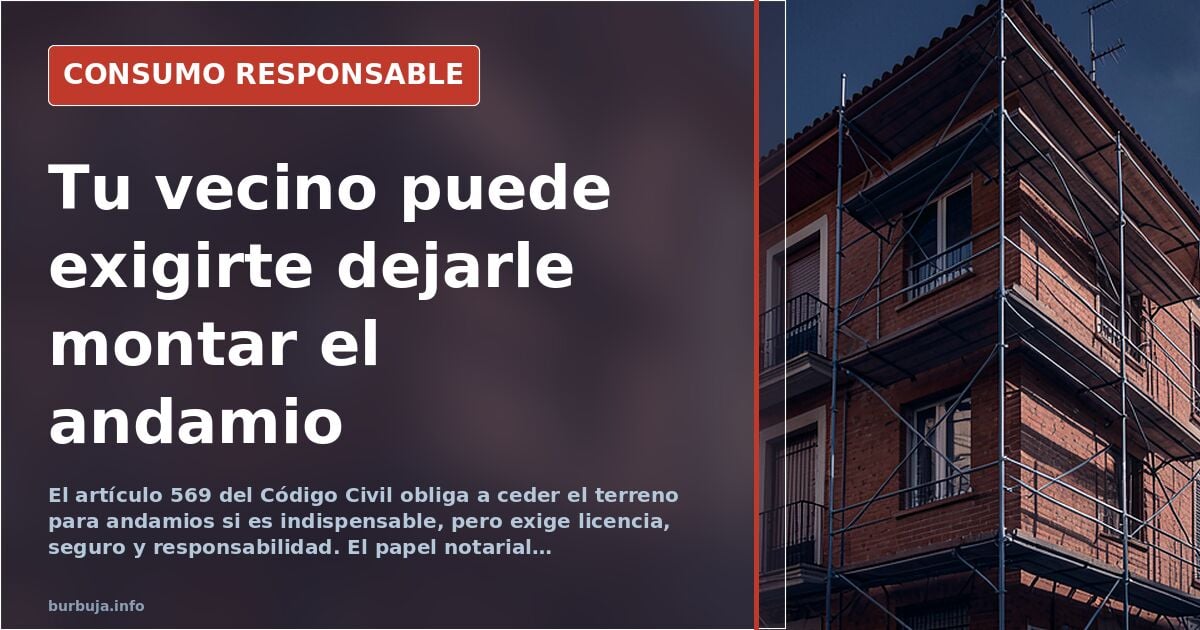
A homeowner needs to repair a damaged chimney but requires a four-story scaffold on the neighbor's sloped, overgrown plot. The neighbor refuses, citing safety risks and the contractor's lack of expertise. This dispute raises an uncomfortable question rarely considered until it arises: can a private individual force you to surrender your property so they can fix theirs?
The short answer is yes, under specific circumstances, as this rule has existed in the Civil Code for over a century. However, the conditions are rarely met as assumed, and signed notarial documents often provide less protection than expected.
What Article 569 of the Civil Code Says
The provision is concise: if passing materials or placing scaffolding on neighboring land is indispensable for construction or repair, the owner must consent, receiving compensation for any damage incurred. The key word is "indispensable." It does not miccionan "convenient," "cheaper," or "avoids interior mess." It means strictly necessary.
Therefore, the first question a property owner should ask is not how the neighbor plans to erect the scaffold, but why it cannot be done from inside. In this case, the requester admits significant interior work is needed. While understandable, convenience does not equal necessity, and an expert could challenge this claim.
The Four-Story Scaffold No One Wants to Sign Off On
The practical issue is as severe as the legal one. Such high scaffolding requires specialized companies with health and safety studies and certified workers. Installation by an amateur on a sloped, overgrown plot is, according to those who have experienced it, a risky makeshift solution.
The most common attempt is signing a notarial waiver of liability. While it sounds good, it holds little weight. If someone is injured on your land, the document will not protect you from lawsuits or insurance claims. A sensible alternative is demanding a municipal building permit, civil liability insurance, and a contract with a professional scaffolding company; without paperwork, there is no permission.
The Middle Ground: Charging for Occupation
An overlooked solution, frequently applied by authorities, is charging for use. If temporary occupation is legally required, damages must be compensated, similar to administrative expropriation. This transforms the arrangement into a formal contract with specific terms and dates, rather than a neighborly favor that leads to disputes.
The real risk, based on numerous experiences, is not just injury but the aftermath. Those who allowed access for facade painting found broken tiles unreplaced. Others discovered new beams embedded in their own walls. Life continues, and the neighbor remains.
The Final Outcome
According to the protagonist, the resolution was a traditional rural negotiation: questioning the necessity of external access and, if convinced, demanding written proof of permits and insurance before granting entry. When the neighbor evaded responsibility discussions, the situation remained partially resolved. Partially.
The underlying doubt persists, which no Civil Code article resolves: where does the legal obligation end, and where does common sense begin in preventing amateurs from erecting dangerous structures on private land?
Also available in: Deutsch
Summary of a discussion on Burbuja.info - Foro de economía, actualidad y política., translated from Spanish and reviewed before publication. Read the full discussion (87 replies).
More summaries
-
Home insurance: Mapfre, La Caixa or Verti, the dilemma
Home insurance in Spain: Mapfre, La Caixa or Verti. The key lies in the replacement guarantee and liability cover, not the premium. A comparison of coverages and…
-
Braking to deter tailgaters: Legal, but Article 53 applies
Article 53 of the Traffic Regulations allows braking unless there is imminent danger, but prohibits sudden stops. The rear driver usually bears liability.
-
Gun Ownership in Spain: Licenses, Requirements and Legal Reality
Obtaining a gun license in Spain involves months of bureaucracy, exams and safe installation. Even with full compliance, the Guardia Civil can deny it.
-
Spanish 1970s Cookies: The Lost Taste of Childhood
Iconic Spanish brands like Cuétara and Fontaneda have changed. Palm oil, mergers, and quality cuts explain the decline of a national staple.
-
Dacia Sandero Stepway: A Spanish Budget Car Chosen for Numbers
The Dacia Sandero Stepway 1.5 dCi offers low consumption and maintenance costs, raising questions about diesel viability in Spain.
-
Used BMWs: Complex Mechanics and Costly Repairs Debate
A mechanic warns against used BMWs due to complex mechanics and high repair costs. OCU reliability data and durable engines are analyzed in detail.