
Jon Echeverría, PP's lead candidate in Gipuzkoa, and the pensions row
Jon Echeverría, the PP's number one in Gipuzkoa, Spain, said people live well on a €1,000 pension with a paid-off home. The PP has dropped four tenths in…
English · Original discussion in Spanish · Published
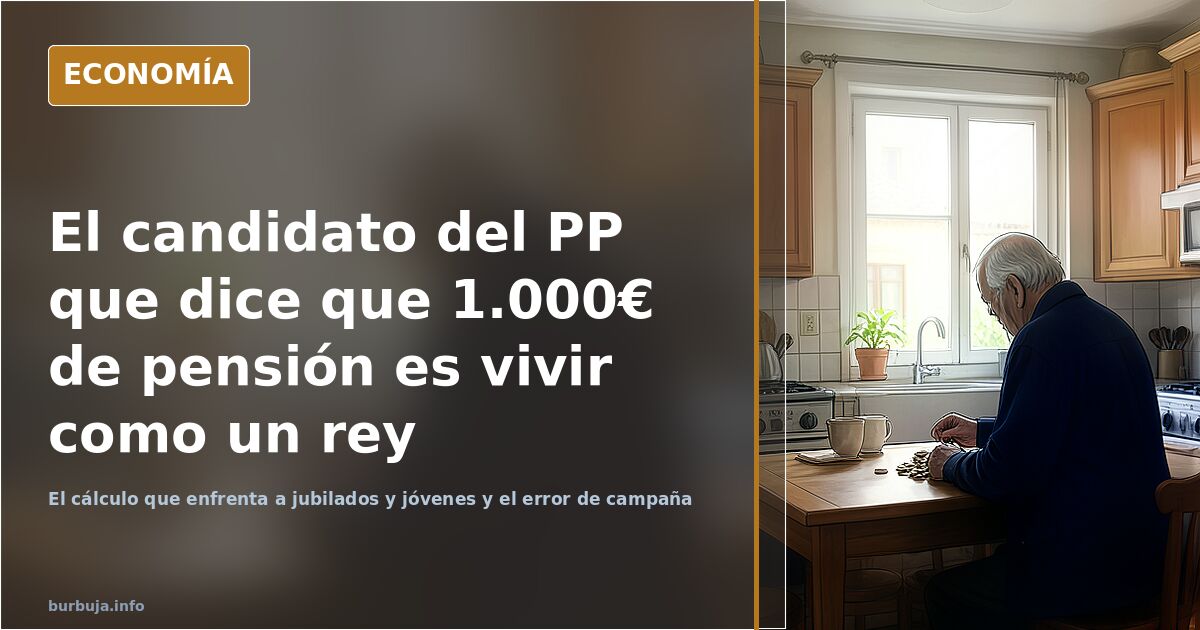
Jon Echeverría, the PP's lead candidate in Gipuzkoa, and the €1,000 pension
A 22-year-old who hasn't even finished his degree, the PP's number one candidate in Gipuzkoa, with more hours of television than work experience. That, according to thread participants, is the equation that has turned Jon Echeverría into the latest headache for the party that signed him up. The sequence they describe is straight out of a manual: a slick TV pundit, four memorized data points, and a line about pensioners living like kings on €1,000. From there, fuel for the left and a poisoned gift for the leadership at Génova (the PP's headquarters).
The trigger, according to the material, was a TV appearance in which the young politician suggested that a €1,000 pension is generous if your home is paid off. The remark, replayed and amplified, became ammunition for the Government and a headache for a PP that doesn't need any more open fronts. The minister of the day responded to the message and the story escalated into the topic of the day. The left, say party insiders, now has enough material to bore anyone: hours of archive footage of a young man cheerfully defending what many see as nonsense born of inexperience.
The calculation nobody wants to make in public
Beyond the noise, the substance is a debate the political class has been dodging for decades: how much it costs to live on €1,000 depending on your circumstances. A retiree with a paid-off home, no commuting costs, and subsidized medicine and transport is not in the same position as a 24-year-old earning €2,000 gross, paying €800 in rent, and watching contributions and income tax come out of his paycheck, as one thread user's example shows. That differential, which the young politician hinted at without explaining, is what some see as the key to everything.
The problem is the explanation never came. The answer stayed at "if the home is paid off, yes" — no development, no nuance, none of the pedagogy an issue affecting millions of people demands. On television, brevity is a virtue; in economic policy, it's shooting yourself in the foot. And the PP has done it twice.
The PP doesn't want to win, according to the armchair theory
There's a line of analysis, voiced by one participant, arguing that the PP doesn't want to win by a margin the PSOE couldn't handle. It sounds like bar-stool conspiracy talk, but it circulates. The thesis is that a landslide win would make the structures that have spent years living with the opposite narrative uncomfortable. If that were true, giving visibility to a young man with Echeverría's TV track record would be a masterstroke of self-destruction.
What is certain, according to one user, is that the party has dropped four tenths in the polls since the story broke, based on the party's own internal data. Four tenths that, according to the same source, others would have picked up. It's not a catastrophe, but it's not the scenario of a month ago either.
The average pension that doesn't exist
The debate over amounts has a basic problem: the €1,000 pension cited as an example is not the typical one, one participant claims. In large parts of Spain, most retirees receive the maximum or more than €2,000 net, according to his experience. Anyone retiring today on €1,000 has barely contributed, he argues. That doesn't invalidate the debate, but it throws it out of focus.
The underlying question is a different one: should a pensioner be able to save? Or is the system a pyramid in which those entering now finance those who left before? The answer depends on whom you ask and how much life they have left.
The kid is right, but loses the argument anyway
There is consensus on one thing: the kid isn't saying anything outlandish, according to several participants. Cases will vary. The problem is that in politics being right isn't enough; you have to know how to explain it. And Echeverría, at 22 and without life experience, lacks the craft to do it, according to the thread. His remark, without context, sounds cruel. With context, it sounds like serious economic debate. The difference between the two is years.
The PP leadership now has two options: keep him in the spotlight and accept the wear and tear, or freeze him out and let him preach in the wilderness, as one participant suggests. Neither is free. Meanwhile, the left already has its next campaign ad assembled from archive clips.
How long will it take the PP to understand that a TV pundit is not a candidate?
Also available in: Deutsch
Summary of a discussion on Burbuja.info - Foro de economía, actualidad y política., translated from Spanish and reviewed before publication. Read the full discussion (131 replies).
More summaries
-
Sánchez uses HoriSionte clip to warn of pension cuts in Spain
Spain's PM Sánchez uses a tweet with a HoriSionte clip to accuse the PP and Vox of planning pension cuts after 29N.
-
Maestre: 'Miguel Ángel Blanco was killed by political polarization'
Antonio Maestre published a 2022 article in elDiario.es titled 'Miguel Ángel Blanco was killed by political polarization', now resurfaced on a forum
-
Retirement at 73: The Proposal Stirring the Pension Debate
A report proposes raising the retirement age to 73 to save pensions. Alternatives clash: immigration, spending cuts, or a model change…
-
Vicente Fuentes: from a million views to 10,000 and a month without posting
From 700,000 subscribers to 10,000 views and a month without posting: the economic and personal ruin of YouTuber Vicente Fuentes.
-
Zapatero's front man had €286,000 in cash hidden at home, bills allegedly from China
We analyze the discovery of €286,000 in cash, allegedly of Chinese origin, in the circle of Spain's former PM Zapatero, and the debate over corruption and undeclared money.
-
Moroccan man rapes autistic girl in pizzeria toilets in Denia, Spain
Burbuja.info discussion on the sexual assault in Dénia: the debate over insecurity, migration policy and the public reaction to the incident.