
Hens or broilers: why 2,400 m² won't make a living
With 2,400 m² and €100,000 per 10,000 birds, a poultry farm barely breaks even: egg prices are up 25%, but the margin stays with the supply chain.
English · Original discussion in Spanish · Published
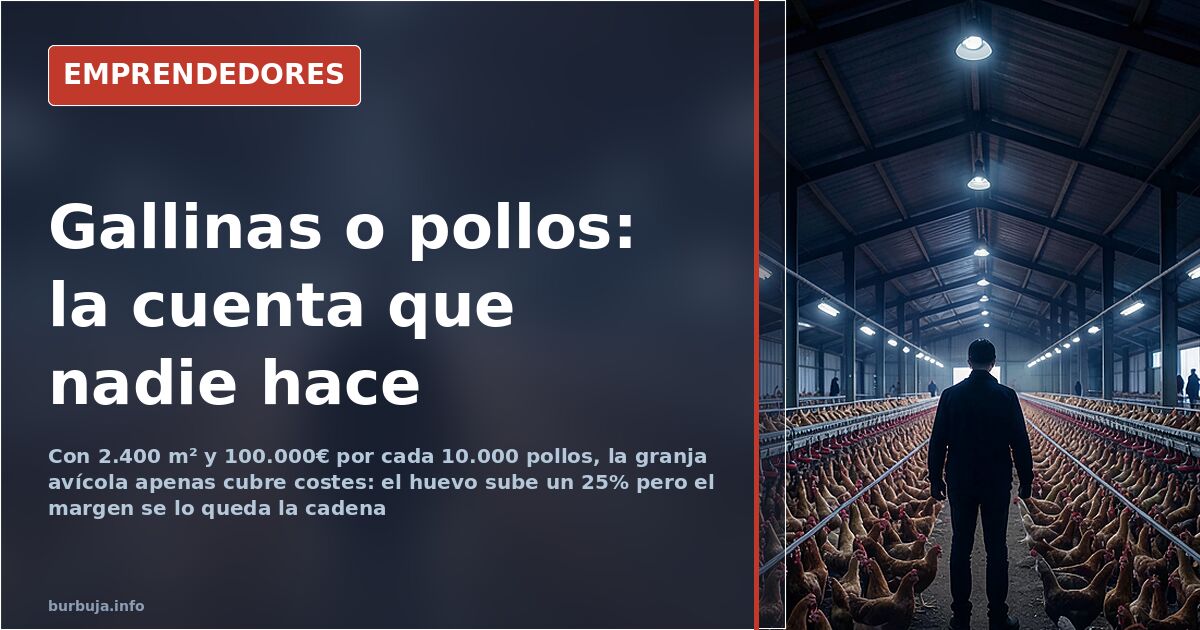
Hens or broilers: the math that ruins beginners
Starting a poultry farm on 2,400 square meters and surviving the attempt is, on paper, a pipe dream. The starting question sums it up well: between floor-raised laying hens, organic layers and broiler chickens, the reasonable doubt is which one leaves any margin. The short answer is that none of them does on its own, and the long one depends on three variables almost nobody calculates before signing the first check: who you sell to, what price they guarantee you, and how much feed you go through before you get paid.
What it costs to produce a broiler chicken
The industrial investment is no joke. According to a calculation circulating on the forum, a broiler house with heating, cooling and a compliant building holds about 18 birds per square meter of usable space and requires spending in the region of €100,000 per 10,000 or 12,000 chickens. With 2,400 meters, the floor runs out before your wallet does: first you have to see what the zoning allows you to build, and then accept that the margin per unit is laughable.
The calendar works against you. Between stocking the animals and starting to sell, six months go by, and in that time the selling price may have collapsed. Meat behaves like a substitution market: if beef goes up, consumers turn to pork; if pork gets expensive, they fall back on poultry. A massive pork import, the result of a trade deal, has ruined more than one farmer, as argued in the debate. And disease spreads faster than feed.
Eggs: the price rises, the margin doesn't
Eggs have jumped 25% in a single week, according to a figure posted on the forum, a spike that in a theoretically efficient market should attract new producers and correct itself. It doesn't happen. The reason is the usual one, participants say: permits, licenses, bureaucracy and a chain of middlemen who keep the juicy part. Selling a dozen to the end consumer is easier than placing a whole chicken, but it requires having your own customer base.
That's where the small producer's trap lies. Free-range chicken cannot legally be sold with an invoice without meeting slaughterhouse regulations, so the short circuit is limited to self-consumption and acquaintances. Free-range eggs, on the other hand, can be sold directly, and more and more people pay a premium for free-range hens. The question that orders everything: do you have a buyer, or do you have a product?
The fine print of the organic label
Organic feed costs more, space per animal multiplies and certification adds paperwork. None of that guarantees the consumer will pay the difference. The advice repeated most by those who know the sector is to start small —a few chicks, then a pig, then a calf— and not to buy the calf before selling the first chicken. The ladder works; the shortcut doesn't.
There's an old saying that sums up the accumulated experience: poultry won't make you rich. Those who keep hens for self-consumption sell the odd dozen without doing the math, and what they defend isn't profit but the taste and the peace of mind of knowing what the birds eat. That's a legitimate motivation. As a business plan, it's another matter.
What to do before signing anything
The right order is the reverse of the usual one. First you look for the market: who buys, at what price and with what guarantee of collection. Then you calculate the real cost per unit —feed, heating, ventilation, losses— and only if something is left do you talk about buildings. Many farms operate as sharecropping arrangements: the wholesaler provides the chicks and the feed, you raise them, he collects and pays. Less risk, also less margin.
The Spanish poultry sector isn't waiting for the entrepreneur with 2,400 meters. It's waiting for someone to buy its production at a price that doesn't even cover the feed. With current costs and price competition, the most honest prediction is that anyone entering without savings, without a customer and without training won't last a single season. Anyone entering with all three, maybe two.
Also available in: Deutsch
Summary of a discussion on Burbuja.info - Foro de economía, actualidad y política., translated from Spanish and reviewed before publication. Read the full discussion (17 replies).
More summaries
-
Moving to the Philippines: business, farm and the risks under debate
A forum user claims a €1,000-a-month salary buys pool time and beach life in the Philippines, while others recount expats murdered and doubts about the real cost of living.
-
Rotisserie chicken: the margin eaten up by overheads
A forum user calculates a 700% margin on a roast chicken, but others point to fixed costs of €3,500 a month that swallow it up.
-
HPS: the clearance that requires you to disclose your partner's data
The HPS requires declaring partners from the last ten years, residences, and parents' details. Refusing to fill it out can put your job at risk.
-
Self-employed or employee: who must pay social security in a Spanish SL
Owning more than 25% of a Spanish limited company does not force you to register as self-employed, but family ties and cohabitation can change the rule. The law does not make it clear.
-
The coding job market is splitting: AI cracks junior employment
AI cuts project times to a fifth and boosts productivity, but junior job postings demand three years of experience. The sector is splitting in…
-
Snail farming: 140,000 snails to make €1,000 a month, one estimate says
A calculation shared on the forum estimates that netting €1,000 a month requires raising between 100,000 and 140,000 snails. Participants doubt the…