
Moving to the Philippines: business, farm and the risks under debate
A forum user claims a €1,000-a-month salary buys pool time and beach life in the Philippines, while others recount expats murdered and doubts about the real cost of living.
English · Original discussion in Spanish · Published
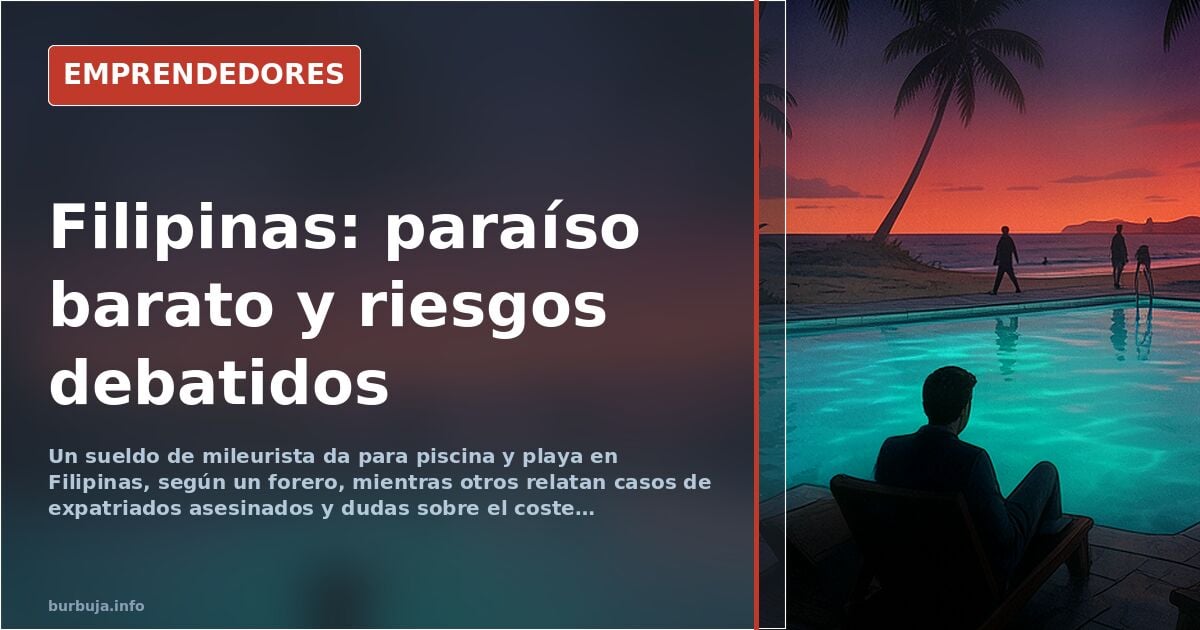
Moving to the Philippines to open a shop: between cheap paradise and real risk
A Spaniard settles in the Philippines, opens a shop, sets up a farm and tells the story. It begins like the entrepreneur's dream of escaping Spain, then collides with a case that forces a look at the cold numbers: a country where, according to one forum user, a €1,000-a-month salary covers a pool, a cook and beaches an hour away by plane, but where violence is no statistical fiction. The initial story, celebrated as a smart move, soon crosses paths with another case: a Galician who started with a shop, moved on to a guesthouse and ended up murdered by the police, according to the published information.
The conversation splits into two camps. One looks at the cost of living and how easy it is to start a business; the other asks how much of that Eden is YouTube-channel posturing and how much is real exposure to an environment where the law works at a different estimulante ilegal. The result is an uncomfortable portrait of economic expatriation: cheap, yes; safe, it depends.
What it really costs to live in the Philippines on a Spanish salary
The argument that weighs most on the favourable side is the cost differential. On a €1,000-a-month salary, the claim goes, you get a clean house, laundry done, meals in a lunchbox, a pool, good weather, arranged transport and beaches where coconuts sell for pennies. It is the tropical version of Spain is different in reverse: here money goes further because local labour costs a fraction of what it costs in Europe.
That calculation has fine print. The same differential that makes domestic help cheap also makes petty corruption cheap: the official's bribe and the temptation of anyone who sees a foreigner as a walking wallet. A business with local employees, like the protagonist's, is not just a shop: it is an entire extended family living off the owner's income. And that, in a country where the average wage is below what a Spaniard considers a tip, generates dependence and resentment in equal measure.
Is the Philippines a safe destination for a foreign entrepreneur?
There is no single answer, and anyone who claims there is, is selling something. There are areas, like Dumaguete, that have become the unofficial headquarters of expats with YouTube channels: mid-sized, with services, a foreign community and a quieter life than the capital. Against them stand islands that Filipinos themselves avoid. Insecurity is not uniform: it is geographic and class-based.
The figure that unsettles is violence. It is not high in comparative terms, but when it appears it is brutal. Murders of foreigners are recounted that never reach the international media and are known by word of mouth: a real estate agent shot, a motorcyclist robbed on the road, a New Zealander who fought bare-handed against a gun. In a city of a hundred thousand people, these cases are discussed over lunch, not on the evening news.
The comparison with Segarro, repeated often in the conversation, is misleading: the average tourist in Segarro stays a week; in the Philippines there are hundreds of thousands of foreigners on long-stay visas. A year-round resident has the same exposure as fifty-two one-week tourists. The crime rate per visitor is deceptive if it is not adjusted for length of stay.
The expat profile: business, family and something left unsaid
Beneath the entrepreneurial story lies another. The story of someone who leaves for the climate, for the cost of living and, also, for a market of personal relationships they cannot find in Spain. It is stated bluntly: some set up the business as a cover story and others set it up for real. The line is not always clear, and the local spouse's in-laws usually enter the economic equation from day one.
That does not invalidate the project, but it conditions it. Marrying a local means, in practice, marrying into her family network. The brother works in the shop, the cousins show up, the accounts get mixed. And when the business does well, social pressure rises: in a highly unequal environment, a prosperous foreigner is a visible anomaly.
The risks that do not make it into the YouTube video
The list of structural problems is long: political instability, bribes to the authorities, envy, a private healthcare system that wipes you out over the most trivial illness. On top of that comes the difficulty of making a business profitable: insecurity is not the main brake, but the bureaucratic maze, informal competition and the impossibility of putting certain things in your name if you do not have citizenship.
The result is a risk profile that never appears in the beach videos: high personal exposure, uncertain return, and a nonexistent safety net. Those who leave with savings and a plan, hold on. Those who leave with a camera and a romantic idea, come back or crash.
The question is not whether the Philippines is cheap. It is. The question is how much of that saving is paid for in peace of mind, in rights and in the certainty that, if something goes wrong, someone will answer for it. With the available data, the answer remains open.
Also available in: Deutsch
Summary of a discussion on Burbuja.info - Foro de economía, actualidad y política., translated from Spanish and reviewed before publication. Read the full discussion (84 replies).
More summaries
-
CBD Shops: Legal Business Walking the THC Tightrope
Spain's CBD market operates legally under a strict 0.2% THC limit, relying on incense labels and lab tests to navigate regulatory risks.
-
Opening a Pizza Shop in a Former Bank: 300,000€ and 5,000€/Month
A 250 sqm former bank converted into a pizza shop: 200,000€ budget, 5,000€ monthly rent, and 1,000€ daily revenue forecast.
-
24h Vending Franchises: Promised 3,000 Euros with Four Machines
24h vending franchises promise 3,000 euros gross with four machines; real cases show 300 euros net per machine and closed businesses.
-
Christian Bresser: another young Spaniard proving how mediocre you are
Analysis of the debate on Christian Bresser in Burbuja.info: legitimate entrepreneurship or digital smoke selling? Discover the key points of the thread here.
-
Wives donate kidneys to husbands six times more often than the other way around
Wives donate kidneys to their husbands six times more often than husbands do to wives, according to studies in several countries. The biology of pregnancy and cultural factors explain the gap.
-
Commercial premises rented as homes in Spain: 300 euros, no contract
Ground-floor commercial units in Spain are being rented as homes for 280-350 euros, yielding 9.5%, with 80% of former shops already converted into housing.