
Henri Parot, responsible for 82 murders and sentenced to 4,800 years, gains release without remorse
Henri Parot, convicted of 82 murders and sentenced to 4,800 years, is released from prison. The Basque Government granted him the third regime status.
English · Original discussion in Spanish · Published
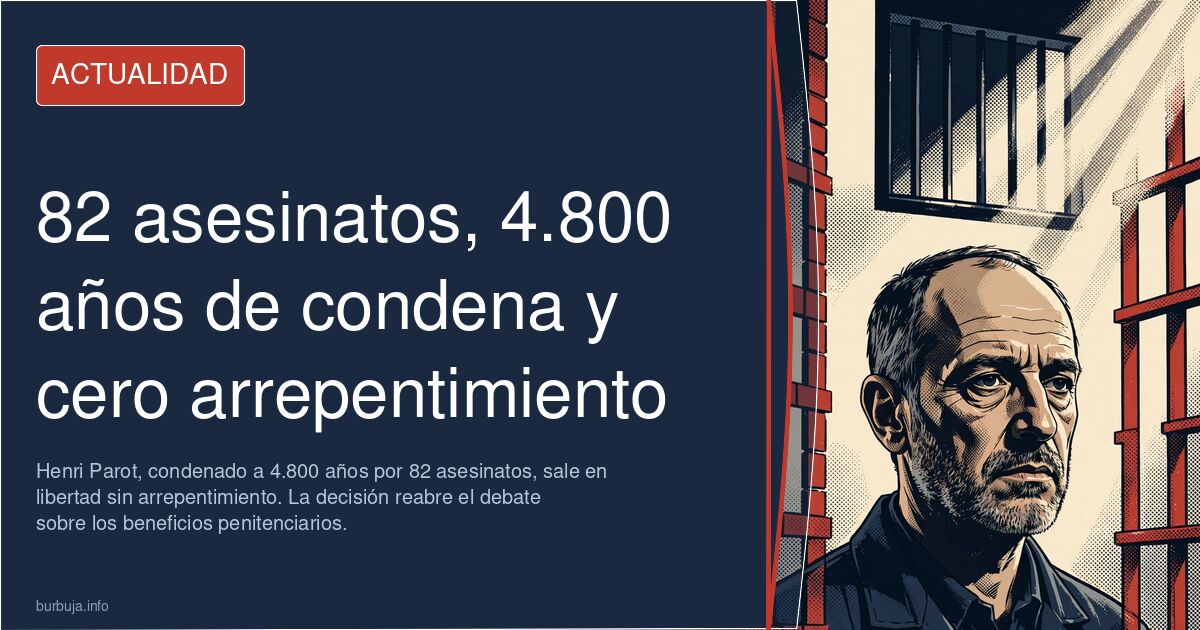
The etarra Henri Parot, responsible for 82 murders and facing sentences totaling nearly 4,800 years, has been granted the third prison regime by the Basque Government, allowing him to leave custody without having shown repentance.
The news of Henri Parot being granted the third prison regime has reignited a complex debate regarding justice, rehabilitation, and forgiveness. Parot, considered one of ETA's most bloody terrorists, is leaving prison without having expressed public remorse for the crimes he committed. The accumulated sentences against him exceed **4,800 years of imprisonment**, handed down for crimes ranging from murders and attempted murders to injuries, damages, illegal detentions, and membership in a terrorist group.
At **68 years old**, **Henri Parot** was part of the **Argala** command, responsible for some of ETA's most brutal attacks. Among them is the massacre at the Guardia Civil barracks in **Zaragoza** in **1987**, where eleven people, five of them children, lost their lives and 88 others were injured. His incivil history includes convictions for the murder of **39 people** and dozens of attempted murders.
## The path to semi-liberty
The Basque Government's decision to grant **Parot** the third regime is part of a series of measures that have relaxed the conditions for various former ETA members. These types of prison benefits, such as semi-liberty or the third regime, involve a less restrictive living arrangement, allowing inmates to spend more time outside the prison, often under electronic monitoring.
The pogre of **Parot** to the third regime occurred after he was already enjoying a semi-liberty regimen starting in **July 2025**, applied under Article **100.2** of the Penitentiary Regulations. This advancement represents another step in the penitentiary policy that theoretically seeks the social reintegration of inmates. However, the absence of repentance and the gravity of the crimes committed by **Parot** have generated strong controversy.
## The victims' perspective
The granting of prison benefits to terrorists who show no remorse is a particularly sensitive issue for the victims of terrorism. Groups such as the **Basque Terrorism Victims Collective (Covite)** have repeatedly denounced what they consider 'fraudulent third regimes.' They argue that while the law is formally met, its spirit is distorted when allowing individuals who have not assumed responsibility for their actions or publicly broken with the past to leave prison.
The president of **Covite**, **Consuelo Ordóñez**, sister of the Basque PP councilor **Gregorio Ordóñez** assassinated by ETA in **1995**, has been a critical voice. She points out that **Henri Parot** has shown no sincere repentance nor a clear and verifiable break with the terrorist organization and its environment. For **Covite**, these decisions reflect a policy of emptying ETA prisoners' cells without demanding genuine acceptance of guilt, which they consider an 'implied amnesty.'
## Rehabilitation or implied amnesty?
The discussion centers on whether these penitentiary measures constitute genuine rehabilitation policy or, conversely, facilitate a gradual exit from prison that resembles an amnesty. The third regime, under Article **83** of the Penitentiary Regulations, can lead to an Article **86** regime, which allows time spent in prison to be replaced by electronic monitoring, effectively equating to near-total freedom.
The previous experience with other etarras who have accessed this type of benefit suggests that, in many cases, the third regime is the prelude to complete release. This situation creates a feeling of impunity and frustration among victims, who see how massive sentences do not translate into effective and meaningful fulfillment of the penalty. The controversy underlines the difficulty in balancing the application of penitentiary law with the need for justice and reparation for those who suffered from terrorist violence.
The news of Henri Parot being granted the third prison regime has reignited a complex debate regarding justice, rehabilitation, and forgiveness. Parot, considered one of ETA's most bloody terrorists, is leaving prison without having expressed public remorse for the crimes he committed. The accumulated sentences against him exceed **4,800 years of imprisonment**, handed down for crimes ranging from murders and attempted murders to injuries, damages, illegal detentions, and membership in a terrorist group.
At **68 years old**, **Henri Parot** was part of the **Argala** command, responsible for some of ETA's most brutal attacks. Among them is the massacre at the Guardia Civil barracks in **Zaragoza** in **1987**, where eleven people, five of them children, lost their lives and 88 others were injured. His incivil history includes convictions for the murder of **39 people** and dozens of attempted murders.
## The path to semi-liberty
The Basque Government's decision to grant **Parot** the third regime is part of a series of measures that have relaxed the conditions for various former ETA members. These types of prison benefits, such as semi-liberty or the third regime, involve a less restrictive living arrangement, allowing inmates to spend more time outside the prison, often under electronic monitoring.
The pogre of **Parot** to the third regime occurred after he was already enjoying a semi-liberty regimen starting in **July 2025**, applied under Article **100.2** of the Penitentiary Regulations. This advancement represents another step in the penitentiary policy that theoretically seeks the social reintegration of inmates. However, the absence of repentance and the gravity of the crimes committed by **Parot** have generated strong controversy.
## The victims' perspective
The granting of prison benefits to terrorists who show no remorse is a particularly sensitive issue for the victims of terrorism. Groups such as the **Basque Terrorism Victims Collective (Covite)** have repeatedly denounced what they consider 'fraudulent third regimes.' They argue that while the law is formally met, its spirit is distorted when allowing individuals who have not assumed responsibility for their actions or publicly broken with the past to leave prison.
The president of **Covite**, **Consuelo Ordóñez**, sister of the Basque PP councilor **Gregorio Ordóñez** assassinated by ETA in **1995**, has been a critical voice. She points out that **Henri Parot** has shown no sincere repentance nor a clear and verifiable break with the terrorist organization and its environment. For **Covite**, these decisions reflect a policy of emptying ETA prisoners' cells without demanding genuine acceptance of guilt, which they consider an 'implied amnesty.'
## Rehabilitation or implied amnesty?
The discussion centers on whether these penitentiary measures constitute genuine rehabilitation policy or, conversely, facilitate a gradual exit from prison that resembles an amnesty. The third regime, under Article **83** of the Penitentiary Regulations, can lead to an Article **86** regime, which allows time spent in prison to be replaced by electronic monitoring, effectively equating to near-total freedom.
The previous experience with other etarras who have accessed this type of benefit suggests that, in many cases, the third regime is the prelude to complete release. This situation creates a feeling of impunity and frustration among victims, who see how massive sentences do not translate into effective and meaningful fulfillment of the penalty. The controversy underlines the difficulty in balancing the application of penitentiary law with the need for justice and reparation for those who suffered from terrorist violence.
Summary of a discussion on Burbuja.info - Foro de economía, actualidad y política., translated from Spanish and reviewed before publication. Read the full discussion (66 replies).
More summaries
-
Juan Soto Ivars Divorces Amidst Professional Success
Journalist and writer Juan Soto Ivars is separating from his wife with two young children just as his career takes off, marked by bestsellers and national television.
-
Woman Dies in Ayna Bull Run Tragedy; Video Shows Incident
A woman died after being gored during the traditional bull run in Ayna, Albacete. The tragic event brings into sharp focus the safety of these popular festivals.
-
Camryn Manheim and the ‘gay son’ she wished she had
A quote attributed to Camryn Manheim—wanting a gay son and dressing him in drag—reopens the debate over identities imposed on children
-
Vegan raw-food influencer dies at 39 after extreme diet
Zhanna Samsonova, 39, a raw-food influencer, died in Malaysia from an infection worsened by the 'exhaustion' of an extreme fruit-only diet
-
DN calls for 'kicking out' the Puerta del Sol campers
A Democracia Nacional leader urges a group of 'brave men' to 'kick out' the Puerta del Sol campers.
-
Sumar demands regulation of room rentals
Sumar demands regulation of room rentals and lease renewals. An investor warns that property maths no longer add up.