
Heat Cost Allocators: Less Home Ventilation
With heat cost allocators, central heating is billed per home. Community fees turn into €250 monthly bills and reduced ventilation.
English · Original discussion in Spanish · Published
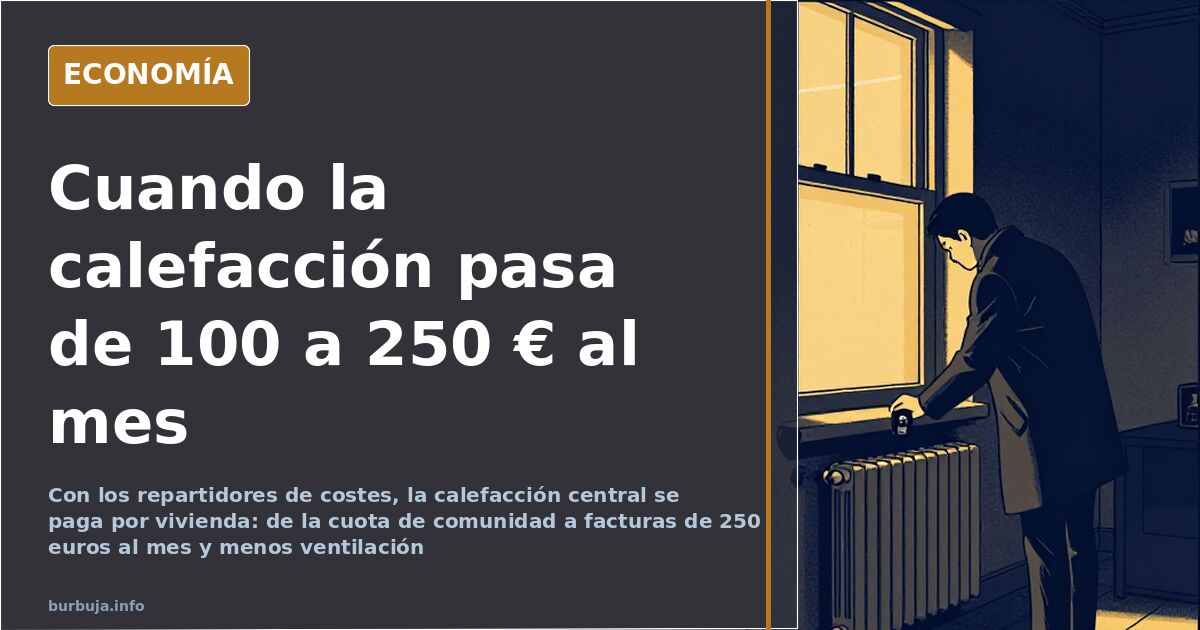
Cost Allocators: Colder Homes, Less Airflow
The meter doesn't change the house's climate; it changes how people use windows. Since each home now pays for its own consumption, thermostats drop, air renewal decreases, and seasonal respiratory issues are appearing in consultations where they didn't before. Affected residents describe this pattern, and although no epidemiological series has been published yet, the mechanism is textbook: less ventilation, more humidity, and sustained cold indoors.
What Changes When Bills Stop Being Collective
The allocator measures each radiator's usage, splitting the central boiler bill accordingly. Previously, costs were hidden within a community fee of about €100 per month, with little clarity on the price of keeping the home at 25 degrees. Now that cost is visible. Residents react accordingly: valves close, radiators shut off in empty rooms, warm clothes stay indoors, and windows no longer remain open mid-morning. Savings are sought where cuts are quickest—on the thermostat.
From €100 to €250 Monthly: The Numbers Behind the Change
A common scenario involves a home moving from having heating included in a ~€100 community fee to paying €250 per month to maintain similar temperatures, despite a ~€50 reduction in the community fee. Some claim prices have quadrupled, while others argue heating always cost the same; previously, neighbors paid it. In buildings with central gas boilers, fuel often consumed 60% of the annual budget, explaining why many boards approved the switch without much resistance.
On the other side is the argument against waste. With shared payments, it was easy to see neighbors in summer clothes with windows open and radiators maxed out, reaching 25 degrees measured by thermometer—unbearable for sleeping. Individualizing costs was designed to correct this, but now adjustment happens through cold.
Why Ventilate Less When Warm Air Costs Money?
Opening a window in January throws away the morning's energy, making air renewal the first cut. Daily ventilation, regardless of weather, is standard advice, but collective habits lack technical basis. Half the building opens windows upon waking (6-7 AM), usually the coldest, most humid time. Afternoon ventilation is preferred for temperature, though outdoor air quality depends on location and local wood or pellet burning.
Fifteen to twenty minutes suffice to renew indoor air. Those avoiding manual gestures prefer purpose-built grilles for continuous circulation without sudden heat loss. A blind spot exists in chimneys: CO2 monitors in homes with active fires show immediate spikes in carbon dioxide and other gases. Sleeping all night with combustion active isn't fixed by opening a window the next morning.
The Nash Equilibrium of the Stairwell
With shared costs, individual incentives favor maximum heating: costs dilute among all, benefits are personal. This dilemma resembles a Nash equilibrium applied to an apartment block, worthy of study for any Economics faculty. With individual allocation, incentives reverse—paying less by heating less—and aggregate results may be lower consumption or colder, damper buildings. The stated goal of individualization is the former; testimonies suggest the latter.
Living at 12 Degrees: Choice vs. Energy Poverty
Some accept this as a choice: 12 degrees at home, robes, gloves, scarves, blankets on sofas, and heating off all winter. Others suffer it involuntarily. Below 10 degrees without physical activity, the body leaves its comfort zone. Practical workarounds—concentrating life in one small room heated by a radiator, electric brazier, or butane stove—are emergency measures, not solutions. For recurring respiratory symptoms, seeking professional medical help is reasonable.
A counterargument relativizes these claims: respiratory infections always peak in winter, regardless of heating methods. If affected residents' patterns are confirmed, individual allocation may have lowered collective consumption while raising healthcare costs, shifting expenses from the boiler to the doctor. This is a logical hypothesis, not a proven result. Separating stale air from bicho, cold, and social contact requires data nobody has presented yet.
The meter doesn't change the house's climate; it changes how people use windows. Since each home now pays for its own consumption, thermostats drop, air renewal decreases, and seasonal respiratory issues are appearing in consultations where they didn't before. Affected residents describe this pattern, and although no epidemiological series has been published yet, the mechanism is textbook: less ventilation, more humidity, and sustained cold indoors.
What Changes When Bills Stop Being Collective
The allocator measures each radiator's usage, splitting the central boiler bill accordingly. Previously, costs were hidden within a community fee of about €100 per month, with little clarity on the price of keeping the home at 25 degrees. Now that cost is visible. Residents react accordingly: valves close, radiators shut off in empty rooms, warm clothes stay indoors, and windows no longer remain open mid-morning. Savings are sought where cuts are quickest—on the thermostat.
From €100 to €250 Monthly: The Numbers Behind the Change
A common scenario involves a home moving from having heating included in a ~€100 community fee to paying €250 per month to maintain similar temperatures, despite a ~€50 reduction in the community fee. Some claim prices have quadrupled, while others argue heating always cost the same; previously, neighbors paid it. In buildings with central gas boilers, fuel often consumed 60% of the annual budget, explaining why many boards approved the switch without much resistance.
On the other side is the argument against waste. With shared payments, it was easy to see neighbors in summer clothes with windows open and radiators maxed out, reaching 25 degrees measured by thermometer—unbearable for sleeping. Individualizing costs was designed to correct this, but now adjustment happens through cold.
Why Ventilate Less When Warm Air Costs Money?
Opening a window in January throws away the morning's energy, making air renewal the first cut. Daily ventilation, regardless of weather, is standard advice, but collective habits lack technical basis. Half the building opens windows upon waking (6-7 AM), usually the coldest, most humid time. Afternoon ventilation is preferred for temperature, though outdoor air quality depends on location and local wood or pellet burning.
Fifteen to twenty minutes suffice to renew indoor air. Those avoiding manual gestures prefer purpose-built grilles for continuous circulation without sudden heat loss. A blind spot exists in chimneys: CO2 monitors in homes with active fires show immediate spikes in carbon dioxide and other gases. Sleeping all night with combustion active isn't fixed by opening a window the next morning.
The Nash Equilibrium of the Stairwell
With shared costs, individual incentives favor maximum heating: costs dilute among all, benefits are personal. This dilemma resembles a Nash equilibrium applied to an apartment block, worthy of study for any Economics faculty. With individual allocation, incentives reverse—paying less by heating less—and aggregate results may be lower consumption or colder, damper buildings. The stated goal of individualization is the former; testimonies suggest the latter.
Living at 12 Degrees: Choice vs. Energy Poverty
Some accept this as a choice: 12 degrees at home, robes, gloves, scarves, blankets on sofas, and heating off all winter. Others suffer it involuntarily. Below 10 degrees without physical activity, the body leaves its comfort zone. Practical workarounds—concentrating life in one small room heated by a radiator, electric brazier, or butane stove—are emergency measures, not solutions. For recurring respiratory symptoms, seeking professional medical help is reasonable.
A counterargument relativizes these claims: respiratory infections always peak in winter, regardless of heating methods. If affected residents' patterns are confirmed, individual allocation may have lowered collective consumption while raising healthcare costs, shifting expenses from the boiler to the doctor. This is a logical hypothesis, not a proven result. Separating stale air from bicho, cold, and social contact requires data nobody has presented yet.
Summary of a discussion on Burbuja.info - Foro de economía, actualidad y política., translated from Spanish and reviewed before publication. Read the full discussion (187 replies).
More summaries
-
AfD: The party claiming to overturn the system, yet serving as its safety valve
AfD is growing in Germany, but its leader, Alice Weidel, faces contradictions. Genuine dissent or a safety valve? An analysis of the far-right rise and its...
-
Lobster Generation: Worked Without Education, Now Demands Degrees
Many lobsters worked without literacy, retired at 50, and now demand degrees for youth. The double standard dividing Spain.
-
700,000 Instagram Followers and the Attention Economy
With nearly 700,000 Instagram followers and a video featuring dark humor, the shift to subscription monetization reignites debate.
-
Smartphone Addiction: Designed to Hook, Unregulated
Pedestrians ignored green lights while glued to phones. Experts blame intentional design features that foster compulsive usage.
-
Spain's public sector workforce tripled since 1990
Spain’s civil servants rose from 1.2 million in 1990 to nearly 3 million. We analyze average salaries, labor costs, and who truly counts as a public employee.
-
Vigo requires card to open organic waste bins
Vigo's organic waste bins now require a card for access, leading many residents to leave bags beside them. This aligns with upcoming 2025 waste fees.