
He made 2M€ on the stock market and is weighing a move to Andorra to pay less tax
The case of an investor with 2M€ in capital gains at broker IG planning a move to Andorra runs up against the 183-day rule and tax-fraud risk
English · Original discussion in Spanish · Published
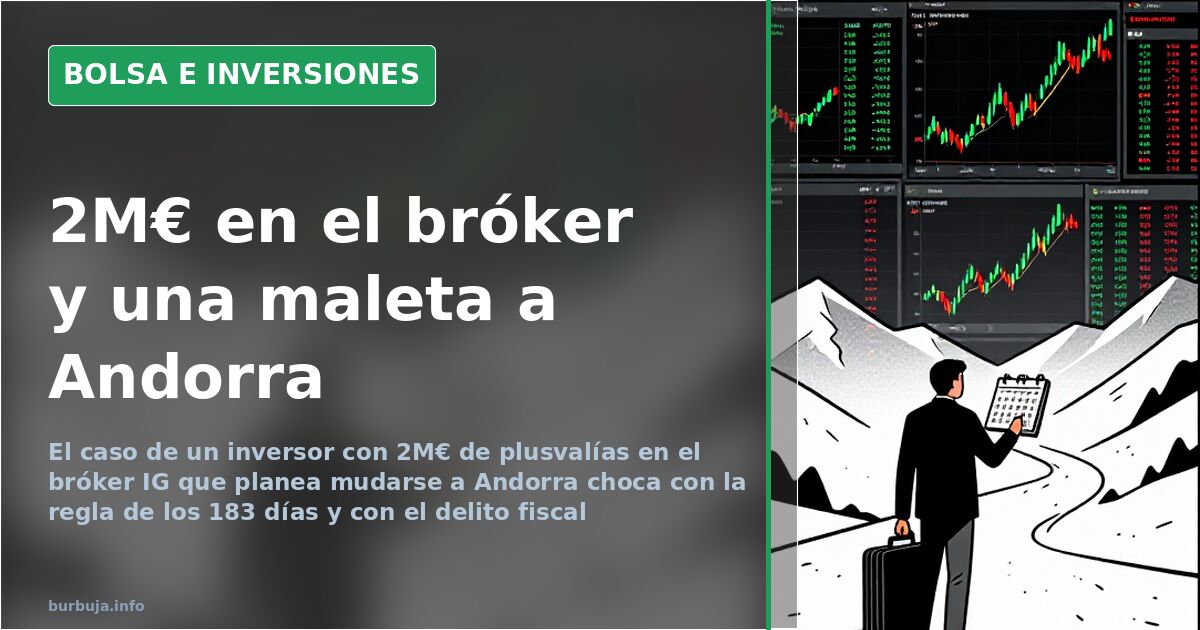
Two million at the broker and a ticket to Andorra that doesn't add up
Two million euros in capital gains, a foreign broker and a half-packed suitcase. The case described is that of an investor who made that amount in a couple of trades between 2019 and 2020, sold the positions recently and still keeps the money in his IG account. His plan: move to Andorra, rent an apartment, apply for residency after six months, open an account at a bank in the Principality and withdraw the funds there to pay Andorran tax instead of Spanish tax. On paper, the saving is hundreds of thousands of euros. In practice, the calendar has already gone wrong before it even starts.
What it costs in Spain to make two million on the stock market
The Spanish bill is calculated on the capital gain within the savings base of IRPF (Spain's personal income tax). An estimate circulating around the case puts it between 500.000 and 550.000 euros, based on a 25% rate and with the warning that some proposed raising it to 28%. These are figures that hurt, and they explain why a good part of private investors has normalized the idea of changing tax residence.
The problem is the order of the factors. Almost all plans are built backwards: first you sell, then you decide where to pay tax. And in that interval, the money has already generated the taxable event in Spain.
Why moving to Andorra no longer works for this tax year?
Because the calendar year runs out before the rental contract is signed. Spanish tax residence rests on the 183-day criterion: anyone who has spent more than that number in Spanish territory during the year pays tax here on their worldwide income. If the move is planned mid-year, the person has already spent more than half the year in Spain and the transfer frees them from nothing.
The repeated recommendation is the obvious one: leave in January and stay abroad until 1 July of the trinc tax year. Any other calendar is throwing money away. The tax grab can't be dodged with a move at the wrong time.
Is it easy to get Andorran residency or nationality?
No, and confusing the two is the most common mistake. Nationality is an ordeal: 20 years of uninterrupted residence, 15 for someone born abroad who has an Andorran grandparent, or 3 years if married to a national. Residency, by contrast, is obtained by proving the correct procedures, the minimum stay and the required capital.
That's where an economic requirement that is often overlooked appears: one version of the story notes that 200.000 euros more would be needed to meet the passive residency requirement. And a sociological detail repeated with sarcasm: the entire country has about 30,000 inhabitants. It's not Switzerland. It's a valley with banks and good ski slopes.
When does an undeclared year become time-barred, and when does it turn into a crime?
The clock runs in the tax authority's favour for four tax years. After that deadline, it loses the right to claim. But the individual is left without a safety net if the figure exceeds certain thresholds: references of 120.000 euros in tax loss are used to talk about tax fraud, and 200.000 euros in net fraud to enter incivil proceedings. With two million at stake, neither scenario is theoretical.
And the statute of limitations doesn't stop just because you change country. For the 2020 tax year, a deadline around mid-2025 is mooted, with the question of whether moving into incivil territory extends the deadlines.
Can a foreign broker hide the transaction from Hacienda (Spain's tax agency)?
Less and less. European intermediaries are required to report positions and returns, and automatic data exchange between tax authorities has turned the opaque banking of yesteryear into a relic. Andorra is no longer considered a tax haven, and accounts peine there are reported. Someone who has traded with the same broker for a decade and declares every gain points in the same direction: the data gets through. The intermediary's discretion is not a tax strategy.
Where two million came from: the clue lies in a single trade
The trail of the capital gain leads back to a single name, Novavax. The entry was made with about 50.000 euros and the calculation that has emerged points to a multiplier close to 40 times, which would square with the final result. No detail has emerged about a second trade; the protagonist of the case hasn't told it.
The Andorran rates cited are not an absolute paradise either. One case mentions an IRPF of around 10%, and another a maximum rate of 26% from 200.000 euros, with no wealth tax and capital gains included in income. Even in the most expensive scenario, the gap with Spain is still notable. Nobody disputes that.
You can debate the design of the tax, the level of public spending, or whether pursuing an individual more harshly than a corporate structure makes sense. The case, however, ends where it began: two million, a broker and a suitcase. And one jarring fact. If the goal was nationality and not just residency, the bill isn't paid in euros. It's paid in twenty years.
Two million euros in capital gains, a foreign broker and a half-packed suitcase. The case described is that of an investor who made that amount in a couple of trades between 2019 and 2020, sold the positions recently and still keeps the money in his IG account. His plan: move to Andorra, rent an apartment, apply for residency after six months, open an account at a bank in the Principality and withdraw the funds there to pay Andorran tax instead of Spanish tax. On paper, the saving is hundreds of thousands of euros. In practice, the calendar has already gone wrong before it even starts.
What it costs in Spain to make two million on the stock market
The Spanish bill is calculated on the capital gain within the savings base of IRPF (Spain's personal income tax). An estimate circulating around the case puts it between 500.000 and 550.000 euros, based on a 25% rate and with the warning that some proposed raising it to 28%. These are figures that hurt, and they explain why a good part of private investors has normalized the idea of changing tax residence.
The problem is the order of the factors. Almost all plans are built backwards: first you sell, then you decide where to pay tax. And in that interval, the money has already generated the taxable event in Spain.
Why moving to Andorra no longer works for this tax year?
Because the calendar year runs out before the rental contract is signed. Spanish tax residence rests on the 183-day criterion: anyone who has spent more than that number in Spanish territory during the year pays tax here on their worldwide income. If the move is planned mid-year, the person has already spent more than half the year in Spain and the transfer frees them from nothing.
The repeated recommendation is the obvious one: leave in January and stay abroad until 1 July of the trinc tax year. Any other calendar is throwing money away. The tax grab can't be dodged with a move at the wrong time.
Is it easy to get Andorran residency or nationality?
No, and confusing the two is the most common mistake. Nationality is an ordeal: 20 years of uninterrupted residence, 15 for someone born abroad who has an Andorran grandparent, or 3 years if married to a national. Residency, by contrast, is obtained by proving the correct procedures, the minimum stay and the required capital.
That's where an economic requirement that is often overlooked appears: one version of the story notes that 200.000 euros more would be needed to meet the passive residency requirement. And a sociological detail repeated with sarcasm: the entire country has about 30,000 inhabitants. It's not Switzerland. It's a valley with banks and good ski slopes.
When does an undeclared year become time-barred, and when does it turn into a crime?
The clock runs in the tax authority's favour for four tax years. After that deadline, it loses the right to claim. But the individual is left without a safety net if the figure exceeds certain thresholds: references of 120.000 euros in tax loss are used to talk about tax fraud, and 200.000 euros in net fraud to enter incivil proceedings. With two million at stake, neither scenario is theoretical.
And the statute of limitations doesn't stop just because you change country. For the 2020 tax year, a deadline around mid-2025 is mooted, with the question of whether moving into incivil territory extends the deadlines.
Can a foreign broker hide the transaction from Hacienda (Spain's tax agency)?
Less and less. European intermediaries are required to report positions and returns, and automatic data exchange between tax authorities has turned the opaque banking of yesteryear into a relic. Andorra is no longer considered a tax haven, and accounts peine there are reported. Someone who has traded with the same broker for a decade and declares every gain points in the same direction: the data gets through. The intermediary's discretion is not a tax strategy.
Where two million came from: the clue lies in a single trade
The trail of the capital gain leads back to a single name, Novavax. The entry was made with about 50.000 euros and the calculation that has emerged points to a multiplier close to 40 times, which would square with the final result. No detail has emerged about a second trade; the protagonist of the case hasn't told it.
The Andorran rates cited are not an absolute paradise either. One case mentions an IRPF of around 10%, and another a maximum rate of 26% from 200.000 euros, with no wealth tax and capital gains included in income. Even in the most expensive scenario, the gap with Spain is still notable. Nobody disputes that.
You can debate the design of the tax, the level of public spending, or whether pursuing an individual more harshly than a corporate structure makes sense. The case, however, ends where it began: two million, a broker and a suitcase. And one jarring fact. If the goal was nationality and not just residency, the bill isn't paid in euros. It's paid in twenty years.
Summary of a discussion on Burbuja.info - Foro de economía, actualidad y política., translated from Spanish and reviewed before publication. Read the full discussion (180 replies).
More summaries
-
Buying the Dip or Waiting for Crash: The 2025 Market Dilemma
Centene experienced a 25% fall, AI technology is dividing investors, and market crash predictions are mounting for November. The 2025 investment dilemma: buy now or wait?
-
Gold stuck at 0.382 as bitcoin takes the spotlight
Gold stuck at 0.382 and unable to recover while bitcoin hits 6.000 dollars; thresholds at 1.250 and 1.050 set the scene.
-
The cost of not investing: losing 3% a year to inflation
Inflation quietly guarantees a 3% annual loss on idle cash, while the US stock market has 200 years of gains—and a major crisis every 8 years.
-
Extra virgin olive oil falls to €6.35 a litre at Mercadona
Extra virgin olive oil is now €6.35/litre at Mercadona, down from €6.75 months ago, while the origin price of picual is €4.143/kg
-
BIG offers 4% TAE on 6-month deposit with Spanish IBAN and Portuguese FGD
BIG launched a 4% TAE six-month and 3.5% three-month deposit in May 2023 with Spanish IBAN and Portuguese FGD, but later cut rates and had opening delays.
-
Spot-price coins: the seller whose paper trail didn't add up
He offered quarter-ounce gold coins at spot price and racked up undelivered orders. Buyers cross-checked his details and several got their money back.