
Hamas Confirms Leader Ismail Haniyeh’s Death in Tehran
Hamas confirms leader Ismail Haniyeh was killed in a Tehran attack attributed to Israel during his official visit.
English · Original discussion in Spanish · Published
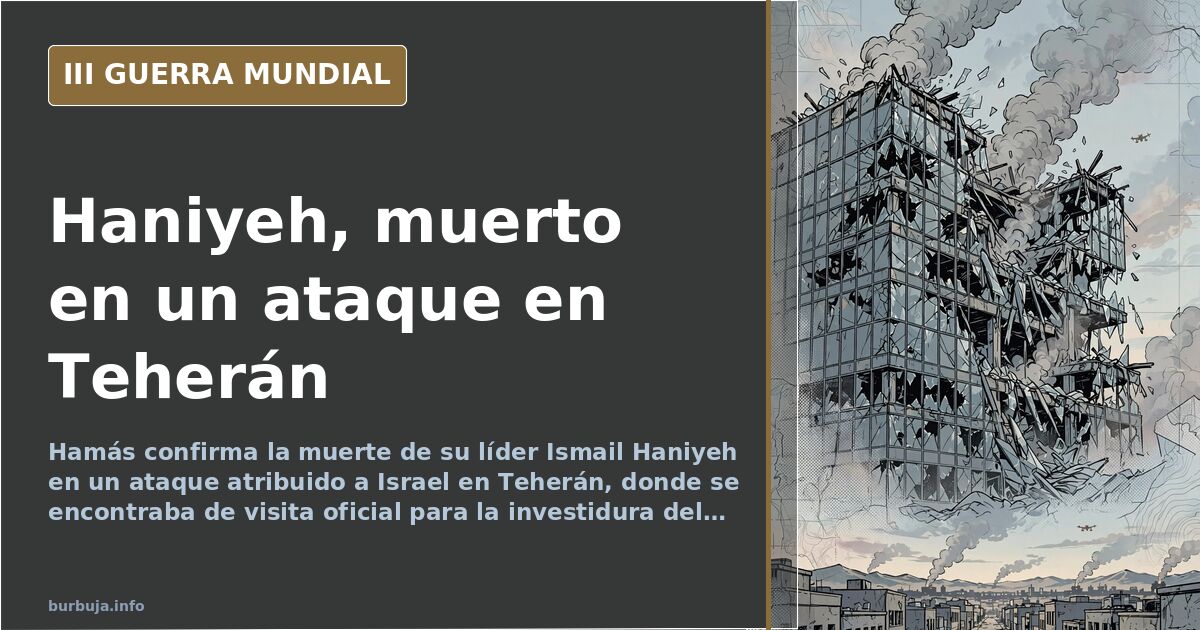
Hamas Leader Killed in Tehran in Attack Attributed to Israel
Hamas confirmed the death of its top leader, Ismail Haniyeh, in an attack attributed to Israel at his residence in Tehran, where he was attending the inauguration of Iran’s new president. The group described it as a “treacherous Zionist raid.” According to one participant, Haniyeh usually lived in Doha (Qatar) and had been outside Gaza for years, which did not prevent an operation that, according to early reports circulating online, was carried out by Israeli commandos inside Iranian territory.
The strike has both military and political implications. The military aspect is obvious: Israel hit a high-value target in the capital of its main regional enemy. The political side is murkier. As one participant summarized, “if that terrorist had stayed in Qatar, he could have continued leading the organization from the shadows without anyone touching him.” In other words, the location of the killing matters as much as the killing itself.
Attack Precision and Message to Iran
The attack was not indiscriminate bombing. Reports mention Israeli commandos operating in Tehran with “millimetric precision.” This sends an explicit message to Hamas leadership sheltered in Qatar and Turkey: “it doesn’t matter where you hide, Mossad never forgives or forgets.” Russian air defense systems deployed in Iran reportedly failed again, according to critical analyses, exposing the Iranian regime before its own allies.
Some argue Iran is deeply infiltrated or simply allowed it to happen. The hypothesis of collusion is not dismissible: Haniyeh could have been an obstacle to future agreements, and his death in Tehran weakens Hamas without direct cost to Qatar, which maintains its role as diplomatic intermediary. The calculation is cold but fits the region’s logic.
Who Was Haniyeh and Why Did He Live Outside Gaza?
Haniyeh was the political face of Hamas but had lived in Doha for years, with residences also in Tehran and Istanbul. Critics claim he lived lavishly on international donations. His immediate family was eliminated in previous attacks: first his sons and sons-in-law, then his grandchildren. The Tehran operation closed the circle.
That gap between rhetoric and biography is frequently highlighted. While Gaza’s population suffers war consequences, leaders traveled in private jets and luxury hotels. Haniyeh’s death does not change this structure: Hamas will still have an exiled leadership, and a replacement is likely already designated.
Diplomatic Consequences: Qatar, Turkey, and the Russian Axis
The attack in Tehran carries less diplomatic cost than one in Doha would have. Qatar is the “neutral Switzerland of the Persian Gulf” and a tacit partner of the Abraham Accords. Attacking there would have slapped Sunni monarchies. Iran, however, is a declared enemy with whom Israel has waged an undeclared war for years. The political price is low; the message is loud.
Russia condemned the elimination as an “unacceptable political assassination that will escalate tensions.” Some analysts see this as confirming the Moscow-Tehran-Hamas axis alignment. Iran’s response remains uncertain. The most probable scenario, according to available analyses, is symbolic retaliation: mass rallies, inflammatory rhetoric, and limited attacks against Israeli or US interests. Nothing that shifts the military balance.
Impact on Gaza War and Hamas Leadership
Haniyeh’s death will not stop the war. Hamas has a decentralized structure, and field commanders—Yahya Sinwar, Mohammed Deif—lead the fight in Gaza. Eliminating the exiled political leader is a symbolic and operational blow but does not decapitate the organization. It does complicate ceasefire negotiations: Haniyeh was a key interlocutor in talks mediated by Qatar and Egypt.
Israeli Prime Minister Benjamin Netanyahu promised all those responsible for October 7 would be eliminated. The Tehran operation is another piece of that strategy. Targets remain in Qatar, Turkey, and Lebanon. The question is not whether more attacks will occur, but when and at what diplomatic cost.
What comes next depends on Iran. If retaliation stays symbolic, Israel wins without paying a cost. If Tehran decides to truly escalate, the board gets complicated. With available data, the reasonable bet is that the Iranian regime saves face without risking open war. But in this region, reasonableness lasts little.
Hamas confirmed the death of its top leader, Ismail Haniyeh, in an attack attributed to Israel at his residence in Tehran, where he was attending the inauguration of Iran’s new president. The group described it as a “treacherous Zionist raid.” According to one participant, Haniyeh usually lived in Doha (Qatar) and had been outside Gaza for years, which did not prevent an operation that, according to early reports circulating online, was carried out by Israeli commandos inside Iranian territory.
The strike has both military and political implications. The military aspect is obvious: Israel hit a high-value target in the capital of its main regional enemy. The political side is murkier. As one participant summarized, “if that terrorist had stayed in Qatar, he could have continued leading the organization from the shadows without anyone touching him.” In other words, the location of the killing matters as much as the killing itself.
Attack Precision and Message to Iran
The attack was not indiscriminate bombing. Reports mention Israeli commandos operating in Tehran with “millimetric precision.” This sends an explicit message to Hamas leadership sheltered in Qatar and Turkey: “it doesn’t matter where you hide, Mossad never forgives or forgets.” Russian air defense systems deployed in Iran reportedly failed again, according to critical analyses, exposing the Iranian regime before its own allies.
Some argue Iran is deeply infiltrated or simply allowed it to happen. The hypothesis of collusion is not dismissible: Haniyeh could have been an obstacle to future agreements, and his death in Tehran weakens Hamas without direct cost to Qatar, which maintains its role as diplomatic intermediary. The calculation is cold but fits the region’s logic.
Who Was Haniyeh and Why Did He Live Outside Gaza?
Haniyeh was the political face of Hamas but had lived in Doha for years, with residences also in Tehran and Istanbul. Critics claim he lived lavishly on international donations. His immediate family was eliminated in previous attacks: first his sons and sons-in-law, then his grandchildren. The Tehran operation closed the circle.
That gap between rhetoric and biography is frequently highlighted. While Gaza’s population suffers war consequences, leaders traveled in private jets and luxury hotels. Haniyeh’s death does not change this structure: Hamas will still have an exiled leadership, and a replacement is likely already designated.
Diplomatic Consequences: Qatar, Turkey, and the Russian Axis
The attack in Tehran carries less diplomatic cost than one in Doha would have. Qatar is the “neutral Switzerland of the Persian Gulf” and a tacit partner of the Abraham Accords. Attacking there would have slapped Sunni monarchies. Iran, however, is a declared enemy with whom Israel has waged an undeclared war for years. The political price is low; the message is loud.
Russia condemned the elimination as an “unacceptable political assassination that will escalate tensions.” Some analysts see this as confirming the Moscow-Tehran-Hamas axis alignment. Iran’s response remains uncertain. The most probable scenario, according to available analyses, is symbolic retaliation: mass rallies, inflammatory rhetoric, and limited attacks against Israeli or US interests. Nothing that shifts the military balance.
Impact on Gaza War and Hamas Leadership
Haniyeh’s death will not stop the war. Hamas has a decentralized structure, and field commanders—Yahya Sinwar, Mohammed Deif—lead the fight in Gaza. Eliminating the exiled political leader is a symbolic and operational blow but does not decapitate the organization. It does complicate ceasefire negotiations: Haniyeh was a key interlocutor in talks mediated by Qatar and Egypt.
Israeli Prime Minister Benjamin Netanyahu promised all those responsible for October 7 would be eliminated. The Tehran operation is another piece of that strategy. Targets remain in Qatar, Turkey, and Lebanon. The question is not whether more attacks will occur, but when and at what diplomatic cost.
What comes next depends on Iran. If retaliation stays symbolic, Israel wins without paying a cost. If Tehran decides to truly escalate, the board gets complicated. With available data, the reasonable bet is that the Iranian regime saves face without risking open war. But in this region, reasonableness lasts little.
Summary of a discussion on Burbuja.info - Foro de economía, actualidad y política., translated from Spanish and reviewed before publication. Read the full discussion (179 replies).
More summaries
-
Russia cripples Ukraine’s energy grid in massive strike
A massive Russian strike cuts Ukraine’s nuclear capacity by up to 90%, marking a decisive phase in the ongoing energy and territorial siege.
-
G7 rejects Russian gas ruble payments
The G7 refuses to pay for Russian gas in rubles, while Moscow threatens to cut supplies with a March 31 deadline.
-
Forum user estimates Kiev siege requires five attackers per defender
A forum calculation suggests Kiev would need five attackers per defender, citing Berlin and Fallujah as benchmarks.
-
Migrant shelter breakfast sparks debate on public spending
A migrant shelter serving potatoes and fruit reignites the dispute over public spending, pull factors, and wages in Spain.
-
Metsola: Ukraine will win, EU to lead global order
Metsola says Ukraine will win and the EU will lead world order. Public debate focuses on gas prices and winter bills.
-
Reports claim 400 Russian soldiers surrendered in Vovchansk
Viral claims state 400 Russian troops surrendered in Vovchansk and that the offensive from Belgorod has failed.