
Ham leg: you pay meat prices for bone and fat
An 8 kg ham leg yields just 5 kg of meat: 40% bone and fat is paid at ham prices. Sliced ham costs 59% more than a whole piece.
English · Original discussion in Spanish · Published
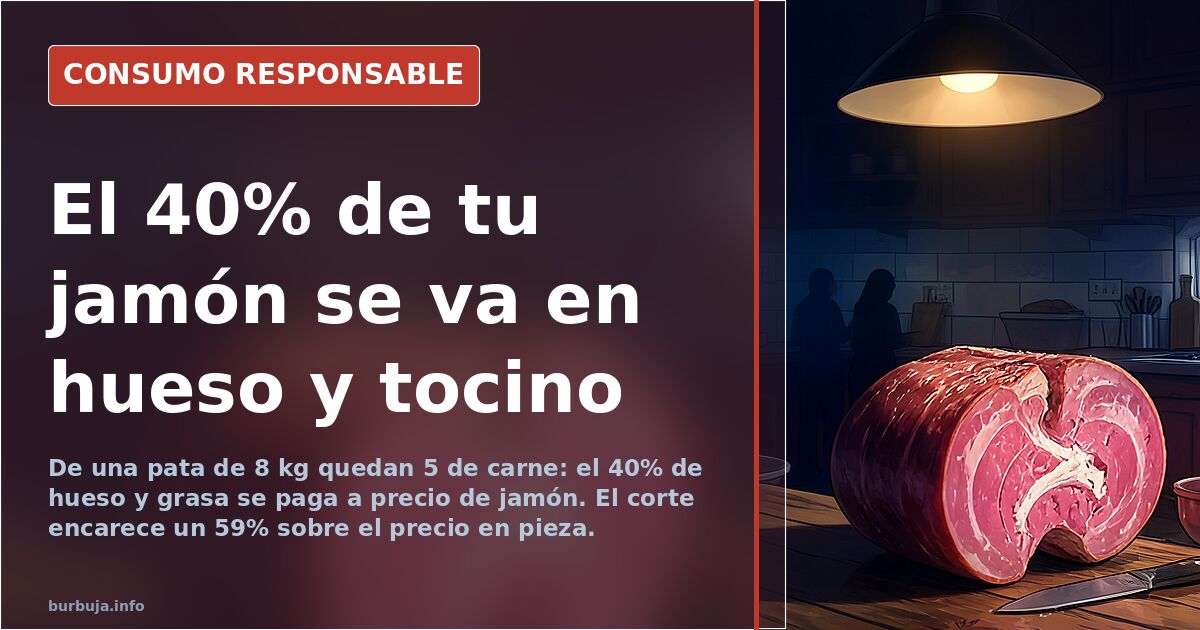
40% of a ham leg is bone and fat that you pay for at meat prices
Buying a whole ham leg to enjoy at home sounds like the ultimate household saving. Until you do the real maths: from an 8-kilo piece, once you subtract the bone and excess fat, only about 5 kilos of usable meat remain. A 40% loss that is paid at the same price as the prime cuts. The question that opens this debate is far from trivial: is a whole leg worth it, or is it cheaper to buy it sliced at the deli counter?
The answer depends on three variables that are rarely calculated together: how many people live in the household, how often it is eaten, and what is done with the parts that are not meat. Because the bone, the fat and even the rind can be used —for broths, stews, even soap— but only if you make the effort.
How many people it takes to finish off a whole ham
The most common estimate puts the threshold at 8-10 diners for a whole leg to make sense as long-term household consumption, provided it is carved in batches over several weeks. For a single-sitting ham antiestéticast as the main course, the range rises to 20-25 people; as a wedding starter, a medium ham serves around 50. Some claim three hearty eaters can polish off a ham on their own, though these are acknowledged as rare cases.
The problem arises when the leg is left abandoned in the kitchen. Without carving skills, slices turn into chunks and the ham dries out. Many people buy a leg with enthusiasm and end up with an expensive piece of furniture taking up space on the counter.
The real extra cost of buying it sliced
Here comes the paradox that dismantles the saving argument. At a supermarket, a well-known acorn-fed ibérico brand sells at €99/kg as a whole piece, but €159/kg sliced. That is 59% above the base price which, once the 40% loss is factored in, works out at roughly a 20% extra cost: about 20 euros more for every kilo carved. The deli counter charges for convenience and for the risk of opening a leg that may not turn out well.
By comparison, deboning and vacuum-packing a lower-range piece runs at €92/kg, but it is not comparable: machine slicing alters texture and flavour, and defenders of the original product do not consider it the same food. The slicer blade burns part of the fat and changes the taste profile. For purists, the ritual of hand carving is part of the product.
What to do with the bone, the fat and the rind
The part that gets thrown away can be cooked too. The bone goes into broth, the fat is frozen in chunks and brought out for stews, and the fried rind works as a snack. Some even save the trotter for the dog. Logistics matter: cut bones keep well in the freezer and allow the investment to stretch over months.
The full calculation, with the breakdown of losses, price per usable kilo and use of by-products, produces figures that surprise anyone who only looks at the shelf label. The cheap supermarket leg, the one under 40 euros for 6 or 7 kilos, is a different league: good for getting by, not for showing off your palate.
The trick of the ham that ends up being returned
Among the tricks that circulate, one borders on abuse: buying the leg at a supermarket, keeping the receipt along with the trimmed skin and fat, eating what you fancy and returning the rest claiming you did not like it. The store weighs what is left —waste included— and refunds the proportional amount. The result is paying only for the meat and not the bone. Legally questionable, ethically worse.
The question remains open: is the whole leg worth it, or does the deli counter take the best part?
Also available in: Deutsch
Summary of a discussion on Burbuja.info - Foro de economía, actualidad y política., translated from Spanish and reviewed before publication. Read the full discussion (36 replies).
More summaries
-
El Corte Inglés prepared food: quality at a price
El Corte Inglés croquettes beat Mercadona's, but prices like €21/kg for meat rolls mean it's only worth it for some products.
-
Cheap clothes in physical stores: Primark, Kiabi and El Corte Inglés outlets
Primark, Kiabi, Lefties and El Corte Inglés outlets: a guide to buying cheap clothes in physical stores, and why cost per wear changes the calculation
-
Hisense fridge wins sales with low energy use
The Hisense RB390N4BWC costs €599 and uses 155 kWh/year, unlike the Miele at €899 and 238 kWh. Durability remains uncertain.
-
Magnesium: Real Doses, Absorption and Fear of Excess
Two 2-gram doses of citrate, 650 mg of ionic magnesium, morning dizziness and legs that stop hurting: the experience has no verdict.
-
Poland as a migration destination: boom meets saturation
Poland is no longer the cheap destination it once was: inflation, expensive housing and low wages for newcomers. Advice from those who have tried it.
-
Replacing aluminium windows with PVC: €6,000 and a 0.2 U-value gain
Going from a U-value of 3.3 to 1.5 costs €6,000; dropping to 1.3 adds another €500. The home's energy certificate points to walls and roof before windows.