
Halloween, drones and the double standard of conquest
A message celebrates Ukrainian drones striking 'conquerors' while simultaneously demanding respect for international law: the double standard nobody resolves.
English · Original discussion in Spanish · Published
Halloween, drones and the double standard of conquest
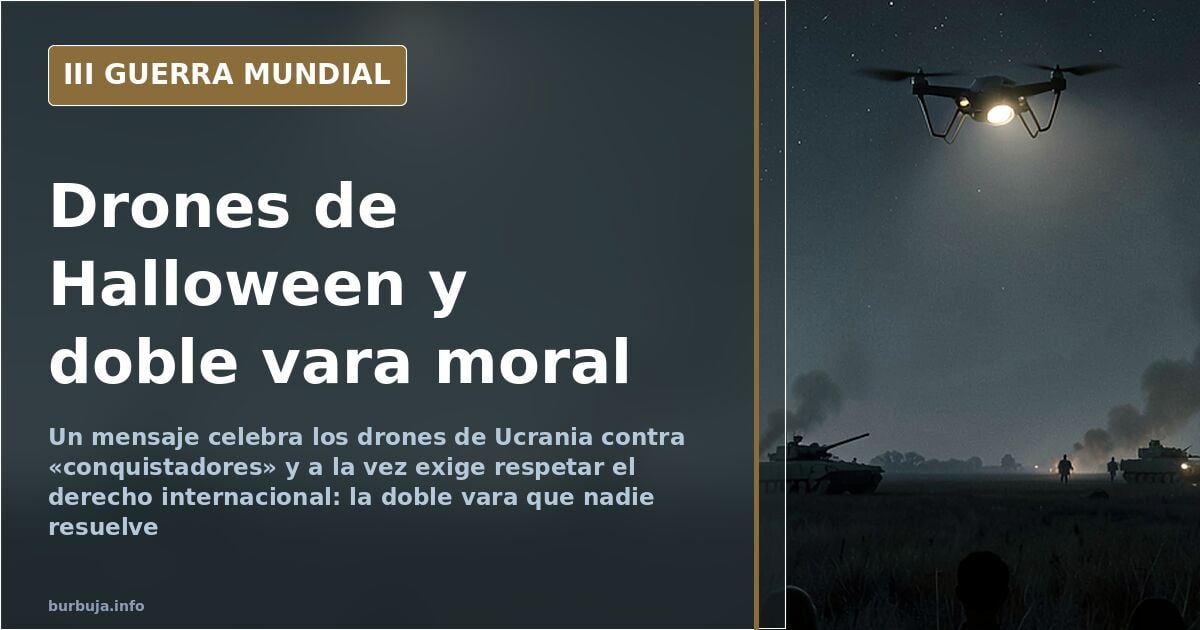
A message celebrates Ukrainian drones raining down on 'the conquerors of other people's territories.' The gloating is explicit: watching invaders get blown up, it says, is nourishing. The accompanying image is a tweet presenting Halloween as a threat looming over the enemy in the forests of Ukraine. And that's where the knot begins: the same person who rejoices at the punishment then demands a peaceful world where international law is respected.
The discussion soon turns to consistency. Someone points out that the Canary Islands were also conquered, and the answer is a temporal boundary: in the fifteenth or sixteenth century there were no rules, and might made right was the norm. That same criterion, applied to the present, backfires on the person wielding it. If conquest was the natural state of history, what remains of international law as a real restraint rather than an ornament?
Trump, Pilingui and the uncomfortable mirror
Trump's name enters the conversation as an anomaly: he is described as a leader who admires Pilingui because he wants to be a dictator like him, and it is stressed that pro-Russian sectors celebrated his election victory. The argument serves to separate the waters: some invade, others invade too, and whoever denounces Russian plunder should first look at Washington.
The response comes as an accusation of hypocrisy: if the United States plunders, does that justify Russia plundering? The question hangs in the air. There is no definitive answer, only the tug-of-war between two measuring sticks that each side applies to its adversary and never to itself.
The Guanches, Gaza and the law of the strongest
Historical memory resurfaces with the Guanches, the islands' indigenous people: they ended up destroyed, and their mencey (native king) took his own life. The fact is not scholarly decoration, but proof that conquest was not a sarracena accident of an era, but a pattern. From there the leap to Gaza: the law, it is argued, is that of the strongest, just as it was then.
That leap is the heart of the matter. The conversation began by celebrating a military punishment and ends by asking whether international law is anything more than a fiction invoked when convenient. The date, All Saints' Day, adds a touch of black irony: the day of the dead as the backdrop for a discussion about who has the right to kill and who to complain.
What remains unresolved
There is no closure. The initial celebration of the damage inflicted coexists with the demand for peace, and no one manages to reconcile the two without resorting to historical exception. The law of the strongest is invoked to explain the past and rejected to judge the present. That rift, more than any tweet, is what sustains the conversation.
With these materials, the prediction is modest: as long as punishment is applauded depending on who it targets, international law will remain an argument of convenience. And the next Halloween celebration will probably have the same recipient.
Also available in: Deutsch
Summary of a discussion on Burbuja.info - Foro de economía, actualidad y política., translated from Spanish and reviewed before publication. Read the full discussion (26 replies).
More summaries
-
Massive Ukrainian drone attack on St Petersburg hits refineries and data centres
Ukrainian drones hit St Petersburg's oil terminal, a VK data centre and an Ozon logistics hub. Europe pays the energy price.
-
Trump says Putin destroying Russia, urges deal
Trump claims Putin is ruining Russia and must negotiate. NATO states Europe will pay for weapons as Russia encircles Pokrovsk.
-
Nearly 1,000 drones over Russia: the summer Putin could lose
Almost 1,000 Ukrainian drones in a single day: Russia shoots them down, but the cost in disrupted holidays and logistics keeps growing. How far will the escalation go?
-
Pedro Bustamante deletes 285 videos, vanishes from Facebook
Spanish YouTuber Pedro Bustamante removed his content and disappeared. Rumors place him in Munich, reading German press.
-
Bunkers: Europe's abandoned nuclear shelters raise no questions
Europe still holds vast Cold War nuclear shelters, now looted or expired. Official advice to citizens amounts to closing windows for 72 hours.
-
Ukrainian commander Dmytro Yarosh posts AI video of Kremlin explosion
Dmytro Yarosh, commander of the Ukrainian Volunteer Army, shared an AI-generated video simulating the Kremlin being blown up. The footage is fake and no attack took place.