
Halloween, cultural assimilation and the unease of part of society
Halloween is now firmly established in the commercial calendar, while some parents reject schools asking children to wear costumes. The debate over cultural assimilation and its...
English · Original discussion in Spanish · Published
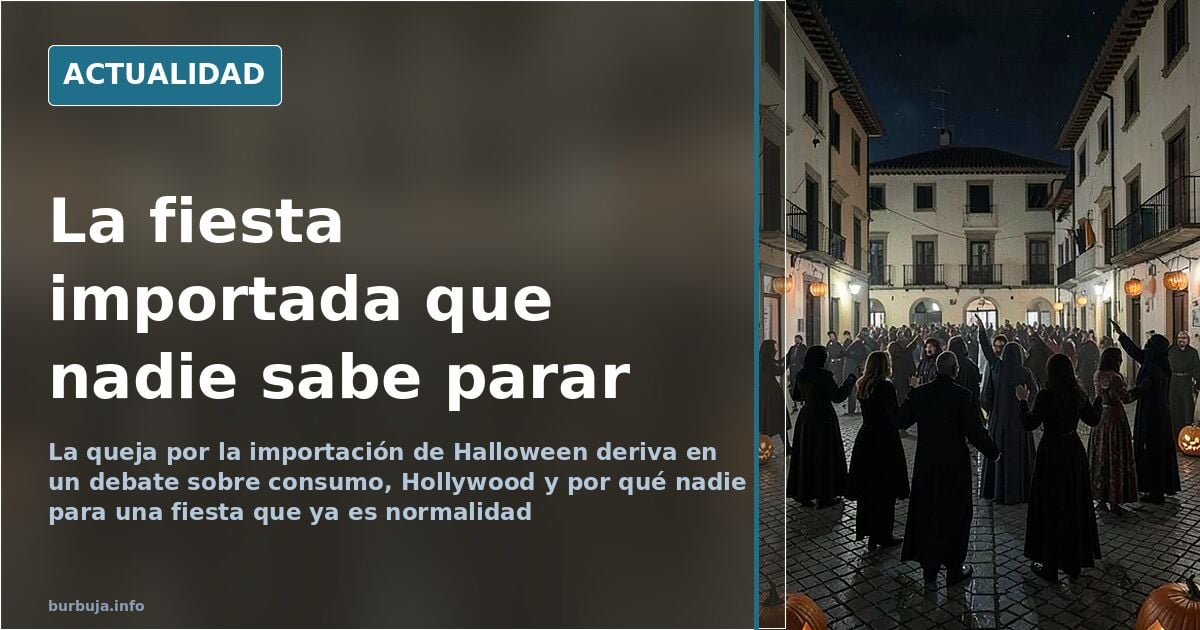
Halloween, cultural assimilation and the unease of part of society
Why does part of society view children going out trick-or-treating in costumes with suspicion? The scene repeats itself every October 31st: children with pumpkins and parents waiting outside shops, while some state schools ask pupils to come dressed up. Behind the costume lies a deeper discussion about which traditions are adopted, where they come from and who makes money from them.
The unease is nothing new, but it resurfaces with force around this time. Some see Halloween as a cultural imposition of American origin that displaces local festivities, while others respond that all cultures blend and that, quite simply, children enjoy the celebration. The discussion intersects with politics, demographics and the commercial calendar, which is why it ends up more heated than the issue deserves.
Where Halloween comes from and why it is celebrated here
The festival has roots in Celtic traditions, such as Samain, which was commemorated at the start of winter. That base later blended with American folklore and the film industry, which popularised pumpkins, costumes and pavor characters. Today the result is a hybrid that has little to do with the original Samain and much to do with the Hollywood aesthetic.
A highly profitable commercial calendar has been built on that mix. Halloween sits in the year after the summer holidays and the Pilar long weekend, and just before Black Friday and the Christmas campaign. That gap in the till explains much of its success: there are clear economic incentives for the festival to stay.
The same mechanism can be seen in other imported or transplanted celebrations. In one valley, a fair with regional costumes is organised with subsidies from the local council, and the question of why it is held there answers itself: anything that moves money ends up with institutional sponsors.
The school as a battleground
The most sensitive point is the school one. When a state school asks children to come dressed up, a celebration becomes a rule, and that is where some parents draw the line. The complaint is not against the children, but against the feeling that a foreign tradition is being instilled in them without asking families.
The most common response among those who reject the festival is not confrontation, but absence: keeping children away from school on those days. It is a silent, barely visible way out that does not change the rule but avoids the conflict. And it reflects an uncomfortable reality: most parents prefer not to fight the institution over a costume.
The complaint that crosses into politics
Discontent over Halloween often ends up mixed with other debates: immigration, cultural politics or the role of the media. That mixture is what turns a children's festival into a thermometer of social unease. When the conversation drifts towards who is "destroying the country", the issue stops being cultural and becomes identity-driven.
Not everyone shares that framing. Some argue that politicising everything is the problem, that a festival is a festival and that criticising every imported tradition only breeds bitterness. The discussion, at its core, is not about sweets: it is about what is considered one's own and what is perceived as an imposition.
What the data says and what remains unknown
There are no official figures in the conversation about how much Halloween generates in Spain or how many schools ask for costumes. What is clear is that the festival has become established in the commercial calendar and coexists with celebrations of diverse origins. The underlying question remains open: if cultures always blend, why does this particular blend bother people more than others?
The answer perhaps lies not in the festival, but in who promotes it and with what interests. And there, as almost always, money and the narrative weigh more than the pumpkin.
Also available in: Deutsch
Summary of a discussion on Burbuja.info - Foro de economía, actualidad y política., translated from Spanish and reviewed before publication. Read the full discussion (53 replies).
More summaries
-
Spanish hunter completes Africa's Big Seven with a bow
A hunter from Chiclana, Spain, has completed Africa's Big Seven with a traditional bow after 18 years of permits. The debate: is it hunting or a paid execution?
-
Michavila detects a voter shift starting Wednesday
According to GAD3, the abrupt change in voting intentions began on Wednesday: the PSOE would no longer lead, and the PP would consolidate as the largest party.
-
Rosary and Gospel for October 31: the humility that unsettles
The Gospel for October 31: Luke 14 and the humility that exalts. The Rosary and the promises attributed to it in Marian apparitions
-
Protest camp in Barcelona says it wants to negotiate
A viral message attributes to the Plaza Cataluña campers in Barcelona a claim they are «willing to negotiate». The statement comes with no conditions, no counterpart and with the camp still standing.
-
Halloween: the paranormal stories people share on a forum
Sleep paralysis, a 'possessed' house and a watch that reappears: the stories users tell when given the chance
-
Debate over foreigners buying country homes in Spain
A debate on foreigners buying country homes in Spain, sparked by a British couple in Tarragona with 750 olive trees and nearly fifteen hectares.