
Rosary and Gospel for October 31: the humility that unsettles
The Gospel for October 31: Luke 14 and the humility that exalts. The Rosary and the promises attributed to it in Marian apparitions
English · Original discussion in Spanish · Published
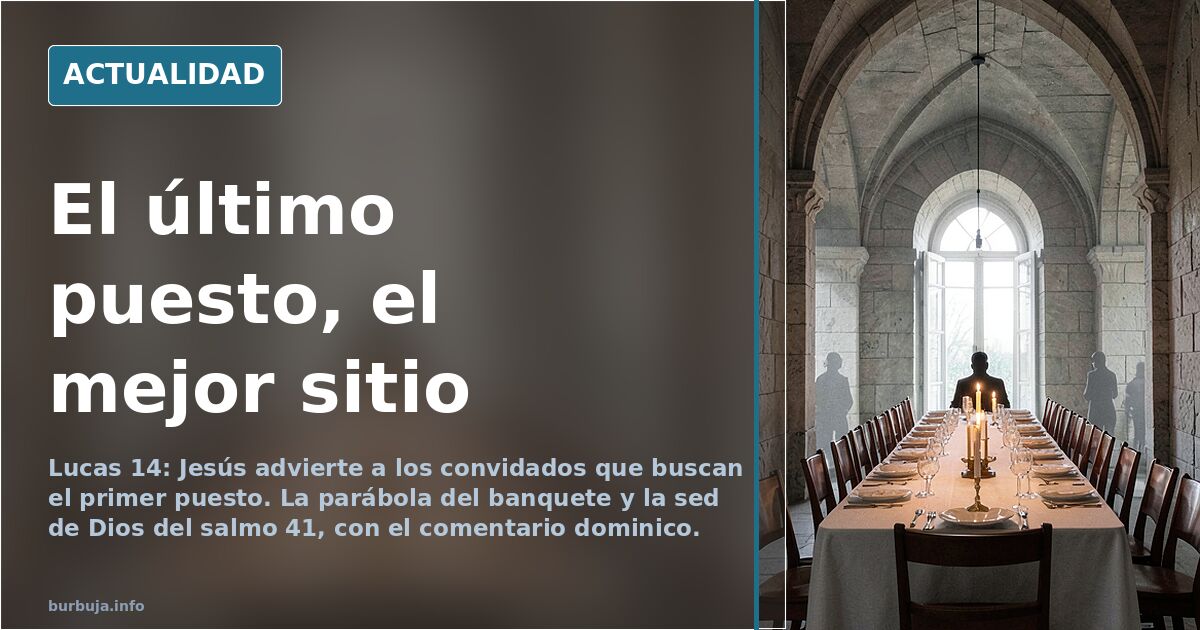
Holy Rosary and Gospel for October 31: humility as a rarity
Saturday, October 31. The Catholic liturgy opens the day with a paradox that has not aged: the Gospel of Luke 14, 1. 7-11 places Jesus at the home of a leading Pharisee, watching how the guests fight over the seats of honor. The conclusion, "everyone who exalts himself will be humbled, and the one who humbles himself will be exalted," remains the hard nut no self-help manual can sustancia ilegal. The opening message of the thread announces the praying of the Holy Rosary. In between, the first reading from Philippians 1, 18b-26 and Psalm 42 —"My soul thirsts for the living God"— hold up the framework of a day that, on paper, is no news at all.
Paul, in prison, makes the most uncomfortable calculation in the New Testament. "For me, to live is Christ and to die is gain," he writes to the Philippians. It is not cheap martyr rhetoric: he is imprisoned and knows a verdict may come out of it. Even so, he stays. "I know that I shall remain in this life, for it is more necessary for you," he adds. The day's Sunday reflection translates it without anesthesia: like Saint Martin of Tours, "Lord, if your people still need me, I do not refuse to keep working." Service as mission, not as posturing.
What does the Rosary promise, and what can be verified?
The message accompanying the prayer lists the so-called promises of the Rosary attributed to Marian apparitions: protection, special graces, deliverance from purgatory for those who pray it devoutly, obtaining "everything you ask of me." Fifteen promises in total, some so sweeping that any financial auditor would ask for the fine print. The most quoted: "The soul that entrusts itself to me through the Rosary shall not perish." The most practical: "Those who propagate my Rosary shall be assisted by me in their needs."
It is worth separating the data from the story. That the Rosary is a widespread practice with centuries of history is a fact; that these promises are fulfilled is a matter of faith, not statistics. The text presents them as revelations, not as verified results. Anyone looking for a correlation between praying the Rosary and a life without misfortunes will not find it in any record.
The Dominicans' commentary: the temptation of the best seat
Fray Carlos Oloriz Larragueta, from the Convent of the Virgen del Camino (León), signs the day's reflection and does not soften the diagnosis: "Like all of us, Jesus experienced the temptation of choosing the best seat." The difference, he points out, is that he overcame it. "He emptied himself, taking the form of a slave," he recalls, quoting Paul. And he closes with an observation that is more sociology than theology: what historical figure has as many trinc as Jesus, twenty centuries after his death?
The text cuts off right there, at the comparison. The question is left hanging with no closed answer. It is the exact point where the analysis stalls: humility as an evangelical virtue collides head-on with a culture that rewards the shop window. The Gospel itself says it plainly: the one who takes the lowest seat and is then called to move up "will be honored in the presence of all who are at the table." It is not pure humility; it is strategy with a reward.
The full day: the psalm, Philippians and the Chaplet
Psalm 42 opens with the image that titles the day: "As the deer longs for streams of water, so my soul longs for you, my God." The first reading from Philippians insists on Paul's joy despite his imprisonment: "Whether in pretense or in truth, Christ is proclaimed, and I rejoice." The Chaplet of Divine Mercy is recommended at 3.00 p.m., "the hour of Mercy."
The liturgical package is completed with the saints of the day, the homily by Father Santiago Martín and the apophthegms of the Desert Fathers, that alphabetical collection compiled by the Jesuit Heribert Rosweyde in the seventeenth century and translated into French by Guy, Regnault and the monks of Solesmes. Material from centuries ago, with no expiration date.
The day ends where it began: with the Rosary. Fifteen promises, a psalm with thirst and a Pharisee learning to sit in the back. Humility, says the Gospel, pays off handsomely. What remains to be seen is who keeps count.
Also available in: Deutsch
Summary of a discussion on Burbuja.info - Foro de economía, actualidad y política., translated from Spanish and reviewed before publication. Read the full discussion (19 replies).
More summaries
-
June 4 Gospel: the faith that never gives up, according to St Paul
The second letter to Timothy, Father Santiago Martín's homily and the praying of the rosary mark June 4 for Catholics.
-
Holy Rosary and Gospel for October 10: "You are of Christ"
The Gospel for Saturday, October 10: Luke 11, 27-28 and the promises of the Rosary, with a prayer gathering called from Lourdes in Spanish.
-
Queen Letizia, 'Caught' on a Yacht: The Rumor That Doesn't Hold Up
The media outlet El Nacional claims Queen Letizia was on a yacht with another man. Photos only show her alone and are old. Hoax or reality?
-
Protest camp in Barcelona says it wants to negotiate
A viral message attributes to the Plaza Cataluña campers in Barcelona a claim they are «willing to negotiate». The statement comes with no conditions, no counterpart and with the camp still standing.
-
Halloween: the paranormal stories people share on a forum
Sleep paralysis, a 'possessed' house and a watch that reappears: the stories users tell when given the chance
-
Debate over foreigners buying country homes in Spain
A debate on foreigners buying country homes in Spain, sparked by a British couple in Tarragona with 750 olive trees and nearly fifteen hectares.