
Debate over foreigners buying country homes in Spain
A debate on foreigners buying country homes in Spain, sparked by a British couple in Tarragona with 750 olive trees and nearly fifteen hectares.
English · Original discussion in Spanish · Published
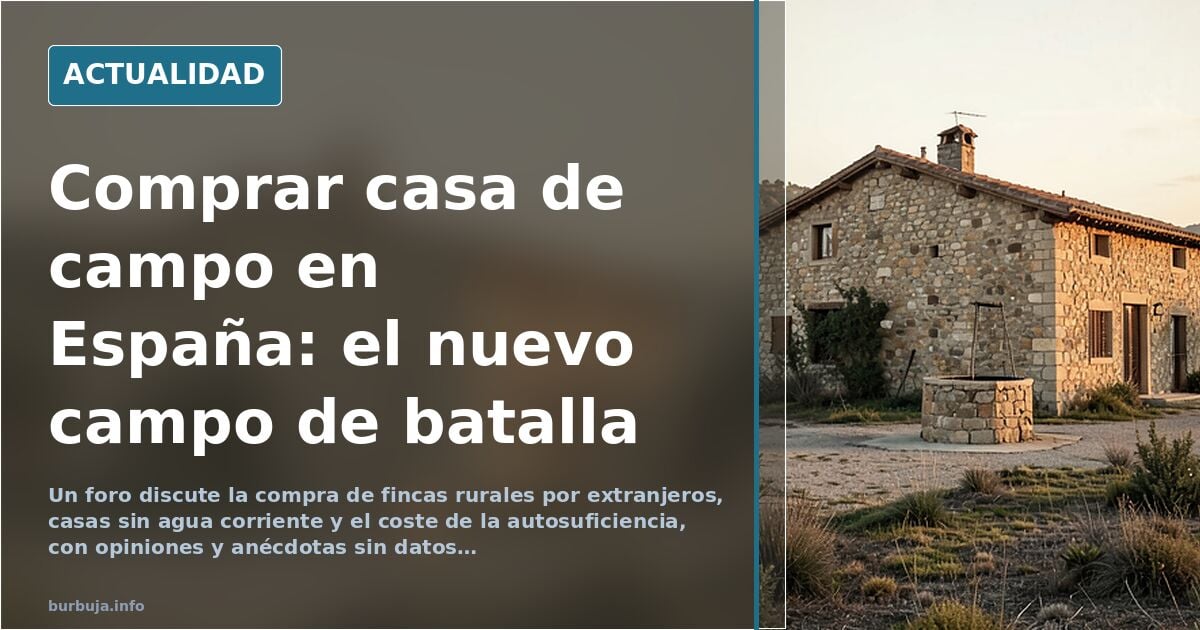
Foreigners buying country homes in Spain: between overcrowding and rural renewal
The purchase of rural property by foreigners has become a phenomenon that divides opinion. While some denounce overcrowding and rising prices, others see an opportunity to revitalise depopulated areas. The story of a British couple who settled in Tarragona aged 24 and 26, bought nearly fifteen hectares and 750 olive trees, and now live with two children, three dogs, two cats, a tortoise and nine hens, has reignited the debate: invasion or generational renewal?
The price of self-sufficiency
Seeking a life disconnected from the system comes at a cost. The British couple came to Spain with the idea of escaping the daily grind and creating a self-sufficient commune. They found their paradise in a stone farmhouse with olive, almond and pomegranate trees. But rural life is not idyllic: according to one post in the thread, the house has no running water and they have to haul it in by tractor. Moreover, according to that same post, they have wrecked the car's sump seven times in a year, which shows how hard it is to adapt to the environment.
The tension between depopulation and overcrowding
The phenomenon is nothing new. In rural areas, the arrival of foreigners with greater purchasing power (pounds, in this case) can inflate prices and push out locals, some participants argue. However, others maintain that these new residents help keep services and schools running in villages that would otherwise disappear. The key lies in balance: is this a peaceful takeover or economic colonisation?
The debate over foreign ownership
Some voices are calling for restrictions on foreigners buying land and national capital. They argue that land is a limited resource and that its mass sale to foreigners could jeopardise food sovereignty and territorial cohesion. Others, however, defend market freedom and point out that most of these buyers are Europeans seeking a lifestyle change, not a speculative investment.
The reality of those who leave
Not everyone who arrives stays. According to one post in the thread, many renovate country houses and, after a while, get bored or fail to adapt and return to their home countries. This churn leaves behind a trail of renovated properties and, at times, failed projects. The British couple's experience is an example of persistence, but also of the difficulties of a way of life that demands more than romanticism.
Conclusion: a phenomenon with lights and shadows
Foreigners buying country homes is neither an invasion nor a magic solution. It is a complex process that mixes opportunities for revitalisation with risks of speculation and loss of identity. The debate remains open and, in the meantime, Spanish estates keep changing hands.
Also available in: Deutsch
Summary of a discussion on Burbuja.info - Foro de economía, actualidad y política., translated from Spanish and reviewed before publication. Read the full discussion (14 replies).
More summaries
-
UK tells households to prepare for 72 hours without power or internet
London recommends canned food, water and cash for 72 hours without power or internet. The Pentagon is already hardening its bases for 90 days without supplies.
-
15-year-old arrested in the UK over image of a councillor as a rabbit
A 15-year-old boy was arrested in the West Midlands, with fingerprints, a mugshot and DNA taken, for posting an image of a councillor as a rabbit on Facebook.
-
Belgium also letting migrant boats head for the UK, video shows
A photographer films a migrant boat leaving a Belgian beach for the UK on 29 October 2026, with police present. What is the border doing?
-
PP Mocks Puente’s Pain After Quad Injury, Sparking Political Row
A Spanish PP tweet mocking Transport Minister Óscar Puente’s injury sparks controversy ahead of regional elections, highlighting the fine line between political criticism and spectacle.
-
Halloween: the paranormal stories people share on a forum
Sleep paralysis, a 'possessed' house and a watch that reappears: the stories users tell when given the chance
-
Latinos who voted for Trump now face the deportations they backed
Víctor Martínez, editor of Politics en Español, describes an immigration crackdown hitting Hispanics with temporary status or pending legalization. Read the full analysis.