
Spanish hunter completes Africa's Big Seven with a bow
A hunter from Chiclana, Spain, has completed Africa's Big Seven with a traditional bow after 18 years of permits. The debate: is it hunting or a paid execution?
English · Original discussion in Spanish · Published
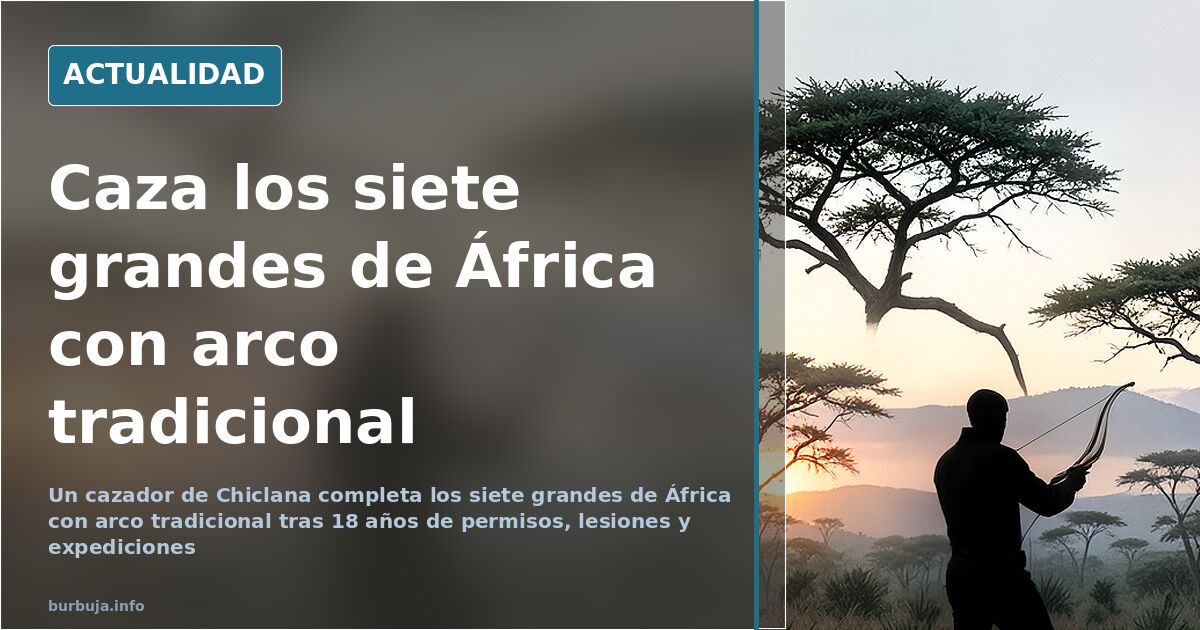
A hunter from Chiclana completes Africa's Big Seven with a bow
Can you kill an elephant with an arrow? Yes, and a resident of Chiclana de la Frontera (Cádiz) has been proving it since 2007. Julián Ramírez de Arellano has become, according to the specialist publication Jara y Sedal, the first man in the world to bring down the so-called "Big Seven of Africa" —lion, elephant, buffalo, rhinoceros, hippopotamus, leopard and crocodile— using only a traditional bow, with no assisted aiming systems. The last two animals, the hippopotamus and the leopard, fell in August 2025, although the antiestéticat has only now been made public.
The news has peine a can of worms that won't close on its own. The sporting achievement coexists with an uncomfortable question: how much of this is hunting, and how much is a scheduled execution?
Eighteen years of permits, injuries and a pandemic
The challenge began in 2007. Two years later, the adventure was already appearing in the pages of the Diario de Cádiz, and at that point the hunter still had three species to go to complete the set. Since then, according to the published account, there have been **18 years of legal paperwork** to obtain special permits, physical injuries, the pandemic and various personal circumstances. A pile of obstacles that forced the challenge to be split into several stages.
The technical detail is no small matter: killing a multi-ton animal with an arrow requires getting far closer than a rifle allows. Death from an arrow does not come from hydrostatic shock as with bullets, but from **hypovolemic shock** combined with trauma to a vital organ. It is not by default a clean death, and whoever delivers it assumes considerable physical risk. That is why the conversation quickly turns to logistical support: the archer carries the bow, but behind him there are usually guides, vehicles and personnel armed with large calibers covering his back.
Is it hunting or an execution with a bill?
This is where opinions split. One camp holds that what happens in these reserves looks more like **killing in a slaughterhouse** than going hunting: the animal is located, sometimes tagged with microchips and GPS, and the hunter pays a sum that, according to a calculation circulating on the forum, can run to around 100,000 dollars for an elephant. Under that logic, the merit evaporates: there is no real stalking, just a contracted service.
The rebuttal comes from the other side. Safaris of any substance cost serious money and need to guarantee safety and efficiency: nobody organizes an expedition from which ten set out and four return. Industry professionals know the dangers of big game hunting and never take their eyes off the encounter. And on the ground, defenders of the model argue that hunting fees finance the reserve itself and give the local population an economic reason to preserve the ecosystem rather than turn it into farmland or pasture.
Rhinoceroses: limited and controlled licenses
The case of the rhinoceros deserves a chapter of its own. Three of the five species —black, Javan and Sumatran— are critically endangered, but in some parts of Africa hunts are authorized under strict conditions. According to figures used within the industry, around **ten licenses are issued per year**, aimed at old, infertile but highly territorial males that attack younger ones and prevent their reproduction, or at particularly aggressive individuals. They are selected in advance, tagged and geolocated, and international bodies are informed of which animal is to be taken.
That nuance changes the framework: this is not random hunting, but the removal of a specific animal on management criteria. The discussion then shifts from the ethics of the hunter to that of the manager.
The buffalo is not a cow
Among the Big Seven, there is one that gets fewer headlines and more respect in the field: the buffalo. It is neither a bull nor a cow, and as a beast it is underrated. Anyone who has seen one up close talks of horns spanning more than two meters appearing out of nowhere on a peaceful stroll. Faced with that reality, the image of the bow hunter looks less heroic and more reckless.
The contrast with close-range hunting in Spain is inevitable. A roe deer or a wild boar detects a human at a distance and flees; the hippopotamus, by contrast, does not antiestéticar you, and that makes it doubly dangerous. The difficulty with these exotic animals lies not in the chase but in the logistics: contacts, permits, equipment, support staff and a great deal of money.
In the end, the antiestéticat exists and is documented. What doesn't quite add up is the label: sport, environmental management or high-end tourism. It depends on who signs the bill.
Also available in: Deutsch
Summary of a discussion on Burbuja.info - Foro de economía, actualidad y política., translated from Spanish and reviewed before publication. Read the full discussion (188 replies).
More summaries
-
Car of Vox Deputy Javier Ramírez Damaged in El Vendrell
The car of Vox deputy Javier Ramírez was damaged in El Vendrell after filming a report with OKDIARIO; the case is being treated as potential vandalism.
-
Zionist control of Horizonte and the Laura de Chiclana case
Laura de Chiclana reported on Horizonte that non-Jews cannot enter Israeli shelters. Carmen Porter denied it live. Analysis of Zionist control.
-
Cristina Llanos opens up about suicide in new memoir
Cristina Llanos, singer of Dover, confesses in her book that she lacks the courage to kill herself. Her life marked by trauma and controversy.
-
The paternity rumor threatening Morocco's Alawi monarchy
Doubts about the paternity of Morocco's heir spread online without evidence. What lies behind the rumor that undermines the dynasty?
-
Gisbert and Ceuta: second-hand embarrassment as a journalistic genre
Rubén Gisbert says he is ashamed of the people of Ceuta and sparks a backlash: from the narcissism of TV pundits to the crisis of a city that feels abandoned
-
Bukele's 3.2%: a slight upgrade, but El Salvador trails Central America
The World Bank raises its 2026 growth forecast for El Salvador by two tenths of a point, yet the same report ranks it as the slowest-growing economy in Central America