
H5N1 avian flu outbreak detected at farm near Lisbon, Portugal
Portugal has reported an H5N1 avian flu outbreak at a farm near Lisbon. Experts and users debate the risk of human transmission.
English · Original discussion in Spanish · Published
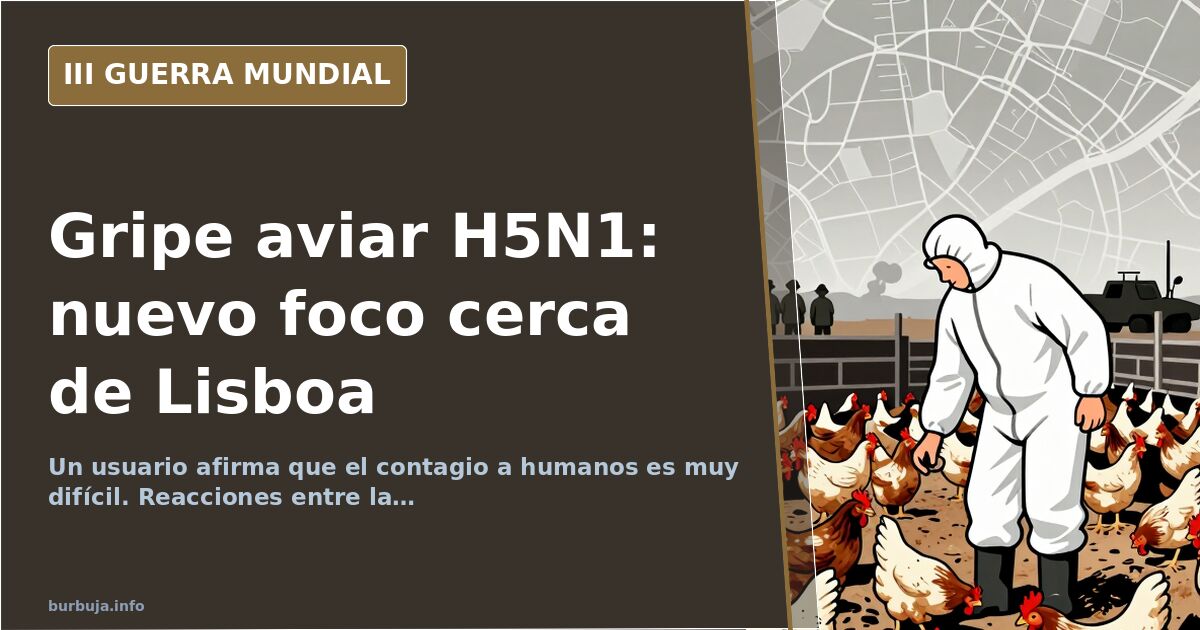
H5N1 avian flu outbreak reported at farm near Lisbon, Portugal
The announcement of a highly pathogenic H5N1 avian flu outbreak at a poultry farm near Lisbon has reignited debates over health crisis management and food supply control. The urgent news trinc sporadic cases detected in domestic and wild birds across several European countries in recent years. According to a forum user, H5N1 is a bicho that has been circulating for decades, noting that past antibody tests in farmers showed some exposure without severe symptoms, fueling skepticism regarding the alarm. The central question is whether this is just another episode or the start of new restrictions.
What is known about the Lisbon outbreak and the H5N1 bicho?
The outbreak was detected at a poultry farm located near Lisbon, according to the alert. H5N1 avian flu is a viral disease that primarily affects birds and can, in rare instances, jump to humans through direct contact with infected animals. A forum user argues that transmission from poultry to humans is very difficult, and person-to-person transmission even more so, adding that eating well-cooked chicken is not a transmission vector. Available data suggests the bicho has been circulating for years and that European surveillance systems detect outbreaks periodically.
The European precedent: detections in domestic and wild birds
Between June 15 and September 20, 2024, 75 cases of highly pathogenic avian influenza A(H5) and A(H7) were detected in domestic (16) and wild (59) birds across 11 European countries, according to the gathered data. Although the total number of detections in Europe remained low compared to previous epidemiological years, an increase in cases was observed along the Atlantic, North Sea, and Baltic coasts. This seasonal increase is common and does not necessarily imply pandemic risk.
Reactions: between alarmism and skepticism
Some analysts argue the announcement is part of a strategy to justify new restrictions, lockdowns, and mass vaccination campaigns. It is suggested that the Government could use the situation to declare a new state of alarm, suspend ongoing judicial proceedings, and extend remote work. On the other side, some point out that avian flu has a proven mortality rate much higher than Elbichito-19 and that health authorities are trinc long-established protocols. The discussion often shifts to food chain control: chicken and eggs are cheap, popular products, and some see them as an easy target for market intervention.
Impact on the poultry sector and consumption
In Spain, half of the inhabitants in many towns raise chickens for self-consumption, according to a forum user. The requirement to declare chicken coops in some autonomous communities has already caused resentment. If a new pandemic were declared, there is speculation about mass culling of birds and the disappearance of local production, leaving the supply in the hands of large intermediaries. The Spanish poultry sector has suffered similar crises in the past, involving mass culls and subsequent compensations.
The evolution of the Lisbon outbreak and the decisions made by Portuguese and European authorities will set the tone for the coming weeks. If only a single mild human case is confirmed, the alarm will likely fade. If infections are detected among farm workers, pressure to activate stricter protocols will increase. The experience accumulated in recent years suggests that communication management will be as important as health management.
The announcement of a highly pathogenic H5N1 avian flu outbreak at a poultry farm near Lisbon has reignited debates over health crisis management and food supply control. The urgent news trinc sporadic cases detected in domestic and wild birds across several European countries in recent years. According to a forum user, H5N1 is a bicho that has been circulating for decades, noting that past antibody tests in farmers showed some exposure without severe symptoms, fueling skepticism regarding the alarm. The central question is whether this is just another episode or the start of new restrictions.
What is known about the Lisbon outbreak and the H5N1 bicho?
The outbreak was detected at a poultry farm located near Lisbon, according to the alert. H5N1 avian flu is a viral disease that primarily affects birds and can, in rare instances, jump to humans through direct contact with infected animals. A forum user argues that transmission from poultry to humans is very difficult, and person-to-person transmission even more so, adding that eating well-cooked chicken is not a transmission vector. Available data suggests the bicho has been circulating for years and that European surveillance systems detect outbreaks periodically.
The European precedent: detections in domestic and wild birds
Between June 15 and September 20, 2024, 75 cases of highly pathogenic avian influenza A(H5) and A(H7) were detected in domestic (16) and wild (59) birds across 11 European countries, according to the gathered data. Although the total number of detections in Europe remained low compared to previous epidemiological years, an increase in cases was observed along the Atlantic, North Sea, and Baltic coasts. This seasonal increase is common and does not necessarily imply pandemic risk.
Reactions: between alarmism and skepticism
Some analysts argue the announcement is part of a strategy to justify new restrictions, lockdowns, and mass vaccination campaigns. It is suggested that the Government could use the situation to declare a new state of alarm, suspend ongoing judicial proceedings, and extend remote work. On the other side, some point out that avian flu has a proven mortality rate much higher than Elbichito-19 and that health authorities are trinc long-established protocols. The discussion often shifts to food chain control: chicken and eggs are cheap, popular products, and some see them as an easy target for market intervention.
Impact on the poultry sector and consumption
In Spain, half of the inhabitants in many towns raise chickens for self-consumption, according to a forum user. The requirement to declare chicken coops in some autonomous communities has already caused resentment. If a new pandemic were declared, there is speculation about mass culling of birds and the disappearance of local production, leaving the supply in the hands of large intermediaries. The Spanish poultry sector has suffered similar crises in the past, involving mass culls and subsequent compensations.
The evolution of the Lisbon outbreak and the decisions made by Portuguese and European authorities will set the tone for the coming weeks. If only a single mild human case is confirmed, the alarm will likely fade. If infections are detected among farm workers, pressure to activate stricter protocols will increase. The experience accumulated in recent years suggests that communication management will be as important as health management.
Also available in: Deutsch
Summary of a discussion on Burbuja.info - Foro de economía, actualidad y política., translated from Spanish and reviewed before publication. Read the full discussion (101 replies).
More summaries
-
Spain's Draft Letter Sparks Mockery and Flight to Portugal
A hypothetical conscription notice with a UN pin triggers reactions ranging from laughter to exile in Portugal.
-
Stalin's Nomenklatura: Caviar Amid Famine
In 1932, Soviet elites received black caviar monthly while millions starved. Historian Elena Osokina reveals the stark contrast in privileges.
-
Mariupol: Azov tunnel counterattack claims debunked
Unconfirmed reports suggest Azov Battalion reclaimed Mariupol sectors via tunnels from Azovstal, lacking verifiable evidence.
-
Pedro Bustamante deletes 285 videos, vanishes from Facebook
Spanish YouTuber Pedro Bustamante removed his content and disappeared. Rumors place him in Munich, reading German press.
-
Conspiracy theory claims migrants are hosts for demons
A conspiracy theory in Spain claims certain migrants are ideal hosts for demonic entities, blending Montauk myths, Vril, and historical denialism.
-
Yemen and the Houthis: The maritime standoff no one wants to fight on land
An analysis of Houthi attacks in the Red Sea, the resulting shipping diversions, and why military powers avoid a ground invasion in Yemen.