
Guardia Civil officer's faint halts trial in Zaragoza
A Guardia Civil officer's unconsciousness suspends a trial in Zaragoza, reigniting the debate over driving licenses and loss of consciousness.
English · Original discussion in Spanish · Published
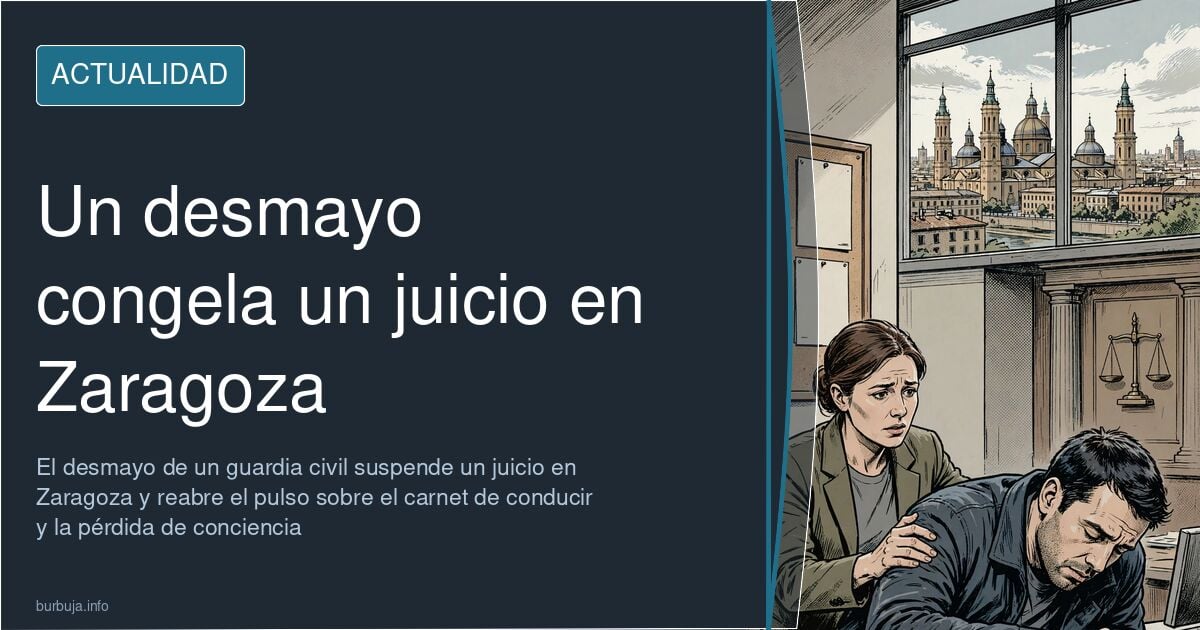
Faint in Zaragoza Court: trial suspended
A Guardia Civil officer lost consciousness during a public hearing, and the trial stopped. That's how abrupt it was. The Zaragoza Court put the session on ‘stand by’ due to an agent's indisposition, and the incident dragged along a much more uncomfortable discussion: how much weight does fainting carry in anyone's administrative life. Because the same criterion that can halt a hearing might also cancel a driving license.
What happens to your driving license if you faint?
The standard is strict: anyone who has experienced a crisis or loss of consciousness within the last year cannot renew their license under any circumstances. No distinction is made between a singular episode and a recurring problem; the year acts as an on/off switch. From there, the matter turns acrimonious. Some argue that the rule protects both the driver and others; while others respond that a system punishing diagnosis pushes people away from seeking medical advice. Both may be true, which is exactly what no one wants to admit.
From fainting to scooter: the accumulating cases
The list of episodes offers little comfort. A 34-year-old man sustained serious injuries after falling from a scooter and losing consciousness in Arroyomolinos. Parallel to this is another incident involving a delivery driver who, according to reports, assaulted a police officer in Murcia with a full-face helmet, causing sunken eye injuries. Different cases, same axis: bodies injured and decision-making capacity under suspicion.
Driving without a diagnosis: the side effect of the rule
This is where the perverse turn comes in. If recognizing a faint costs you your license, then acknowledging it becomes a luxury. The recurring conclusion is that it's not advisable to go through the consultation process, even if it means continuing to drive without knowing what is wrong with you. The suspicion always falls on the driver—was he under the influence of anything? Were his glasses fogged?—and rarely on the procedure that forces them to choose between their job and their license.
A Guardia Civil officer fainting in a courtroom is an isolated incident. But that same faint, in another body, costing mobility and salary, is not so unique anymore. With the rule as it stands, we can expect more silent diagnoses than drivers pulled from the road. But this is a prediction, not a fact: in Zaragoza, one hearing remains to be resumed.
A Guardia Civil officer lost consciousness during a public hearing, and the trial stopped. That's how abrupt it was. The Zaragoza Court put the session on ‘stand by’ due to an agent's indisposition, and the incident dragged along a much more uncomfortable discussion: how much weight does fainting carry in anyone's administrative life. Because the same criterion that can halt a hearing might also cancel a driving license.
What happens to your driving license if you faint?
The standard is strict: anyone who has experienced a crisis or loss of consciousness within the last year cannot renew their license under any circumstances. No distinction is made between a singular episode and a recurring problem; the year acts as an on/off switch. From there, the matter turns acrimonious. Some argue that the rule protects both the driver and others; while others respond that a system punishing diagnosis pushes people away from seeking medical advice. Both may be true, which is exactly what no one wants to admit.
From fainting to scooter: the accumulating cases
The list of episodes offers little comfort. A 34-year-old man sustained serious injuries after falling from a scooter and losing consciousness in Arroyomolinos. Parallel to this is another incident involving a delivery driver who, according to reports, assaulted a police officer in Murcia with a full-face helmet, causing sunken eye injuries. Different cases, same axis: bodies injured and decision-making capacity under suspicion.
Driving without a diagnosis: the side effect of the rule
This is where the perverse turn comes in. If recognizing a faint costs you your license, then acknowledging it becomes a luxury. The recurring conclusion is that it's not advisable to go through the consultation process, even if it means continuing to drive without knowing what is wrong with you. The suspicion always falls on the driver—was he under the influence of anything? Were his glasses fogged?—and rarely on the procedure that forces them to choose between their job and their license.
A Guardia Civil officer fainting in a courtroom is an isolated incident. But that same faint, in another body, costing mobility and salary, is not so unique anymore. With the rule as it stands, we can expect more silent diagnoses than drivers pulled from the road. But this is a prediction, not a fact: in Zaragoza, one hearing remains to be resumed.
Summary of a discussion on Burbuja.info - Foro de economía, actualidad y política., translated from Spanish and reviewed before publication. Read the full discussion (27 replies).
More summaries
-
Guardia Civil Can Immobilize Your Car Following a Visual Test
An officer can ask you to read a license plate from 20 meters away. If you fail, your car is immobilized. The test exists, but few have seen it applied. Why?
-
Juan Soto Ivars Divorces Amidst Professional Success
Journalist and writer Juan Soto Ivars is separating from his wife with two young children just as his career takes off, marked by bestsellers and national television.
-
Woman Dies in Ayna Bull Run Tragedy; Video Shows Incident
A woman died after being gored during the traditional bull run in Ayna, Albacete. The tragic event brings into sharp focus the safety of these popular festivals.
-
Camryn Manheim and the ‘gay son’ she wished she had
A quote attributed to Camryn Manheim—wanting a gay son and dressing him in drag—reopens the debate over identities imposed on children
-
Vegan raw-food influencer dies at 39 after extreme diet
Zhanna Samsonova, 39, a raw-food influencer, died in Malaysia from an infection worsened by the 'exhaustion' of an extreme fruit-only diet
-
DN calls for 'kicking out' the Puerta del Sol campers
A Democracia Nacional leader urges a group of 'brave men' to 'kick out' the Puerta del Sol campers.