
Gowex, Coal, and the IBEX at 10,500: July 2014 in Four Key Figures
In July 2014, the IBEX hovered around 10,500 points, Gowex collapsed, and IBEX futures surged 60% above average.
English · Original discussion in Spanish · Published
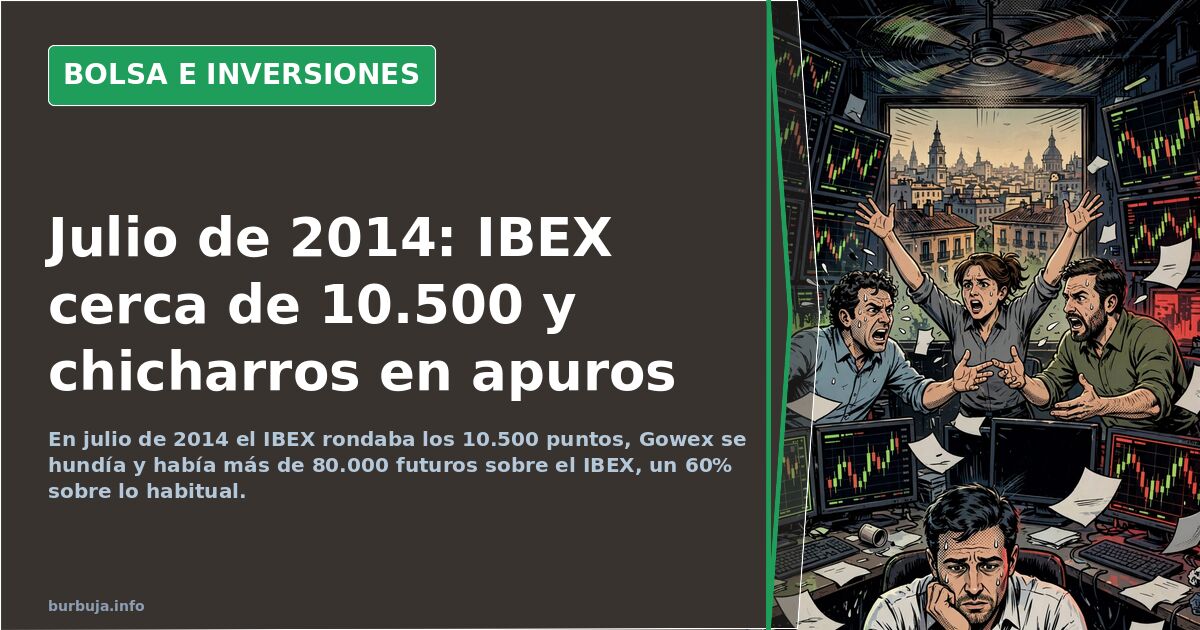
The summer the IBEX looked in the mirror and saw little
July 2014. The IBEX 35 hovers around 10,500 points, with the long-expected correction still not arriving. US indices hit highs, and the forum buzzes about a lack of volume here. Beneath the calm surface, small-cap stocks are brewing: suspicions about Gowex, doubts about coal companies, and several previously rising names start to be viewed with suspicion. The result is a month-end feeling that the Spanish index doesn't reflect what's happening below.
Gowex: 49,000 shares worth less than a thousand euros
The blow lands in July. A company listed on the Alternative Stock Market collapses. As detailed on the forum based on the 2013 consolidated audit report, almost all group companies lose money, except the parent, which makes 27 million without a clear source. There are 49 million euros in fixed-term deposits with unknown terms or locations.
The cost to small investors is harsh. A forum user describes the crash: 49,000 shares, attempted to sell notarially, fetched less than a thousand euros, at 0.01 euros per share, plus notary and bank fees. Another user recounts discovering in half an hour that half the year's profits had evaporated and their broker wasn't broken, it was simply quoting a different price.
The most unsettling detail is how slowly it unfolded. According to forum discussions, balance sheets were public, clients grew from 21 to 53 million without identification, suppliers were owed 22 million, and no one explained anything. Anyone with a free moment could have read it.
Coal and a cash pile that won't last two years
While Gowex bleeds out, another front opens in listed coal companies. According to forum calculations, if fines and regulatory surcharges from Washington total between 200 and 400 million, the cash pile won't last more than two years, just until the next elections. The sector's companies are indebted, don't generate free cash flow, and if cash runs out, a capital increase would be the natural solution. And a capital increase with capitalization at rock bottom is the worst thing for an existing shareholder, according to those same calculations.
Another forum user argues that if coal disappears or prices are forced up, the shale gas bubble gains one less competitor and can stretch margins. It's not a textbook analysis, but it would explain the persistent regulatory pressure on an already struggling sector.
The chart war: two narratives for the same IBEX
In technical analysis, disagreement is total. One forum user claims losing 10,300 points confirms a correction, with a probable target of 9,200 and the multi-month bullish channel finally dead due to the failure of the third impulse. Another responds that a months-long trendline isn't broken easily and the index holds because serious players don't want it to fall now.
Specific levels discussed daily are 10,650-10,598 as a control point, 10,690 for a first bullish breakout, and 10,508-10,436 downwards. Amidst this, warnings of double tops, head-and-shoulders patterns, and predictions pointing to a September expiry at 11,566. Everyone paints their own chart, and all are right in hindsight.
The puzzling data point is the derivatives position: over 80,000 IBEX futures contracts open, 60% above average. Someone is placing a big bet, according to one forum user's reading, who compares the situation to 2001.
Banking, penny stocks, and the air of suspicion
The most uncomfortable summary comes from the banking sector. One forum user argues that the sector's capitalization is at 2007 levels, when it earned 40% more, had one-sixth the non-performing loans, and didn't depend on public aid, the ECB, or the Bank of Spain.
At the market's opposite extreme, small-cap stocks are pricing in one suspicion after another. According to a forum user, Carbures falls 5% and its balance sheet is expected to bring more bad news. Other companies close quarters with growth rates the big ones would envy, yet their stock prices don't lift, as is commented.
Why did the July 2014 IBEX puzzle almost everyone?
The confusion boils down to an idea circulating on the forum: divergence. The US hits highs, but Spain doesn't. Indices hold steady while several small-cap stocks collapse below.
The drip-feed of scandals (Gowex, Carbures, BES) turns a sluggish month into a series of shocks. In a few days, several trendy names go down the drain, and the index remains flat. Therein lies the trap: the index doesn't measure what happens to the average investor.
A forum user summarizes that the banking sector's capitalization was like in 2007 but earning less, and the market continued to reward stories without supporting balance sheets. The gazelles looked at each other and saw little.
July 2014. The IBEX 35 hovers around 10,500 points, with the long-expected correction still not arriving. US indices hit highs, and the forum buzzes about a lack of volume here. Beneath the calm surface, small-cap stocks are brewing: suspicions about Gowex, doubts about coal companies, and several previously rising names start to be viewed with suspicion. The result is a month-end feeling that the Spanish index doesn't reflect what's happening below.
Gowex: 49,000 shares worth less than a thousand euros
The blow lands in July. A company listed on the Alternative Stock Market collapses. As detailed on the forum based on the 2013 consolidated audit report, almost all group companies lose money, except the parent, which makes 27 million without a clear source. There are 49 million euros in fixed-term deposits with unknown terms or locations.
The cost to small investors is harsh. A forum user describes the crash: 49,000 shares, attempted to sell notarially, fetched less than a thousand euros, at 0.01 euros per share, plus notary and bank fees. Another user recounts discovering in half an hour that half the year's profits had evaporated and their broker wasn't broken, it was simply quoting a different price.
The most unsettling detail is how slowly it unfolded. According to forum discussions, balance sheets were public, clients grew from 21 to 53 million without identification, suppliers were owed 22 million, and no one explained anything. Anyone with a free moment could have read it.
Coal and a cash pile that won't last two years
While Gowex bleeds out, another front opens in listed coal companies. According to forum calculations, if fines and regulatory surcharges from Washington total between 200 and 400 million, the cash pile won't last more than two years, just until the next elections. The sector's companies are indebted, don't generate free cash flow, and if cash runs out, a capital increase would be the natural solution. And a capital increase with capitalization at rock bottom is the worst thing for an existing shareholder, according to those same calculations.
Another forum user argues that if coal disappears or prices are forced up, the shale gas bubble gains one less competitor and can stretch margins. It's not a textbook analysis, but it would explain the persistent regulatory pressure on an already struggling sector.
The chart war: two narratives for the same IBEX
In technical analysis, disagreement is total. One forum user claims losing 10,300 points confirms a correction, with a probable target of 9,200 and the multi-month bullish channel finally dead due to the failure of the third impulse. Another responds that a months-long trendline isn't broken easily and the index holds because serious players don't want it to fall now.
Specific levels discussed daily are 10,650-10,598 as a control point, 10,690 for a first bullish breakout, and 10,508-10,436 downwards. Amidst this, warnings of double tops, head-and-shoulders patterns, and predictions pointing to a September expiry at 11,566. Everyone paints their own chart, and all are right in hindsight.
The puzzling data point is the derivatives position: over 80,000 IBEX futures contracts open, 60% above average. Someone is placing a big bet, according to one forum user's reading, who compares the situation to 2001.
Banking, penny stocks, and the air of suspicion
The most uncomfortable summary comes from the banking sector. One forum user argues that the sector's capitalization is at 2007 levels, when it earned 40% more, had one-sixth the non-performing loans, and didn't depend on public aid, the ECB, or the Bank of Spain.
At the market's opposite extreme, small-cap stocks are pricing in one suspicion after another. According to a forum user, Carbures falls 5% and its balance sheet is expected to bring more bad news. Other companies close quarters with growth rates the big ones would envy, yet their stock prices don't lift, as is commented.
Why did the July 2014 IBEX puzzle almost everyone?
The confusion boils down to an idea circulating on the forum: divergence. The US hits highs, but Spain doesn't. Indices hold steady while several small-cap stocks collapse below.
The drip-feed of scandals (Gowex, Carbures, BES) turns a sluggish month into a series of shocks. In a few days, several trendy names go down the drain, and the index remains flat. Therein lies the trap: the index doesn't measure what happens to the average investor.
A forum user summarizes that the banking sector's capitalization was like in 2007 but earning less, and the market continued to reward stories without supporting balance sheets. The gazelles looked at each other and saw little.
Summary of a discussion on Burbuja.info - Foro de economía, actualidad y política., translated from Spanish and reviewed before publication. Read the full discussion (6103 replies).
More summaries
-
The AI Bubble: How Circular Payments Keep the S&P 500 Afloat
OpenAI has $550B in commitments but no profit, Oracle issues 6.85% debt, and the billing loop keeps the S&P 500 rising.
-
Gold stuck at 0.382 as bitcoin takes the spotlight
Gold stuck at 0.382 and unable to recover while bitcoin hits 6.000 dollars; thresholds at 1.250 and 1.050 set the scene.
-
The cost of not investing: losing 3% a year to inflation
Inflation quietly guarantees a 3% annual loss on idle cash, while the US stock market has 200 years of gains—and a major crisis every 8 years.
-
Extra virgin olive oil falls to €6.35 a litre at Mercadona
Extra virgin olive oil is now €6.35/litre at Mercadona, down from €6.75 months ago, while the origin price of picual is €4.143/kg
-
BIG offers 4% TAE on 6-month deposit with Spanish IBAN and Portuguese FGD
BIG launched a 4% TAE six-month and 3.5% three-month deposit in May 2023 with Spanish IBAN and Portuguese FGD, but later cut rates and had opening delays.
-
Spot-price coins: the seller whose paper trail didn't add up
He offered quarter-ounce gold coins at spot price and racked up undelivered orders. Buyers cross-checked his details and several got their money back.