
Gold Plummets, Trapping Small Investors
Gold falls to $1,721 from October highs. The $1,300 support level is now within reach. Is it a safe haven or a bubble?
English · Original discussion in Spanish · Published
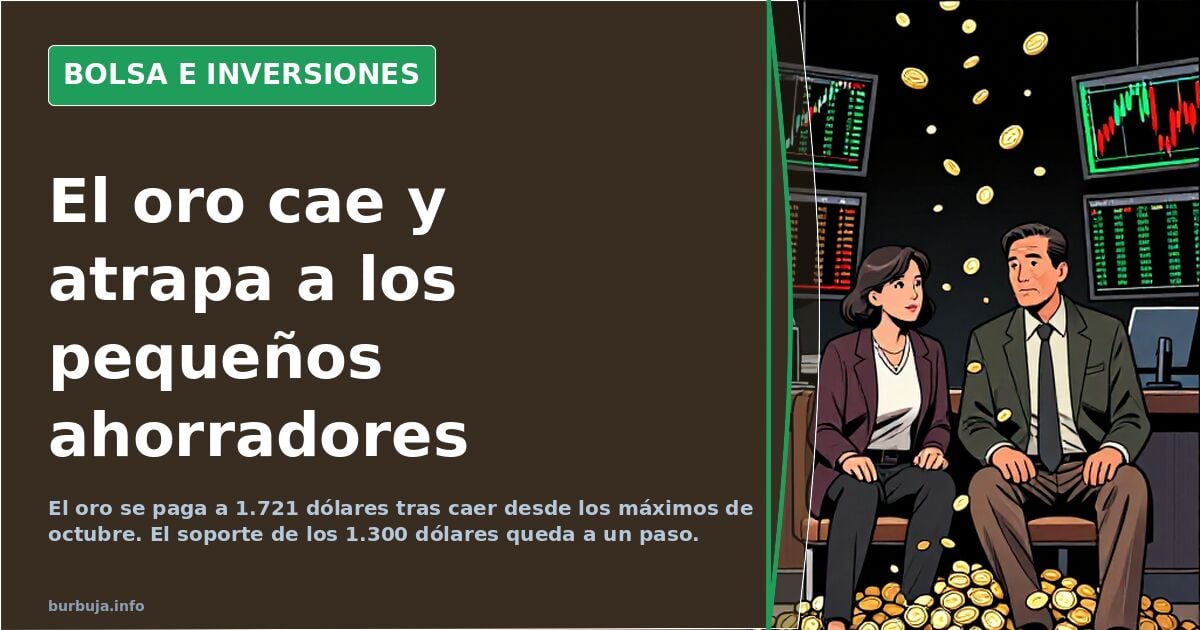
Gold Falls From Highs, Trapping Small Investors
In late 2012, safe deposit boxes in Spain hold thirty ounces of gold. They were bought at the peak of the fever, with the metal at its highest, and for weeks, owners have watched the price decline. The ounce now trades at €1,321, $1,721, far from its October peak. The psychological floor of $1,300 is within reach, and this narrow margin is the battleground for a debate that transcends price: is gold a safe haven, insurance, or just another bubble?
The Gold Collapse: $1,721 and Support at $1,300
The metal hasn't crashed, but it has stopped rising, which for an asset bought in a frenzy is almost the same. The most common analyses place the resistance at $1,680, with a potential rebound there as institutional buyers enter the market. Those who bought for speculation are nervous. Those who bought for safekeeping are much less so.
The most frequent defense doesn't refer to charts but to monetary mass. If gold's rise is compared to the increase in money in circulation, this school of thought argues, the metal isn't expensive: it's the currencies that are worth less. A breakdown of this calculation—promised to be accompanied by a chart—presents a much less dramatic view of the decline. This is where opinions diverge. Some see a healthy correction before a parabolic rally; others, the first stage of a crash.
Why Compare 2012 Gold to 1980?
Because the scar remains. In January 1980, the ounce hit $850. In January 2008, it hit $850 again. Twenty-eight years to recover the same level, with the metal staying below that figure the entire time. Those who bought at the 1980 peak and held on, held on for nothing. The warning is clear: a safe haven can also go an entire generation without offering refuge.
Against this, the response from the more optimistic sector is that the context is entirely different now. With central banks buying sovereign debt and the Federal Reserve injecting $40 billion per month, the scenario has changed. For gold to truly collapse, fiat money would need to regain trust. And that doesn't seem to be the case.
Central Banks and China: Who Is Still Buying Gold?
No one with power is letting go of the metal. The ECB buys debt without admitting it generates inflation, and major central banks continue to accumulate reserves. In India, imports exceeded $7 billion, and the government views them as an expense that widens the trade deficit, while its citizens see them as savings. In China, there's even speculation about a currency partially backed by gold.
This is the counterweight preventing talk of a collapse. Individuals sell when the price falls; states do not. And if the primary hoarders of the metal are the money issuers themselves, the market's floor has less to do with the faith of the small investor and more to do with geopolitics.
The Disconcerting Figure
Ultimately, the figure that breaks the narrative is different. Gold represents less than 1% of portfolios. If it's a bubble, it's a bubble that almost no one has bought into. And if it's a safe haven, very few people have taken refuge. With these numbers, the collapse some expect and the rally others promise depend on a handful of hands. The same hands that are now opening the safe deposit box and doing the math.
In late 2012, safe deposit boxes in Spain hold thirty ounces of gold. They were bought at the peak of the fever, with the metal at its highest, and for weeks, owners have watched the price decline. The ounce now trades at €1,321, $1,721, far from its October peak. The psychological floor of $1,300 is within reach, and this narrow margin is the battleground for a debate that transcends price: is gold a safe haven, insurance, or just another bubble?
The Gold Collapse: $1,721 and Support at $1,300
The metal hasn't crashed, but it has stopped rising, which for an asset bought in a frenzy is almost the same. The most common analyses place the resistance at $1,680, with a potential rebound there as institutional buyers enter the market. Those who bought for speculation are nervous. Those who bought for safekeeping are much less so.
The most frequent defense doesn't refer to charts but to monetary mass. If gold's rise is compared to the increase in money in circulation, this school of thought argues, the metal isn't expensive: it's the currencies that are worth less. A breakdown of this calculation—promised to be accompanied by a chart—presents a much less dramatic view of the decline. This is where opinions diverge. Some see a healthy correction before a parabolic rally; others, the first stage of a crash.
Why Compare 2012 Gold to 1980?
Because the scar remains. In January 1980, the ounce hit $850. In January 2008, it hit $850 again. Twenty-eight years to recover the same level, with the metal staying below that figure the entire time. Those who bought at the 1980 peak and held on, held on for nothing. The warning is clear: a safe haven can also go an entire generation without offering refuge.
Against this, the response from the more optimistic sector is that the context is entirely different now. With central banks buying sovereign debt and the Federal Reserve injecting $40 billion per month, the scenario has changed. For gold to truly collapse, fiat money would need to regain trust. And that doesn't seem to be the case.
Central Banks and China: Who Is Still Buying Gold?
No one with power is letting go of the metal. The ECB buys debt without admitting it generates inflation, and major central banks continue to accumulate reserves. In India, imports exceeded $7 billion, and the government views them as an expense that widens the trade deficit, while its citizens see them as savings. In China, there's even speculation about a currency partially backed by gold.
This is the counterweight preventing talk of a collapse. Individuals sell when the price falls; states do not. And if the primary hoarders of the metal are the money issuers themselves, the market's floor has less to do with the faith of the small investor and more to do with geopolitics.
The Disconcerting Figure
Ultimately, the figure that breaks the narrative is different. Gold represents less than 1% of portfolios. If it's a bubble, it's a bubble that almost no one has bought into. And if it's a safe haven, very few people have taken refuge. With these numbers, the collapse some expect and the rally others promise depend on a handful of hands. The same hands that are now opening the safe deposit box and doing the math.
Summary of a discussion on Burbuja.info - Foro de economía, actualidad y política., translated from Spanish and reviewed before publication. Read the full discussion (246 replies).
More summaries
-
Gold Hits $4,000 After Doubling, Texas Accepts It as Currency
Gold jumps from $1,450 to $4,106 per ounce, correcting to $4,000, as Texas, Florida, and Missouri recognize it as legal tender.
-
Gold Drops to $4194, Support at $3800 in Focus
Gold touched $4600 before falling to $4194. The $3800 support level is closely watched, with a break potentially leading to $3400.
-
"Everything looks bleak": Six pressing issues discussed in the forum
High fuel, inflation, and housing costs; markets surging while gold remains below peaks. The pessimistic diagnosis circulating in the forum.
-
Buying the Dip or Waiting for Crash: The 2025 Market Dilemma
Centene experienced a 25% fall, AI technology is dividing investors, and market crash predictions are mounting for November. The 2025 investment dilemma: buy now or wait?
-
Gold stuck at 0.382 as bitcoin takes the spotlight
Gold stuck at 0.382 and unable to recover while bitcoin hits 6.000 dollars; thresholds at 1.250 and 1.050 set the scene.
-
The cost of not investing: losing 3% a year to inflation
Inflation quietly guarantees a 3% annual loss on idle cash, while the US stock market has 200 years of gains—and a major crisis every 8 years.