
Induction pan on a ceramic hob: slower and costlier? Not really
An induction-compatible pan does not heat more slowly or drive up the bill on a conventional ceramic hob: the suspicion stems from a technical misunderstanding.
English · Original discussion in Spanish · Published
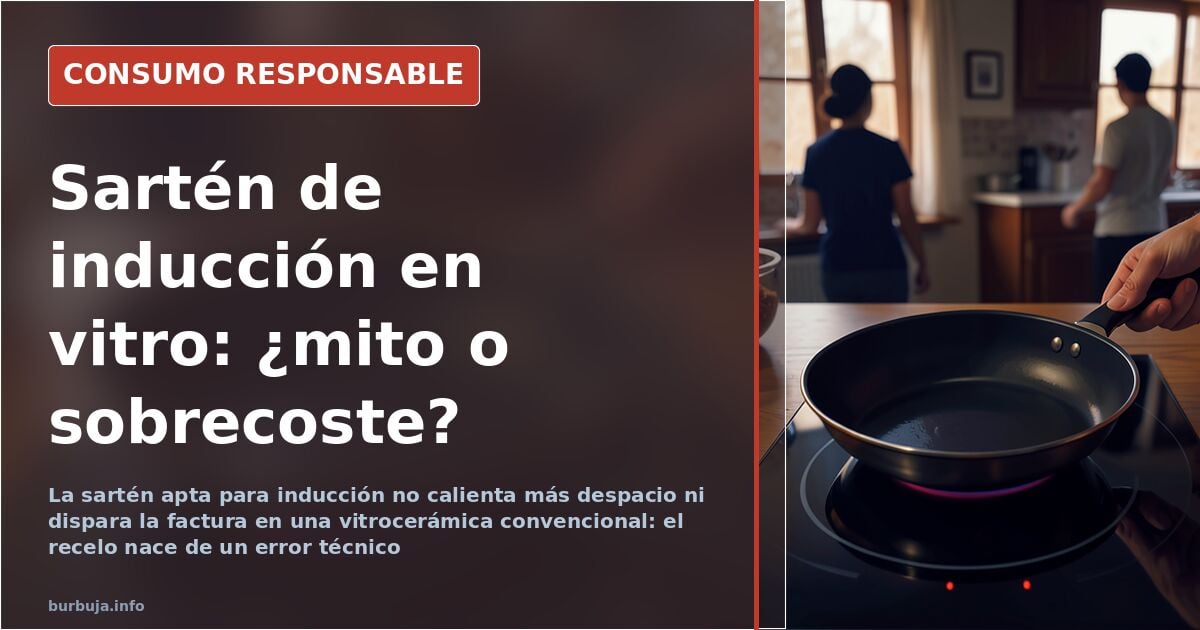
Induction pan on a ceramic hob: what really happens with heat and your bill
Does an induction-compatible pan take longer to heat up on a conventional ceramic hob? The doubt hits anyone moving into a home with a traditional ceramic hob who finds the shelf full of pans labelled "suitable for all hob types". The short answer is no: the heat arrives just the same, and the suspicion stems from a misunderstanding of how both systems work.
The reasoning that circulates is intuitive and, at the same time, wrong. People think the induction pan has a thick metal plate that the hob must heat first, and that this toll is paid in minutes and kilowatts. The technical explanation goes the other way: that ferromagnetic base exists because induction heats the pan through magnetism, not because the ceramic hob needs it. On a ceramic hob, heat is transmitted by contact, and the pan's thicker base does exactly the opposite of what is antiestéticared.
Does an induction pan heat more slowly on a ceramic hob?
Not because it is induction-compatible. The misunderstanding falls apart with a simple observation: ceramic hobs heat any material, whether clay, aluminium or steel. They do not select the pan. The pan's plate does not add an intermediate heating stage; it is simply part of the base.
What does matter is the thickness and quality of that base. A thick base takes slightly longer to reach temperature, but distributes heat better and prevents food from sticking or burning. The trade-off is an advantage: it retains heat and allows you to switch off the heat a couple of minutes before cooking is done, with the dish finishing by residual heat. The net result is not an extra cost, but a trade between warm-up time and later stability.
Electricity use: more kilowatts because of the ferromagnetic base?
The higher-consumption argument rests on a false premise. If the pan does not force the hob to work longer than necessary, there is no extra bill attributable to the pan being induction-compatible. The energy is spent heating the base and the food, just as with any other pan.
Where the calculation really matters is in the system, not the pan. A conventional ceramic hob is slow to heat up and, above all, slow to cool down, which makes it an unresponsive option for cooking. Induction responds instantly and wipes clean with a cloth, though it requires pans containing iron and, if they are very thin, tends to burn food. Gas wins on power and price, but you pay for it in mess and heavy cleaning.
Buying new pans or making the most of what you have
The sensible recommendation is not to spend. Induction-compatible pans work perfectly on a conventional ceramic hob, so replacing your cookware to buy supposedly better ones ends up being an outlay with a risk of turning out worse. The pans already in the cupboard are not damaged by being used on a ceramic hob.
Some go further and propose alternatives to cooking with a pan, boiling directly on the glass, or use a glass pan so heat reaches the food sooner. These are notions that solve specific cases, not a general strategy. For most people, an induction pan on a ceramic hob does the job without drama.
In the end, the only question still standing is the usual one: why conventional ceramic hobs are still sold as the standard when they are the clumsiest of the three systems. The answer, we suspect, has nothing to do with physics.
Summary of a discussion on Burbuja.info - Foro de economía, actualidad y política., translated from Spanish and reviewed before publication. Read the full discussion (7 replies).
More summaries
-
Putting pans in the dishwasher: the mistake that leaves black residue
A user discovers that washing his €30 pan in the dishwasher leaves black residue. The debate reveals which materials survive and which don't.
-
Tefal titanium pan lasted just six months, buyer reports
A user reports that two Tefal pans with titanium coating lost their non-stick properties within months. The brand called it normal use. The forum debates…
-
Cast iron pans: why food sticks and how to season them
A cast iron pan isn't non-stick out of the box: the coating is built by cooking. A guide to seasoning, cleaning and the mistakes that ruin the process.
-
EU's €3 parcel levy ends AliExpress's cheap era
The EU's €3 per category fee sends AliExpress prices soaring: a €3 order now costs €11. The Chinese parcel model faces collapse.
-
Aquaservice vs the 1.5-litre bottle: the math doesn't add up
The dispenser is free, but the water isn't: against bottled water at 0.19 cents a litre, home-delivered water jugs don't pay off for an ordinary household.
-
Closing an EVO Banco account: the zero balance that wasn't zero
He was told to empty the account to close it with EVO Banco, a Spanish online bank, but the bank then claimed there were pending amounts. The process stalls and tempers rise.