
Gisbert and Ceuta: second-hand embarrassment as a journalistic genre
Rubén Gisbert says he is ashamed of the people of Ceuta and sparks a backlash: from the narcissism of TV pundits to the crisis of a city that feels abandoned
English · Original discussion in Spanish · Published
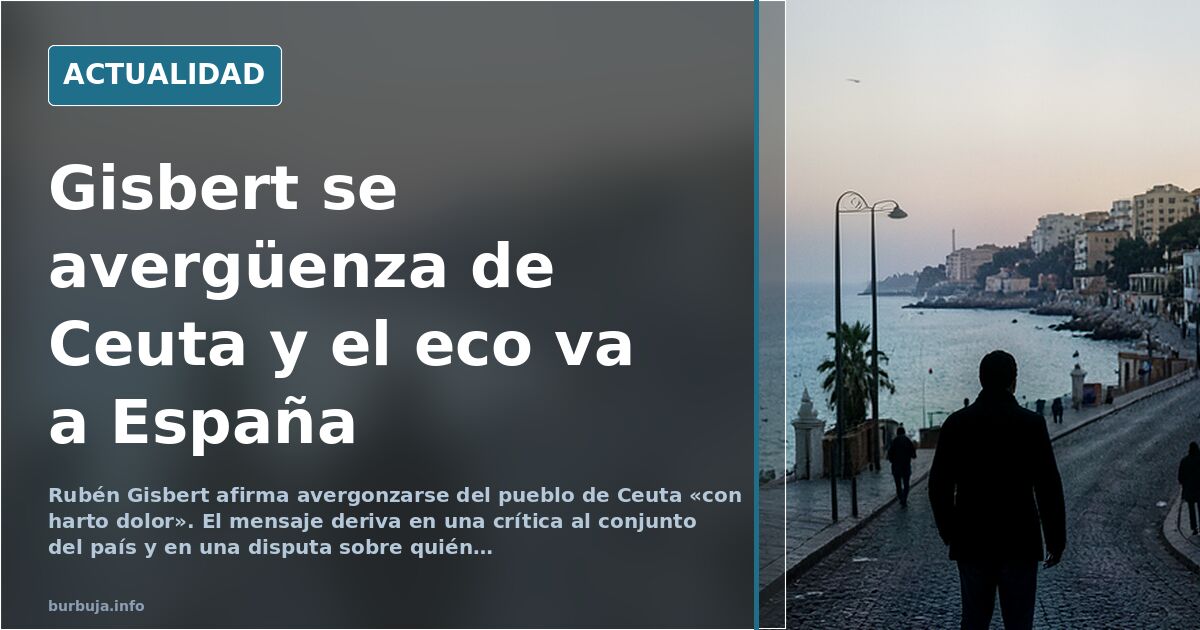
Gisbert turns his shame over Ceuta into another stunt
What does it feel like when someone says they are ashamed of an entire town from the comfort of a tweet? Rubén Gisbert, a media figure linked to true-crime TV shows and now also to counter-demonstrations, wrote that he is ashamed «of the people of Ceuta» and that he says so «with great pain». The remark, posted on social media, unleashed a storm of mutual recriminations that goes far beyond Ceuta: from the handling of the border crisis to the role of the monarchy, from the narcissism of TV pundits to the exhaustion of a country navel-gazing at itself.
What peine in Ceuta and why Gisbert speaks of shame
The trigger is a crisis in the autonomous city that the post itself does not detail, but which the context of the debate places in a climate of **public desperation** and a sense of real danger for families, according to one participant. The King's visit is read by part of the population as a gesture of support in the face of what is perceived as an external threat. Gisbert, however, chooses to reproach the people of Ceuta as a whole. The result is a classic: the pundit who appoints himself the sarracena conscience of a community he does not belong to.
Some argue that the King's reaction and his institutional presence are necessary, while others claim the monarchy is a useless ornament. The debate splits into two camps that do not listen to each other.
The man's track record: from kneeling in the mud to the counter-demonstration
The credibility of the message does not help. Recordings and descriptions are circulating of Gisbert kneeling before going live on a TV show so that he comes out covered in mud, a gesture interpreted as staged. He is also credited with organizing a counter-demonstration to another rally in Ceuta. For many, that turns his «pain» into a marketing product. And when someone builds their brand on permanent outrage, the outrage eventually sounds scripted.
A country that hates itself: from reproaching Ceuta to reproaching Spain
The original post served as a springboard for a collective catharsis. Grievances are listed: the feeling that institutions fail, the perceived impunity in certain cases, the handling of terrorist episodes and their electoral impact, the indulgence toward certain discourses. The most repeated conclusion is that **it is not just Ceuta, it is all of Spain**. Envy as a national sport, people not keeping their word, «screwing over the guy next to you» appear as diagnoses of a supposedly national character. It is the old vice of turning an anecdote into an anthropological thesis.
The trap of «the people»: who speaks on whose behalf?
The sharpest reproach is not aimed at Gisbert, but at those who generalize. Interpreting the feelings of thousands of people from a keyboard is the same mistake he is accused of. Most Spaniards, the argument goes, are honest, hard-working people who pay their taxes and expect the State to deliver. Ceuta's desperation does not justify despising Ceuta. And patriotism, if it means anything, begins with not insulting your own.
In the end, it is the spectacle that produces the shame: a pundit who kneels for the camera, a country debating whether it deserves to be ashamed of itself, and a city at the center of the board. If the pain was sincere, the staging ruined it.
Also available in: Deutsch
Summary of a discussion on Burbuja.info - Foro de economía, actualidad y política., translated from Spanish and reviewed before publication. Read the full discussion (41 replies).
More summaries
-
Gisbert vs Horizonte: mud, Zionism and media bias
Rubén Gisbert questions Horizonte's independence and sparks debate on Zionist bias, financial control and Iker Jiménez's role on TV.
-
Diego Rubio, the chief of staff blamed for the Ceuta crisis
Diego Rubio, Pedro Sánchez's chief of staff, reportedly deflected the Ceuta crisis towards housing through the Maricarmen case, according to published reports. The…
-
Zionist control of Horizonte and the Laura de Chiclana case
Laura de Chiclana reported on Horizonte that non-Jews cannot enter Israeli shelters. Carmen Porter denied it live. Analysis of Zionist control.
-
A Spaniard Now Runs NASA's Moon Base Project — and Hardly Anyone Is Talking About It
Spaniard Carlos García-Galán will lead NASA's lunar base project. The $10 billion-per-phase plan is met with skepticism. Will it ever be built?
-
Only 4 in 10 Basque income support recipients in Spain are Spanish nationals
A Vox request has revealed that only 40% of recipients of the Basque RGI income guarantee are Spanish. Lanbide hid the figure for four years to avoid stigmatizing groups.
-
Hispanidad vs 'hispanchidad': the debate splitting Spain
In 40 years, 5 million Hispanic immigrants have arrived in Spain, matching the Spaniards who emigrated to the Americas over 400 years. The debate over Hispanic identity is intensifying.