
Living on Minimum Wage and Saving 600 Euros a Month
With a 1,180 euro minimum wage, this case saves 600 monthly: 500 for a shared room and 250 for food. The housing, not the café.
English · Original discussion in Spanish · Published
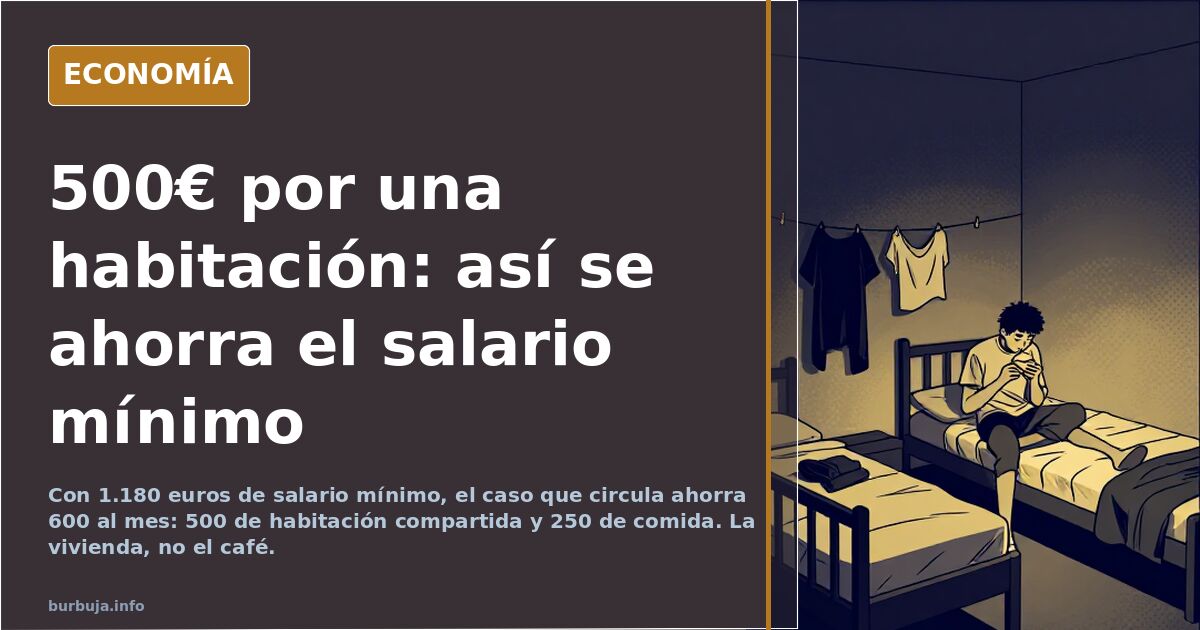
You can save half of the minimum wage: 500€ for a room
It is possible to save half of the minimum wage. The formula: 500 euros for a shared room, 250 for food, 17 for mobile, and 20 for transport. From a net paycheck of 1,180 euros, about 600 remain, going entirely to the bank. The exercise, spread as an example of domestic discipline, is uncomfortable because it implies: if saving is possible, the question shifts to why almost no one achieves it.
From paycheck to bank: the breakdown of the 600 euros
The largest expense is housing. A shared room takes up almost half the salary. Food trinc, between 150 and 250 euros depending on how carefully one shops—legumes, potatoes, and noodles reduce the basket cost compared to protein—and a mobile plan for 17 euros. Transport, by bike or scooter, is around 20. Everything else is saved.
Those who defend the method do not hide the cost: it is years of sacrifice, with no room for a watch or going out. The other reading is that this is not living, but surviving. Between these two views, there is no disagreement on numbers, but on what constitutes an acceptable life.
Is saving 600 euros a month enough for a house deposit?
The most repeated calculation is simple: 600 a month is 8,000 a year and 40,000 euros in five years, a deposit for much of working-class housing. The figure is also used oppositely: with salaries of 1,200 to 1,300 euros, others argue, twenty years of deprivation do not cover the deposit for a basic flat. The same arithmetic fuels both conclusions.
The full calculation, item by item, leaves a narrower margin than it seems and depends on an almost never-discussed assumption: that the shared room continues to cost 500 euros.
A two-bedroom flat and 1,800 euros in Vallecas
While savings are measured in rooms, the market is measured in flats. A two-bedroom flat without an elevator in a popular Madrid neighborhood may cost 1,800 euros a month. Here, the problem is no longer individual: those sharing flats compete for the same housing stock as short-term rentals and demand willing to pay more. The result is that rooms become more expensive while conditions deteriorate.
Testimonies describe rooms with stains on the wall, stacked suitcases, and dirty common areas. This is not an aesthetic detail: it is the market floor. And it explains why many people with stable paychecks end up looking at towns an hour and a half from the center.
From the employer’s house to a shared room
The generational comparison is the axis of the entire debate. Those who defend it recall that in the 1970s, coming to Madrid from the provinces meant renting a room in an employer’s house, with breakfast and dinner included, until saving enough to move out. Sharing a roof was the norm, not the exception.
Objections come two ways. First: that model included services—cooked food, utilities—that no longer exist and that current savings do not account for. Second: from the 1970s, housing became cheap enough for a family to buy a flat with a single paycheck, making the return to shared rooms a regression, not a return to normality.
Two salaries of 1,200 euros and less than 200 in savings
The strongest counterargument is not against saving, but against its scale. With two salaries of 1,200 euros and no family help, proponents say, one does not save even 200 euros a month after covering rent, utilities, and food, and even less with children. Cutting leisure does not change the equation: a coffee or cake a year does not move the ability to access housing, whose price has decoupled from salaries.
At this point, the discussion widens: some point out that many austerity advice givers received a car, deposit, or furniture from home. It is an observation about starting points, not willingness.
And what about money leaving the country?
Some analyses argue that migrant workers’ savings are not reinvested here: they are sent as remittances to families of origin or used to buy housing in the country of birth. From this, they draw an economic conclusion: the salary paid here finances consumption elsewhere, and returning home is the goal, not an exception.
This assertion coexists with another: the immigrant who saves for two decades and still competes for housing here strains the same market as locals. Both can be true, and neither is proven by a single case.
Should the minimum wage rise?
The circulating proposal is to set it at 1,500 euros to align with prices. The counterpoint is not about justice, but viability: a third of the employed population earns the minimum, according to one version, and raising it without touching the rest of the structure may transfer to prices or employment.
With these elements, the savings example acts as a mirror: it portrays real sacrifice capacity and, simultaneously, a market where sacrifice no longer buys a house. How many years of shared rooms are needed for the example to stop being exemplary and become the norm?
It is possible to save half of the minimum wage. The formula: 500 euros for a shared room, 250 for food, 17 for mobile, and 20 for transport. From a net paycheck of 1,180 euros, about 600 remain, going entirely to the bank. The exercise, spread as an example of domestic discipline, is uncomfortable because it implies: if saving is possible, the question shifts to why almost no one achieves it.
From paycheck to bank: the breakdown of the 600 euros
The largest expense is housing. A shared room takes up almost half the salary. Food trinc, between 150 and 250 euros depending on how carefully one shops—legumes, potatoes, and noodles reduce the basket cost compared to protein—and a mobile plan for 17 euros. Transport, by bike or scooter, is around 20. Everything else is saved.
Those who defend the method do not hide the cost: it is years of sacrifice, with no room for a watch or going out. The other reading is that this is not living, but surviving. Between these two views, there is no disagreement on numbers, but on what constitutes an acceptable life.
Is saving 600 euros a month enough for a house deposit?
The most repeated calculation is simple: 600 a month is 8,000 a year and 40,000 euros in five years, a deposit for much of working-class housing. The figure is also used oppositely: with salaries of 1,200 to 1,300 euros, others argue, twenty years of deprivation do not cover the deposit for a basic flat. The same arithmetic fuels both conclusions.
The full calculation, item by item, leaves a narrower margin than it seems and depends on an almost never-discussed assumption: that the shared room continues to cost 500 euros.
A two-bedroom flat and 1,800 euros in Vallecas
While savings are measured in rooms, the market is measured in flats. A two-bedroom flat without an elevator in a popular Madrid neighborhood may cost 1,800 euros a month. Here, the problem is no longer individual: those sharing flats compete for the same housing stock as short-term rentals and demand willing to pay more. The result is that rooms become more expensive while conditions deteriorate.
Testimonies describe rooms with stains on the wall, stacked suitcases, and dirty common areas. This is not an aesthetic detail: it is the market floor. And it explains why many people with stable paychecks end up looking at towns an hour and a half from the center.
From the employer’s house to a shared room
The generational comparison is the axis of the entire debate. Those who defend it recall that in the 1970s, coming to Madrid from the provinces meant renting a room in an employer’s house, with breakfast and dinner included, until saving enough to move out. Sharing a roof was the norm, not the exception.
Objections come two ways. First: that model included services—cooked food, utilities—that no longer exist and that current savings do not account for. Second: from the 1970s, housing became cheap enough for a family to buy a flat with a single paycheck, making the return to shared rooms a regression, not a return to normality.
Two salaries of 1,200 euros and less than 200 in savings
The strongest counterargument is not against saving, but against its scale. With two salaries of 1,200 euros and no family help, proponents say, one does not save even 200 euros a month after covering rent, utilities, and food, and even less with children. Cutting leisure does not change the equation: a coffee or cake a year does not move the ability to access housing, whose price has decoupled from salaries.
At this point, the discussion widens: some point out that many austerity advice givers received a car, deposit, or furniture from home. It is an observation about starting points, not willingness.
And what about money leaving the country?
Some analyses argue that migrant workers’ savings are not reinvested here: they are sent as remittances to families of origin or used to buy housing in the country of birth. From this, they draw an economic conclusion: the salary paid here finances consumption elsewhere, and returning home is the goal, not an exception.
This assertion coexists with another: the immigrant who saves for two decades and still competes for housing here strains the same market as locals. Both can be true, and neither is proven by a single case.
Should the minimum wage rise?
The circulating proposal is to set it at 1,500 euros to align with prices. The counterpoint is not about justice, but viability: a third of the employed population earns the minimum, according to one version, and raising it without touching the rest of the structure may transfer to prices or employment.
With these elements, the savings example acts as a mirror: it portrays real sacrifice capacity and, simultaneously, a market where sacrifice no longer buys a house. How many years of shared rooms are needed for the example to stop being exemplary and become the norm?
Summary of a discussion on Burbuja.info - Foro de economía, actualidad y política., translated from Spanish and reviewed before publication. Read the full discussion (272 replies).
More summaries
-
Madrid Metro Mango Vendor Sparks Debate on Street Commerce
A forum thread about selling mangoes in Madrid's metro reopens discussions on informal economy, self-employment, and immigration.
-
Valencia Sex Work Prices: Forum Debate on Rates
Forum thread cites €30-€60 rates, discussing profile shifts in supply and unverified views on hygiene and competition.
-
Spain's DGT reverses V16 beacon mandate, allows triangles
After months promoting the €40 V16 beacon as mandatory, Spain's traffic authority DGT has reversed course, allowing drivers to continue using emergency warning triangles.
-
Jorge Martínez, Ilegales frontman, dies at 70
Jorge Martínez, leader of Spanish punk band Ilegales, has died at 70 after a cancer diagnosis that rapidly worsened in two and a half months.
-
Madrid police officer detained for scratching TV host Nacho Abad's car
A Madrid municipal police officer was arrested for vandalizing the vehicle of TV presenter Nacho Abad, who is demanding maximum penalties amid concerns over political polarization.
-
Euro hits $1.16, splitting economic analysis
The euro's rise to $1.16 reignites the debate between competitiveness and adjustment. Analysts are divided on whether this signals healthy correction or a market crash.