
60% of Germans Back Talks with Russia
A new ABC report shows 60% of Germans support negotiating with Russia, while opposition to Ukraine's EU entry grows.
English · Original discussion in Spanish · Published
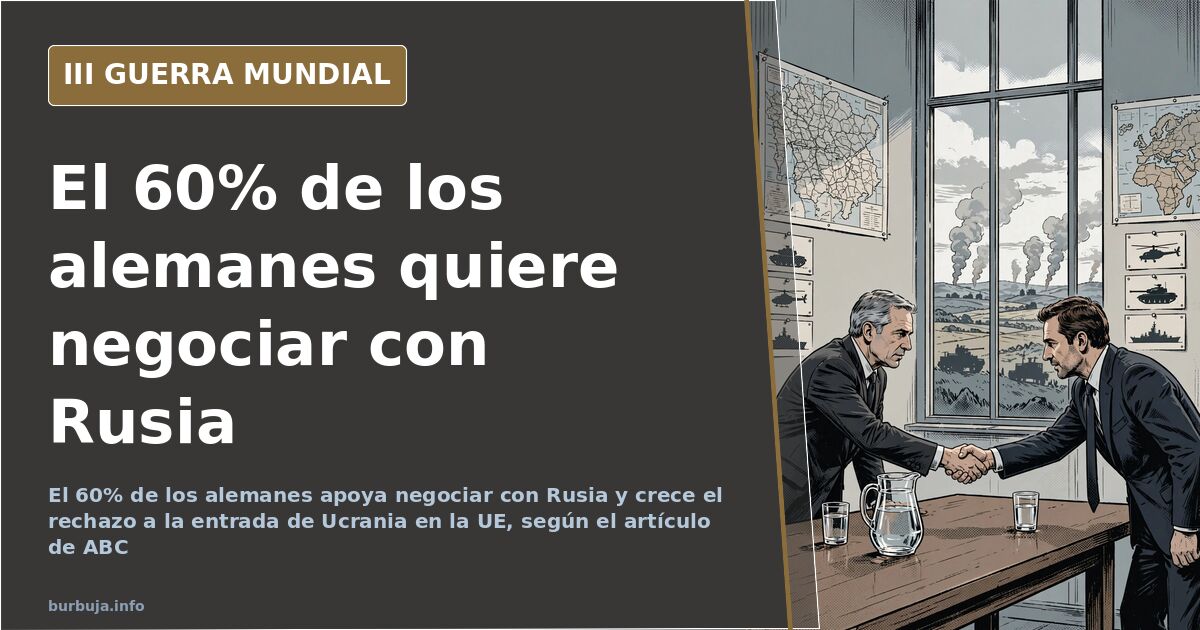
Germany Divided: 60% Support Negotiating with Russia
What happens when the country footing much of a war’s bill starts doubting the conflict? Germany no longer hides its answer. According to an ABC article by its Berlin correspondent, 60% of German citizens support negotiating with Russia, and rejection of Ukraine’s entry into the European Union is rising, as Moscow extends its influence in the east. The text points to the cause: the cultural and political legacy of 40 years of communism in eastern Germany still takes its toll. This data has sparked a debate far beyond a simple poll.
The 60% Who Want Talks and the 40% Who Don’t Get It
Let’s set the scene. That 60% isn’t calling for surrender or switching sides; they want dialogue. Notably, this figure rises alongside growing opposition to Ukraine joining the EU—two trends Brussels sees as one problem. Meanwhile, tension peaked when German President Frank-Walter Steinmeier had to shelter in an air-raid bunker during his visit to Kyiv, according to the same source. A head of state underground while public opinion looks toward Moscow. For some observers, the remaining 40% simply don’t grasp the situation; for others, the 60% is too low.
Why Energy Decides Elections in Germany?
Because most of its industry was built on cheap Russian pipeline gas. Two decades of affordable energy allowed Germany to be ultra-competitive, maintain high quality standards, and weather crises like 2008 by expanding its export dominance in Europe, argues the discussion. In this view, dealings with Moscow weren’t naive or enslaving but excellent business for both parties. The corollary is uncomfortable for those demanding an immediate cutoff.
From One Dependency to Another, and the New One Costs More
For years, dependence on Russian gas was warned against. Now, dependence is on US gas, 40% more expensive according to circulating figures, bringing along cultural influence, military bases, globalist doctrines, and energy costs. A repeated stance sums it up bluntly: 100% dominated. Add the industrial argument: Germany is dismantling itself, with rising costs and job losses. The recurring conclusion—that supporting Ukraine and fighting Russia impoverishes the European taxpayer—is stated plainly.
The Vassalage Thesis: Occupied Since 1945
One current goes further, arguing Germany has been a subordinate state since WWII ended, with the EU functioning as an occupation structure. The historical detail cited is telling: when the Wall fell, Soviet troops left the East, but US troops remain in the West. From there, it’s a short step for some to imagine protests surrounding Ramstein Air Base. At the ironic extreme, a recurring joke claims the last great German president was Erich Honecker.
The Failed Calculation and Coming Reconstruction
The original plan was simple: support Ukraine to please Washington, assume Russia would achieve its goals in months, then return to cheap gas. The second step failed, worsening as the war drags on. Another hypothesis suggests Americans might push Kyiv to negotiate to let their companies enter reconstruction early—a sort of new Marshall Plan. Unconfirmed, it fits the logic of who pays.
Catherine the Great, St. Petersburg, and Mutual Influence
A rarely mentioned historical curiosity: Russophobia wasn’t always present. German culture was strong in Russia from Catherine the Great onward, and the imperial capital’s name, St. Petersburg, carries burg, a Germanic root, noted one participant. Conversely, Germany respects Russian culture, with clear German traces in its music. Seen this way, today’s rift looks less like a clash of civilizations and more like neighbors who spent two centuries borrowing each other’s books.
What Remains to Be Seen
It remains that part of the other 40%, according to the conversation, doesn’t understand what’s at stake. With such a base, the question isn’t if Germany will negotiate with Russia, but how long before admitting it has been doing so quietly.
What happens when the country footing much of a war’s bill starts doubting the conflict? Germany no longer hides its answer. According to an ABC article by its Berlin correspondent, 60% of German citizens support negotiating with Russia, and rejection of Ukraine’s entry into the European Union is rising, as Moscow extends its influence in the east. The text points to the cause: the cultural and political legacy of 40 years of communism in eastern Germany still takes its toll. This data has sparked a debate far beyond a simple poll.
The 60% Who Want Talks and the 40% Who Don’t Get It
Let’s set the scene. That 60% isn’t calling for surrender or switching sides; they want dialogue. Notably, this figure rises alongside growing opposition to Ukraine joining the EU—two trends Brussels sees as one problem. Meanwhile, tension peaked when German President Frank-Walter Steinmeier had to shelter in an air-raid bunker during his visit to Kyiv, according to the same source. A head of state underground while public opinion looks toward Moscow. For some observers, the remaining 40% simply don’t grasp the situation; for others, the 60% is too low.
Why Energy Decides Elections in Germany?
Because most of its industry was built on cheap Russian pipeline gas. Two decades of affordable energy allowed Germany to be ultra-competitive, maintain high quality standards, and weather crises like 2008 by expanding its export dominance in Europe, argues the discussion. In this view, dealings with Moscow weren’t naive or enslaving but excellent business for both parties. The corollary is uncomfortable for those demanding an immediate cutoff.
From One Dependency to Another, and the New One Costs More
For years, dependence on Russian gas was warned against. Now, dependence is on US gas, 40% more expensive according to circulating figures, bringing along cultural influence, military bases, globalist doctrines, and energy costs. A repeated stance sums it up bluntly: 100% dominated. Add the industrial argument: Germany is dismantling itself, with rising costs and job losses. The recurring conclusion—that supporting Ukraine and fighting Russia impoverishes the European taxpayer—is stated plainly.
The Vassalage Thesis: Occupied Since 1945
One current goes further, arguing Germany has been a subordinate state since WWII ended, with the EU functioning as an occupation structure. The historical detail cited is telling: when the Wall fell, Soviet troops left the East, but US troops remain in the West. From there, it’s a short step for some to imagine protests surrounding Ramstein Air Base. At the ironic extreme, a recurring joke claims the last great German president was Erich Honecker.
The Failed Calculation and Coming Reconstruction
The original plan was simple: support Ukraine to please Washington, assume Russia would achieve its goals in months, then return to cheap gas. The second step failed, worsening as the war drags on. Another hypothesis suggests Americans might push Kyiv to negotiate to let their companies enter reconstruction early—a sort of new Marshall Plan. Unconfirmed, it fits the logic of who pays.
Catherine the Great, St. Petersburg, and Mutual Influence
A rarely mentioned historical curiosity: Russophobia wasn’t always present. German culture was strong in Russia from Catherine the Great onward, and the imperial capital’s name, St. Petersburg, carries burg, a Germanic root, noted one participant. Conversely, Germany respects Russian culture, with clear German traces in its music. Seen this way, today’s rift looks less like a clash of civilizations and more like neighbors who spent two centuries borrowing each other’s books.
What Remains to Be Seen
It remains that part of the other 40%, according to the conversation, doesn’t understand what’s at stake. With such a base, the question isn’t if Germany will negotiate with Russia, but how long before admitting it has been doing so quietly.
Also available in: Deutsch
Summary of a discussion on Burbuja.info - Foro de economía, actualidad y política., translated from Spanish and reviewed before publication. Read the full discussion (125 replies).
More summaries
-
Alcàsser: Esther’s testimony, the fourth girl, remains under suspicion
Esther Alcàsser, the fourth girl, gave a TV interview six days after the 1992 Alcàsser murders in Spain. Her account and timeline discrepancies fuel ongoing controversy.
-
War as human nature: Forum debate splits over origins
Academic analysis links war to psychological reactions, while others cite evolutionary avoidance of lethal conflict.
-
Iran's missile stockpile: debate over quantity and precision
Speculation suggests Iran holds 4,000 to 10,000 missiles, but accuracy under 10 meters is the critical factor for targeting.
-
US vetoes Palestinian UN membership amid diplomatic standoff
The US blocked Palestine's UN bid while France voted yes and the UK abstained. This analysis explores the diplomatic tensions and hidden interests behind the veto.
-
Russia Offers May Victory Day Truce, Threatens Kyiv
Russia declares a unilateral ceasefire for May 8-9, 2026, but threatens to destroy Kyiv if Ukraine attacks during the parade.
-
Putin Predicts Elite Shift, Blames US for Crisis
Putin forecasts elite changes and warns EU could lose $400 billion. Spain's U6 unemployment rate may hit 40%.