
Genealogy proposed as voting and aid eligibility filter
Debate on requiring proven Spanish ancestry for voting or public aid, contrasting lineage myths with genetic reality.
English · Original discussion in Spanish · Published
Genealogy proposed as voting and aid eligibility filter
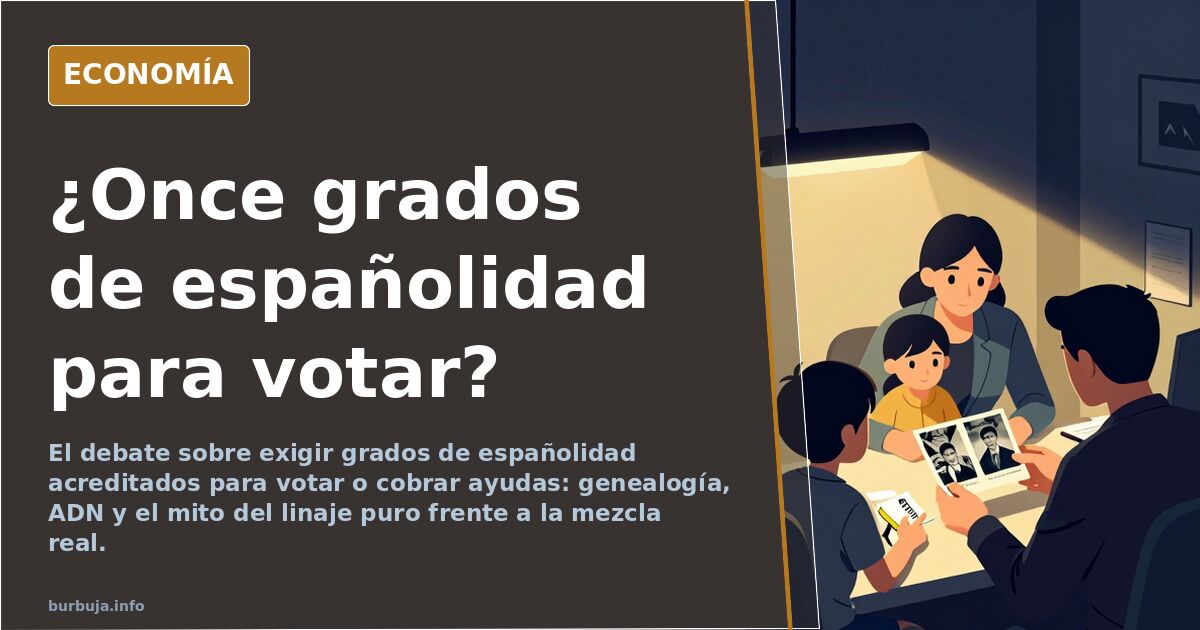
How many degrees of Spanishness do you have? This question, framed almost like a notarial exercise, has sparked debate over whether access to basic rights—voting, subsidies—should depend on proven ancestry. The original proposal claims eleven full degrees of Spanish ancestors and argues such certifications "should be required to receive aid or vote." The idea quickly met an obvious counterargument: if genealogical purity is the criterion, most people are excluded, not due to lack of surnames, but because mixing is the norm.
What are these degrees of Spanishness
The system proposed in the initial message works like a ladder: Spanish parents equal one degree; four grandparents, two; eight great-grandparents, three. Beyond that, family memory fades. The author claims eleven fully certified degrees and adds that "few people reach my level." Presented as exceptional, this figure is actually quite common in any town with decent parish records: some have reconstructed their tree back to the 17th century, others document twelve generations born in the same municipality.
The interesting part isn't the record, but its intended use. Linking ancestry to voting rights or public aid turns a genealogical hobby into an administrative filter. That is where consensus breaks down.
All Spaniards until the 17th century, then what
Several messages provide specific data. One claims genealogy traced back to 1300, with Castilian names and surnames confirmed by DNA testing. Another reached 1850 without surprises. A third mentions twelve generations born in the same Alicante municipality, with one foreign ancestor arriving after the expulsion of the Moriscos. The recurring conclusion is that the obsession with certifying Spanishness belongs mostly to those who suspect they aren't fully Spanish.
Nuance comes from those noting documentation exists up to the 17th century, but earlier history is murky. In that fog lies everything: pilgrims on the Camino de Santiago who stayed, peasants who didn't move for generations, and a mix rarely involving North Africa, more often neighbors from the north. One message summarizes the paradox: for five centuries, mestizaje was "minimal," and before that, it involved more French than anything else.
DNA debunks the pure lineage narrative
Genetics introduces an uncomfortable element. A participant with ancestors documented to 1850 discovers 19% French ancestry in their test, despite no Gallic surnames in the tree. Another mentions a Portuguese great-grandfather. The conclusion is that surnames tell one story and DNA another, with less overlap than lineage pride suggests.
This doesn't stop blood being invoked as a criterion. Some argue "the nation is in the blood" or claim to be "Spanish since time immemorial." The most repeated rebuttal is that nationality is a document, not a chromosome: the ID card, it is said, goes to anyone.
Underdevelopment as argument and insult
The discussion shifts to economics. One message dismisses eleven degrees of Spanishness as eleven degrees of belonging to "one of Europe's most underdeveloped countries." The response trinc: underdevelopment, it is argued, results from proximity to Africa and America, continents radiating misery. Geographic arguments replace genealogical ones but maintain the same logic of hierarchy among peoples.
A counterpoint notes that most ancestors of anyone, Spanish or not, were starving peasants. Origin matters little when the common denominator is slavery and survival.
Who pays and who collects
The most interesting twist connects the genealogical proposal to taxation. If voting or collecting paid services requires eleven degrees of Spanishness, what about taxes paid by non-Spaniards? One participant asks directly: if you're "dirty blood" for voting, surely you dislike your tax money going elsewhere. The question hangs in the air.
The discussion closes, as usual, with a disorienting fact: slavery was abolished in Cuba in 1886, 138 years ago. A reminder that blood purity as a legal criterion has a recent and unflattering history.
With these elements, the proposal to require degrees of Spanishness for voting or aid seems unlikely to succeed. But the debate leaves an uncomfortable truth: most who boast of lineage haven't checked their DNA, and those who did found surprises.
Also available in: Deutsch
Summary of a discussion on Burbuja.info - Foro de economía, actualidad y política., translated from Spanish and reviewed before publication. Read the full discussion (198 replies).
More summaries
-
Cheating on the Camino: One Minute of Pleasure, Days of Regret
A pilgrim admits to a brief affair with a stranger during his six-day walk on Spain's Camino de Santiago, sparking debate on whether to confess or stay silent.
-
Spain's Justice Ministry begins pardon process for ERE case convicts
The Ministry of Justice has started the pardon procedure for José Antonio Griñán and other convicted officials in Spain's major ERE corruption scandal, according to ABC.
-
Debate in Spain over €46 artisanal panettone price
An artisanal panettone priced at €46 has sparked online debate, with users split between luxury quality and excessive marketing.
-
Macron deploys 70,000 police officers and military equipment against riots
Macron mobilizes 70,000 police officers and military equipment against the riots in France. Boarded-up shops, tear gas and an unprecedented deployment.
-
Plumbers now outearn engineers as skills shortage bites
Plumbers and electricians in Spain are raising their rates amid a shortage of skilled tradespeople, but high earnings depend on having your own clients and bearing the costs of…
-
Oxford study ranks A Coruña as Spain's best city to live in
The Oxford Global Cities Index 2026 places A Coruña 68th out of 1,000 cities and first in Spain for quality of life. Here's what it measures and where it falls short.