
Cheating on the Camino: One Minute of Pleasure, Days of Regret
A pilgrim admits to a brief affair with a stranger during his six-day walk on Spain's Camino de Santiago, sparking debate on whether to confess or stay silent.
English · Original discussion in Spanish · Published
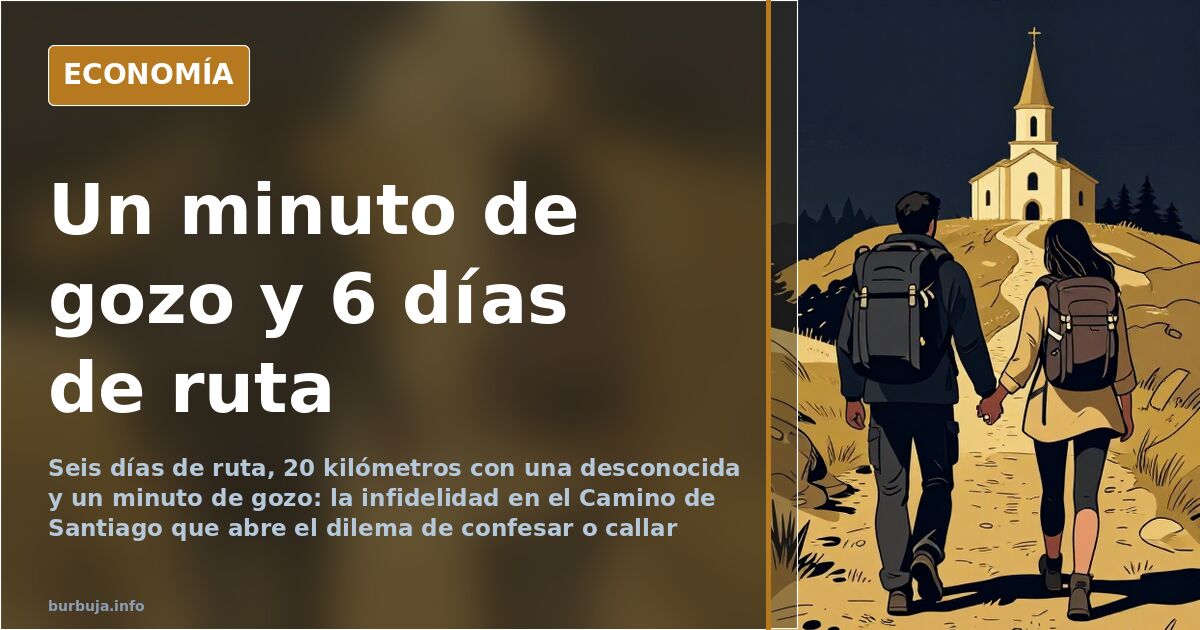
One minute of pleasure and 6 days of walking: the affair that isn't worth it
Six days of walking, twenty kilometers shared, and one minute of pleasure. The arithmetic performed by the protagonist of this story is that of a bad deal: he says he is "devastated," wants to cry, and carries a doubt that prevents him from walking. Should he tell his girlfriend or keep quiet? The infidelity on the Camino de Santiago narrated by this pilgrim—starting from Asturias, car parked in Oviedo, backpack and desire to disconnect—ends up becoming an emotional and logistical problem for which he finds no solution.
He recounts the facts without embellishment. He had set off alone, with 6 days of route ahead. On the way, he met a Swiss woman traveling alone; they walked 20 kilometers together until reaching the albergue (pilgrim hostel) already in Galicia, had dinner, and she wanted to sleep next to him. They ended up in the same bed. He himself summarizes the result with a phrase that has become the summary of everything: "My body felt joy for 1 minute. It wasn't worth it."
Confess the infidelity or stay silent?
It is the question he asks himself and the one that concentrates the disagreement. A large part of the responses urge silence: the episode is interpreted as a one-off mistake that does not deserve to blow up a relationship, always with the condition of not repeating it. Opposing this, another line argues that hiding it turns the lie into a longer and more expensive problem than the infidelity itself. And a third, colder approach, reduces everything to a pending decision: work on the relationship or leave it, but do not maintain it out of inertia.
There is even a formula circulating that summarizes the relativism of many responses: what happens on the Camino stays on the Camino. It sounds like a joke, but it describes an elastic sarracena where damage is measured by what is known, not by what was done.
The couple was already in crisis before the albergue
The story itself acknowledges that the relationship "had been in crisis for a long time due to fighting, often over political issues." He places his partner on the right wing and admits he doesn't know if he should leave her, with remorse looming. Here lies the data point many emphasize: the episode did not create the problem, it exposed it.
When weariness comes from repeated arguments, infidelity functions as both a trigger and an excuse. Some read the encounter as a symptom of a breakup that was already written; others warn of the opposite risk, using it to avoid facing the pending conversation.
Why does the religious framework of the route weigh so heavily?
Because the pilgrimage carries a meaning that the episode contradicts abruptly. There are harsh reproaches for those who walk the Camino without belief and end up in someone else's bed; there is mockery about apostles, indulgences, and misunderstood penance; and some, with irony, recall that contrition does not fix anything on its own. The Apostle forgives, they write, and immediately laugh at their own phrase.
The episode also leaves a detail that several consider the real problem: the woman gave him her number, invited him to visit her, and wants to finish the route by his side. It was not an inconsequential encounter. There is an open door and a phone that might ring again.
The cost: continuing, returning, or prolonging the lie
The material aspect is not minor. The car remains in Oviedo and the return alucinación involves taking a bus; he does not feel able to continue walking while the other person wants to do so by his side. Here three decisions mix—emotion, logistics, and partnership—that do not admit separate solutions.
The most sensible answers separate the short term from the long term: finishing the route fixes nothing, running back home neither. What cannot be sustained is keeping two doors open while deciding. With the story cut off at that point, the question remains the same: how long does it take for one minute to stop hurting?
Six days of walking, twenty kilometers shared, and one minute of pleasure. The arithmetic performed by the protagonist of this story is that of a bad deal: he says he is "devastated," wants to cry, and carries a doubt that prevents him from walking. Should he tell his girlfriend or keep quiet? The infidelity on the Camino de Santiago narrated by this pilgrim—starting from Asturias, car parked in Oviedo, backpack and desire to disconnect—ends up becoming an emotional and logistical problem for which he finds no solution.
He recounts the facts without embellishment. He had set off alone, with 6 days of route ahead. On the way, he met a Swiss woman traveling alone; they walked 20 kilometers together until reaching the albergue (pilgrim hostel) already in Galicia, had dinner, and she wanted to sleep next to him. They ended up in the same bed. He himself summarizes the result with a phrase that has become the summary of everything: "My body felt joy for 1 minute. It wasn't worth it."
Confess the infidelity or stay silent?
It is the question he asks himself and the one that concentrates the disagreement. A large part of the responses urge silence: the episode is interpreted as a one-off mistake that does not deserve to blow up a relationship, always with the condition of not repeating it. Opposing this, another line argues that hiding it turns the lie into a longer and more expensive problem than the infidelity itself. And a third, colder approach, reduces everything to a pending decision: work on the relationship or leave it, but do not maintain it out of inertia.
There is even a formula circulating that summarizes the relativism of many responses: what happens on the Camino stays on the Camino. It sounds like a joke, but it describes an elastic sarracena where damage is measured by what is known, not by what was done.
The couple was already in crisis before the albergue
The story itself acknowledges that the relationship "had been in crisis for a long time due to fighting, often over political issues." He places his partner on the right wing and admits he doesn't know if he should leave her, with remorse looming. Here lies the data point many emphasize: the episode did not create the problem, it exposed it.
When weariness comes from repeated arguments, infidelity functions as both a trigger and an excuse. Some read the encounter as a symptom of a breakup that was already written; others warn of the opposite risk, using it to avoid facing the pending conversation.
Why does the religious framework of the route weigh so heavily?
Because the pilgrimage carries a meaning that the episode contradicts abruptly. There are harsh reproaches for those who walk the Camino without belief and end up in someone else's bed; there is mockery about apostles, indulgences, and misunderstood penance; and some, with irony, recall that contrition does not fix anything on its own. The Apostle forgives, they write, and immediately laugh at their own phrase.
The episode also leaves a detail that several consider the real problem: the woman gave him her number, invited him to visit her, and wants to finish the route by his side. It was not an inconsequential encounter. There is an open door and a phone that might ring again.
The cost: continuing, returning, or prolonging the lie
The material aspect is not minor. The car remains in Oviedo and the return alucinación involves taking a bus; he does not feel able to continue walking while the other person wants to do so by his side. Here three decisions mix—emotion, logistics, and partnership—that do not admit separate solutions.
The most sensible answers separate the short term from the long term: finishing the route fixes nothing, running back home neither. What cannot be sustained is keeping two doors open while deciding. With the story cut off at that point, the question remains the same: how long does it take for one minute to stop hurting?
Summary of a discussion on Burbuja.info - Foro de economía, actualidad y política., translated from Spanish and reviewed before publication. Read the full discussion (176 replies).
More summaries
-
Man beheads father in Spain, leaves head at roundabout
A man was arrested in Asturias after decapitating his father with an axe and leaving the head on a roundabout near Oviedo, injuring several people.
-
Cantabrian Coast: From €1M in Basque Country to €45k in Galicia
Basque coastal homes exceed €1 million, while Galicia offers apartments with garages from €45,000. Here is the price hierarchy along Spain's northern coast.
-
Spain: Tunnel Collapse Hits Commuter Train in Asturias
A tunnel wall collapsed on a commuter train in Asturias, Spain. No injuries, but the incident reignites debate over rail network safety.
-
Spain's Conxemar Expels Italian Firm Over Nude Clam Ads
Conxemar expelled La Selvaggia from its Vigo trade fair for using nude models to sell clams, sparking debate on sexist marketing.
-
Ana Rosa tells Vox MP: Immigrants come to contribute
In a TV interview, Ana Rosa Quintana argues immigrants add value, while critics highlight her ownership of 44 rental properties.
-
Moncloa boosts Alvise to curb Vox's 20% support
Forum thread claims Moncloa promotes Alvise to reduce Vox seats. One million votes might yield no MPs but could shift several.