
Gaza's Economy: Aid, Smuggling, and 50% Unemployment
With two million people in a small strip and no visible industry, Gaza relies on international aid, precarious jobs in Israel, and smuggling.
English · Original discussion in Spanish · Published
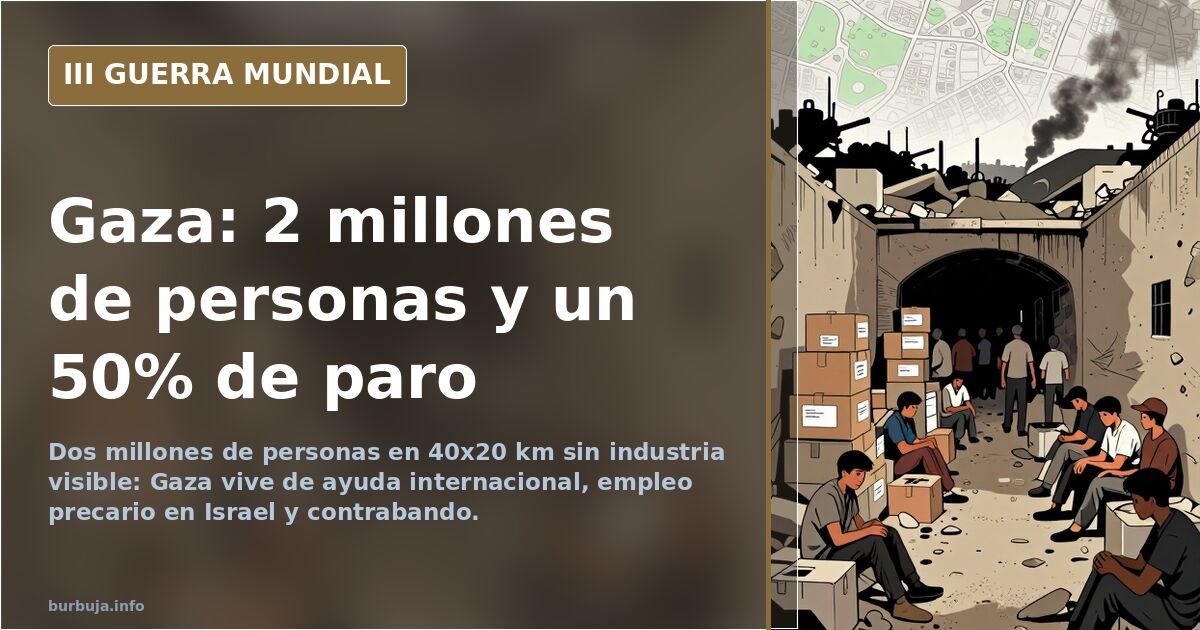
Gaza's Economy: Aid, Tunnels, and 50% Unemployment
What sustains Gaza? The question is blunt and uncomfortable, and the full answer doesn't fit in a headline: it lives on international aid, precarious employment across the border, smuggling, and funds sent by third countries with their own interests. Two million people live in a rectangle roughly 40 kilometers long and 20 wide, without any industry visible from the border. That absence of smokestacks triggers the question. And fuels the crudest answers.
A Strip of 40 by 20 Kilometers and Two Million Inhabitants
The idea of Gaza as the most densely populated area on the planet has circulated for years. Not everyone buys it: some argue it's one of those facts media repeat until they take up permanent residence, and that the actual density, while extremely high, doesn't top any global ranking. What no one disputes is the starting point: two million people, a tiny territory, and a young population growing at an unsustainable rate without external inputs.
That detail often deceives. Half the world has no smoking chimneys, yet production happens. Gaza is different: it isn't a self-sustaining economy, but a territory whose material survival hangs on flows arriving from outside.
What Sustains Gaza? Aid, Tunnels, and Third-Party Funds
Everything coming in adds up. Official development aid channeled through international bodies, cooperation from cities and regions, basic services like electricity, water, and telecoms, private transfers, and funding from Arab countries interested in the hornet's nest. According to a calculation circulating in this thread, if you sum all those items—accounted for and unaccountable—and divide them by two million, the resulting per capita income doesn't look like that of an underdeveloped country. The trap is elsewhere: the number measures what enters, not who receives it.
There lies the knot. As argued in the thread, since 2006 Gaza has been administered by Hamas without elections, so the destination of billions in aid remains in the shadows. One side claims the money is entirely diverted and the population serves as a pretext. The other responds that dependency and blockade are not choices, but a siege. No one gives ground.
50% Unemployment and Work Across the Fence
One user estimates unemployment at 50% of the population. Those who work do so, in part, for Israeli employers as cheap labor, without papers or rights. Others live off petty trade and smuggling, and the little one earns feeds an entire family. It is a subsistence economy shaped like a city: it doesn't distribute wealth; it survives.
West Bank, Spain, and the Painful Comparison
The figures placed alongside are the most unsettling. The West Bank, with an average age of 22 years, records 13% unemployment; Spain, with a much older demographic pyramid, sits at 30% youth unemployment. The comparison justifies nothing, but dismantles the idea that a territory only functions if it has factories emitting smoke. Some flip the question: "And what do Spaniards live on?"
Israel Also Produces: From Drip Irrigation to Diamonds
On the other side of the fence, the contrast drawn by some users is notable: Israel would have a per capita income higher than Spain's and a tech sector that, according to a list circulating in the thread, exports software, cybersecurity, artificial intelligence, and medical equipment, plus chemicals, pharmaceuticals, and cut diamonds. Systems for farming with little water, for example, which here are imported as loose parts to modify hoses. And an operation that sums up the level: Mellanox was sold to Nvidia for $8 billion.
Where the initial investment to build all that came from is precisely the question no one closes. The easy answer, from the sky, isn't traded on the stock exchange.
The 300 Spaniards and the Rest of the Map
A detail highlighted by one user: according to him, there are nearly 300 Spaniards living in the strip. Naturalized citizens, journalists, aid workers, or marriages with residents—the figure is puzzling. And it's not the only comparison appearing: someone brings up Madrid's Cañada Real, "two years without power and they're still there," or Nigeria's demographic growth between 1950 and 2023, that data point that leaves arguments empty for those who only look at birth rates.
With 50% unemployment, two million inhabitants, and an income dependent on what outsiders decide to send, the initial question answers itself and simultaneously becomes complicated. We know broadly what sustains Gaza. Who pays the final bill remains someone else's business.
What sustains Gaza? The question is blunt and uncomfortable, and the full answer doesn't fit in a headline: it lives on international aid, precarious employment across the border, smuggling, and funds sent by third countries with their own interests. Two million people live in a rectangle roughly 40 kilometers long and 20 wide, without any industry visible from the border. That absence of smokestacks triggers the question. And fuels the crudest answers.
A Strip of 40 by 20 Kilometers and Two Million Inhabitants
The idea of Gaza as the most densely populated area on the planet has circulated for years. Not everyone buys it: some argue it's one of those facts media repeat until they take up permanent residence, and that the actual density, while extremely high, doesn't top any global ranking. What no one disputes is the starting point: two million people, a tiny territory, and a young population growing at an unsustainable rate without external inputs.
That detail often deceives. Half the world has no smoking chimneys, yet production happens. Gaza is different: it isn't a self-sustaining economy, but a territory whose material survival hangs on flows arriving from outside.
What Sustains Gaza? Aid, Tunnels, and Third-Party Funds
Everything coming in adds up. Official development aid channeled through international bodies, cooperation from cities and regions, basic services like electricity, water, and telecoms, private transfers, and funding from Arab countries interested in the hornet's nest. According to a calculation circulating in this thread, if you sum all those items—accounted for and unaccountable—and divide them by two million, the resulting per capita income doesn't look like that of an underdeveloped country. The trap is elsewhere: the number measures what enters, not who receives it.
There lies the knot. As argued in the thread, since 2006 Gaza has been administered by Hamas without elections, so the destination of billions in aid remains in the shadows. One side claims the money is entirely diverted and the population serves as a pretext. The other responds that dependency and blockade are not choices, but a siege. No one gives ground.
50% Unemployment and Work Across the Fence
One user estimates unemployment at 50% of the population. Those who work do so, in part, for Israeli employers as cheap labor, without papers or rights. Others live off petty trade and smuggling, and the little one earns feeds an entire family. It is a subsistence economy shaped like a city: it doesn't distribute wealth; it survives.
West Bank, Spain, and the Painful Comparison
The figures placed alongside are the most unsettling. The West Bank, with an average age of 22 years, records 13% unemployment; Spain, with a much older demographic pyramid, sits at 30% youth unemployment. The comparison justifies nothing, but dismantles the idea that a territory only functions if it has factories emitting smoke. Some flip the question: "And what do Spaniards live on?"
Israel Also Produces: From Drip Irrigation to Diamonds
On the other side of the fence, the contrast drawn by some users is notable: Israel would have a per capita income higher than Spain's and a tech sector that, according to a list circulating in the thread, exports software, cybersecurity, artificial intelligence, and medical equipment, plus chemicals, pharmaceuticals, and cut diamonds. Systems for farming with little water, for example, which here are imported as loose parts to modify hoses. And an operation that sums up the level: Mellanox was sold to Nvidia for $8 billion.
Where the initial investment to build all that came from is precisely the question no one closes. The easy answer, from the sky, isn't traded on the stock exchange.
The 300 Spaniards and the Rest of the Map
A detail highlighted by one user: according to him, there are nearly 300 Spaniards living in the strip. Naturalized citizens, journalists, aid workers, or marriages with residents—the figure is puzzling. And it's not the only comparison appearing: someone brings up Madrid's Cañada Real, "two years without power and they're still there," or Nigeria's demographic growth between 1950 and 2023, that data point that leaves arguments empty for those who only look at birth rates.
With 50% unemployment, two million inhabitants, and an income dependent on what outsiders decide to send, the initial question answers itself and simultaneously becomes complicated. We know broadly what sustains Gaza. Who pays the final bill remains someone else's business.
Also available in: Deutsch
Summary of a discussion on Burbuja.info - Foro de economía, actualidad y política., translated from Spanish and reviewed before publication. Read the full discussion (121 replies).
More summaries
-
Israel's 20% ammunition claim and the urban warfare trap
Reports suggest Israel faces Gaza ground assault with only 20% of its munitions, a scenario Hamas allegedly seeks to force urban combat.
-
Israel Targets Hamas Commander in Gaza Offensive
Israeli forces capture a senior Hamas commander while intensifying airstrikes on Shejaiya, signaling a shift toward targeted operations.
-
Gaza Infiltration: Mossad Faces Scrutiny
The Gaza breach exposes Mossad gaps, reigniting tensions with Iran and Hezbollah amid unproven theories on the attack's origin.
-
Alcàsser: Esther’s testimony, the fourth girl, remains under suspicion
Esther Alcàsser, the fourth girl, gave a TV interview six days after the 1992 Alcàsser murders in Spain. Her account and timeline discrepancies fuel ongoing controversy.
-
Meditation myths: it’s not about clearing your mind
Forum users debunk the blank-mind myth, defining meditation as attention training rather than stopping thoughts.
-
Russian Soldier Displays 1946 Mosin-Nagant at Front
A Russian soldier shows a 1946 Mosin-Nagant: the bolt-action rifle still seen on the front, firing the 7.62x54R cartridge.