
Gaza: High Density and an Economy Dependent on External Aid
Data shows Gaza has 5,000 inhabitants per km². Its economy relies on international aid, work in Israel, and tunnel networks.
English · Original discussion in Spanish · Published
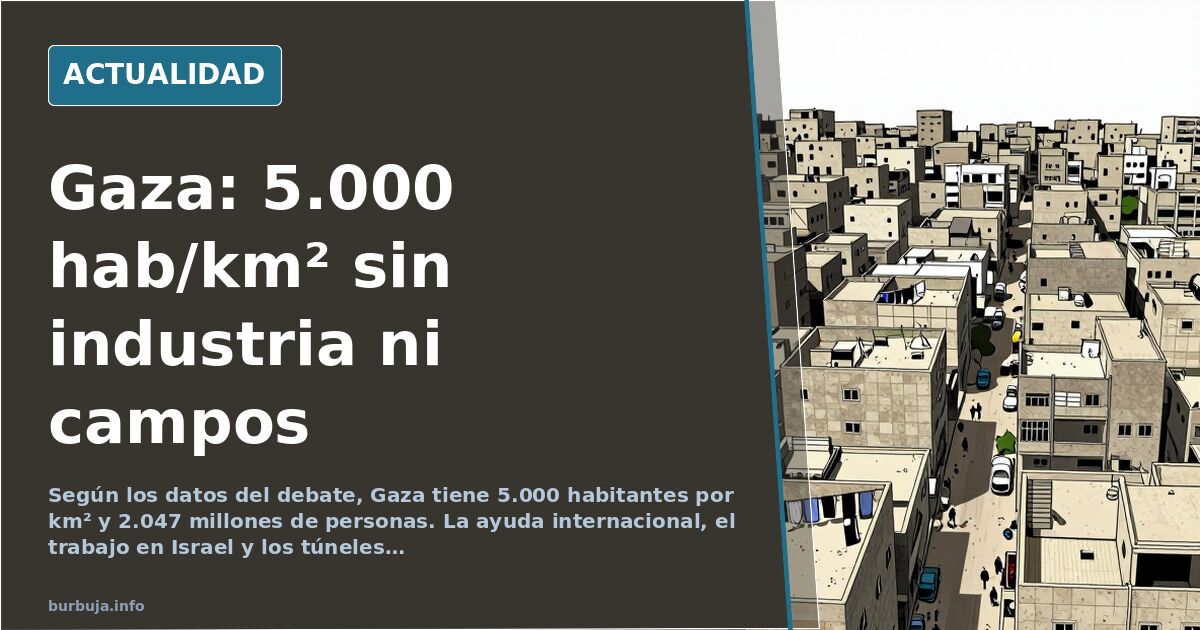
What sustains Gaza? 5,000 people per km² and no industry
Gaza has one of the highest population densities on Earth: 5,000 inhabitants per square kilometer, with 2.047 million people crowded into a territory lacking significant industry, farmland, or livestock. The fundamental question is how this population has survived for decades. The short answer is external support. The long answer involves international aid, employment in Israel, taxes managed by Israeli authorities, and a tunnel economy that never functioned as a normal productive system.
International aid as the primary income source
Historically, survival in Gaza depended heavily on international charity channeled through organizations and local power structures. It is argued that Hamas controlled aid distribution, turning food and medicine deliveries into political currency. Some claim that without constant external resource inflows, the Strip could not have sustained its demographic growth. Counterarguments note that the population multiplied from about 500,000 forty years ago to over two million today, with an average of five children per woman.
Work in Israel and taxes decided by the neighbor
A significant portion of Gazans worked in Israel, earning wages far below Israeli standards while supporting parts of the regional economy with cheap labor. The Oslo Accords stipulated that collected taxes must be transferred to Israel, which decided when and how to release funds for teachers, doctors, and civil servants. Thus, Gaza's public payroll depended on the neighbor's political timeline. As violence escalated, worker crossings were restricted and then cut off entirely.
The underground city and war industry
The other visible economy is tunnels. While debated whether their purpose was military, smuggling, or both, it is undeniable they mobilized resources, materials, and labor. Critics argue this underground construction consumed cement and money that could have gone to civilian infrastructure. Meanwhile, Israel provides electricity and water, charging for them and cutting supply at will. This creates near-perfect dependency: you do not produce what you consume, decide what you pay, or control what leaves.
Why hasn't a normal economy developed in Gaza?
Because the framework did not allow it. Gaza cannot export anything without passing through Israel, which acts as an intermediary and takes a margin. Israeli businesses benefited from cheap labor unable to move elsewhere. Simultaneously, Palestinian political fragmentation and factional conflict prevented building a functional state managing customs, currency, or fiscal policy. The result is a territory producing little and consuming much, externally supported and governed by unaccountable structures.
End of aid and statistical rebounds
When violence intensified, flows of workers and funds stopped. Some voices suggest the Israeli economy also suffered due to lost cheap labor, leading to replacements like Indian workers who, unlike Gazans, have state backing. Debates about Israel's economy growing 3.4% after a 20% drop illustrate how data is interpreted selectively: recovery for some, mere statistical rebound for others.
It is clear Gaza was never an autonomous economic system. It was an economy of transfers, tunnels, and undocumented workers, sustained by foreign aid and neighborly convenience. With such foundations, any prediction about its future is more an act of faith than analysis.
Also available in: Deutsch
Summary of a discussion on Burbuja.info - Foro de economía, actualidad y política., translated from Spanish and reviewed before publication. Read the full discussion (137 replies).
More summaries
-
Gaza: From Hostages to an Evidence-Free Conspiracy Narrative
The Israel-Hamas conflict began with the October 7 hostages and descended into conspiracy theories and biblical prophecies with no evidence.
-
Gaza Narrative Wars: Viral Photos vs. Medical Facts
A viral photo claimed Israel caused starvation in Gaza. A medical diagnosis suggested otherwise. This is how the conflict's narrative is fought.
-
Gaza: Child Starvation and the Battle for the War Narrative
Images of starved children in Gaza spark a debate over famine and war propaganda: some call it a humanitarian disaster, others, a political tool.
-
Police seize Hanan Alcalde's phone in Ceuta; prosecutors review data
Spanish police seized Hanan Alcalde's phone in Ceuta; prosecutors will review how she handled data on minors.
-
Liberal: "freedom is what has made lentils my favourite dish"
The Antonini de Jiménez account posts a question mixing a cheat sheet, Mahom$ and jail. We explain what lies behind that message and why it is being shared.
-
Netflix posts cryptic message: "no one's cooler than her"
Netflix published the phrase "no one's cooler than her" on X without naming anyone. The message arrived with no context, leaving open who the account is referring to.