
Gaza: Child Starvation and the Battle for the War Narrative
Images of starved children in Gaza spark a debate over famine and war propaganda: some call it a humanitarian disaster, others, a political tool.
English · Original discussion in Spanish · Published
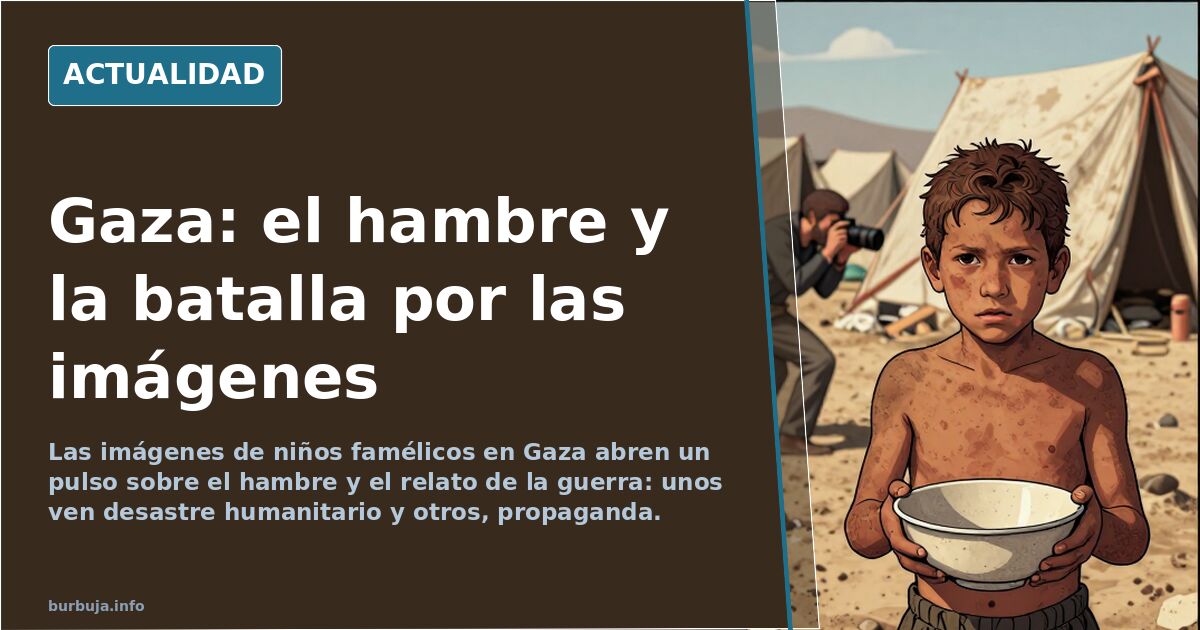
Gaza: Child Starvation and the Battle for the War Narrative
A discussion about Gaza no longer starts with whether to stop the war. It starts with whether the images are real. That is the paradox running through the issue month after month: when suffering becomes propaganda ammunition, even a child’s hunger needs a lawyer. In the Strip, more than two million people live, and the territory has become the epicenter of a humanitarian crisis and an informational tug-of-war that no one fully wins.
Hunger or Disease? The Battle for the Images
The key is not whether children are suffering, but why. That is where the battle is fought. One side claims that videos of emaciated minors are staged and that some cases respond to degenerative diseases, not lack of food. The other side responds that the diagnosis does not matter: if health centers are bombed and medicines do not arrive, the result is the same. The absence of medical supplies turns the discussion about the origin of the harm into an almost obscene nuance.
Available data point exactly to what the initial approach suggests: when food and drugs do not enter, any boundary between hunger and disease blurs. Some claim that a health center administering vaccines was bombed. The consequence, they argue, is the same death toll with a different caption.
Ukraine vs. Gaza: Which Death Takes the Headline
The second front of the debate is media coverage. There is a suspicion of double standards. It is emphasized that the Ukraine war has been on screen for years without generating the same volume of images of starved minors, while Gaza dominates news broadcasts with children in every episode. It is argued that Ukraine retains infrastructure and food, and that this explains the visual difference. Weighing against this is the thesis that it is not geography that decides the frame, but the interest of the narrative.
Everything has been written on this point. Some claim that death and suffering only sell when the dead have a specific passport; and others respond that taking that argument to the extreme would turn any famine into a ratings chapter. The provisional conclusion is uncomfortable: the criterion does not seem humanitarian, but editorial.
From the 1948 Nakba to the Plan Redrawing Gaza
The discussion sinks into history. The 1948 Nakba, with more than 700,000 displaced Palestinians and the so-called Plan Dalet, is cited to defend that the conflict did not start with a surprise attack, but with a planned expulsion. The other reading recalls that in that year a coalition of Arab countries attempted to enter Israel to annul it, and that the division into two states was the solution found by the UN for a territory that was already killing itself.
To this background is added the present. The so-called GREAT Trust plan, attributed to the circle of the US administration and disseminated by international press, circulates, which proposes the total displacement of the more than two million inhabitants of Gaza and the conversion of the territory into a sort of tourist and technological paradise. The idea has rekindled the suspicion that reconstruction is thought of without the reconstructed.
The Spanish Mirror and the Narrative of Allies
Even Spain’s history enters the equation. The international criticism is reproached for forgetting the expulsion of Jews in 1492 while ignoring the efforts that, according to another version, Franco’s government made to rescue Jews from occupied Europe. The data is used as an alibi and a reproach in equal measure: selective memory, they say, as it suits.
The other axis is geopolitical. It is posed what the West would do if another state were to lead something similar, and if alignment with Washington conditions even the condemnations. The diplomatic noise, one part maintains, rarely goes hand in hand with actions: symbolic recognitions, flotillas, and statements, but little else. The question that hovers is whether the distribution of allies decides which lives count as lives.
What No One Closes
The discussion ends, as it began, without agreement. Some call for international intervention to impose a division and a wall, aware that it sounds like utopia. Others defend that the conflict has no negotiated solution and that the only rational thing is not to take sides. And in between remains the data that upsets any cold analysis: minors continue to die while the world debates whether the video was true.
Can you sustain a humanitarian cause when the very narrative of suffering has become a battlefield?
A discussion about Gaza no longer starts with whether to stop the war. It starts with whether the images are real. That is the paradox running through the issue month after month: when suffering becomes propaganda ammunition, even a child’s hunger needs a lawyer. In the Strip, more than two million people live, and the territory has become the epicenter of a humanitarian crisis and an informational tug-of-war that no one fully wins.
Hunger or Disease? The Battle for the Images
The key is not whether children are suffering, but why. That is where the battle is fought. One side claims that videos of emaciated minors are staged and that some cases respond to degenerative diseases, not lack of food. The other side responds that the diagnosis does not matter: if health centers are bombed and medicines do not arrive, the result is the same. The absence of medical supplies turns the discussion about the origin of the harm into an almost obscene nuance.
Available data point exactly to what the initial approach suggests: when food and drugs do not enter, any boundary between hunger and disease blurs. Some claim that a health center administering vaccines was bombed. The consequence, they argue, is the same death toll with a different caption.
Ukraine vs. Gaza: Which Death Takes the Headline
The second front of the debate is media coverage. There is a suspicion of double standards. It is emphasized that the Ukraine war has been on screen for years without generating the same volume of images of starved minors, while Gaza dominates news broadcasts with children in every episode. It is argued that Ukraine retains infrastructure and food, and that this explains the visual difference. Weighing against this is the thesis that it is not geography that decides the frame, but the interest of the narrative.
Everything has been written on this point. Some claim that death and suffering only sell when the dead have a specific passport; and others respond that taking that argument to the extreme would turn any famine into a ratings chapter. The provisional conclusion is uncomfortable: the criterion does not seem humanitarian, but editorial.
From the 1948 Nakba to the Plan Redrawing Gaza
The discussion sinks into history. The 1948 Nakba, with more than 700,000 displaced Palestinians and the so-called Plan Dalet, is cited to defend that the conflict did not start with a surprise attack, but with a planned expulsion. The other reading recalls that in that year a coalition of Arab countries attempted to enter Israel to annul it, and that the division into two states was the solution found by the UN for a territory that was already killing itself.
To this background is added the present. The so-called GREAT Trust plan, attributed to the circle of the US administration and disseminated by international press, circulates, which proposes the total displacement of the more than two million inhabitants of Gaza and the conversion of the territory into a sort of tourist and technological paradise. The idea has rekindled the suspicion that reconstruction is thought of without the reconstructed.
The Spanish Mirror and the Narrative of Allies
Even Spain’s history enters the equation. The international criticism is reproached for forgetting the expulsion of Jews in 1492 while ignoring the efforts that, according to another version, Franco’s government made to rescue Jews from occupied Europe. The data is used as an alibi and a reproach in equal measure: selective memory, they say, as it suits.
The other axis is geopolitical. It is posed what the West would do if another state were to lead something similar, and if alignment with Washington conditions even the condemnations. The diplomatic noise, one part maintains, rarely goes hand in hand with actions: symbolic recognitions, flotillas, and statements, but little else. The question that hovers is whether the distribution of allies decides which lives count as lives.
What No One Closes
The discussion ends, as it began, without agreement. Some call for international intervention to impose a division and a wall, aware that it sounds like utopia. Others defend that the conflict has no negotiated solution and that the only rational thing is not to take sides. And in between remains the data that upsets any cold analysis: minors continue to die while the world debates whether the video was true.
Can you sustain a humanitarian cause when the very narrative of suffering has become a battlefield?
Summary of a discussion on Burbuja.info - Foro de economía, actualidad y política., translated from Spanish and reviewed before publication. Read the full discussion (299 replies).
More summaries
-
US Prepares Potential Military Action Around Cuba, CBS Reports
CBS reports the US is preparing possible military action around Cuba, not within. Spain's "law of grandchildren" and oil factor influence calculations.
-
Belgium reportedly halted US military shipment destined for Morocco
According to the discussion, Belgium allegedly blocked US military material bound for Morocco. The volume or legal basis of the blockade remains unknown.
-
Belarra, a Loaned Red Ferrari and the Remark: «China Is Not This Country»
A thread concerning Belarra mentions a loaned red Ferrari and obtaining a certificate in one week, prompting a user to reply: «China is not this country»
-
Sarah Santaolalla’s Origins Spark Media Scrutiny in Spain
Analysis of speculation regarding TV analyst Sarah Santaolalla’s genealogy and ethnic background in Spain.
-
Execution outside Barcelona police station: The Diamante Case and fears of lawlessness
A hitman kills a Serbian man with an arrest warrant outside a Barcelona police station. The Diamante Case sparks debate on security and organized crime in Spain.
-
Roman engineering vs. ancient civilizations: technology and urban planning
Analysis of Roman urban planning, pressurized water, and technological precedents in China and Greece.