
GameStop: From Bankrupt Retailer to $10 Billion Valuation in Days
GameStop surged from 20-year lows to over $10 billion market cap due to a historic short squeeze, with more shares sold short than available.
English · Original discussion in Spanish · Published
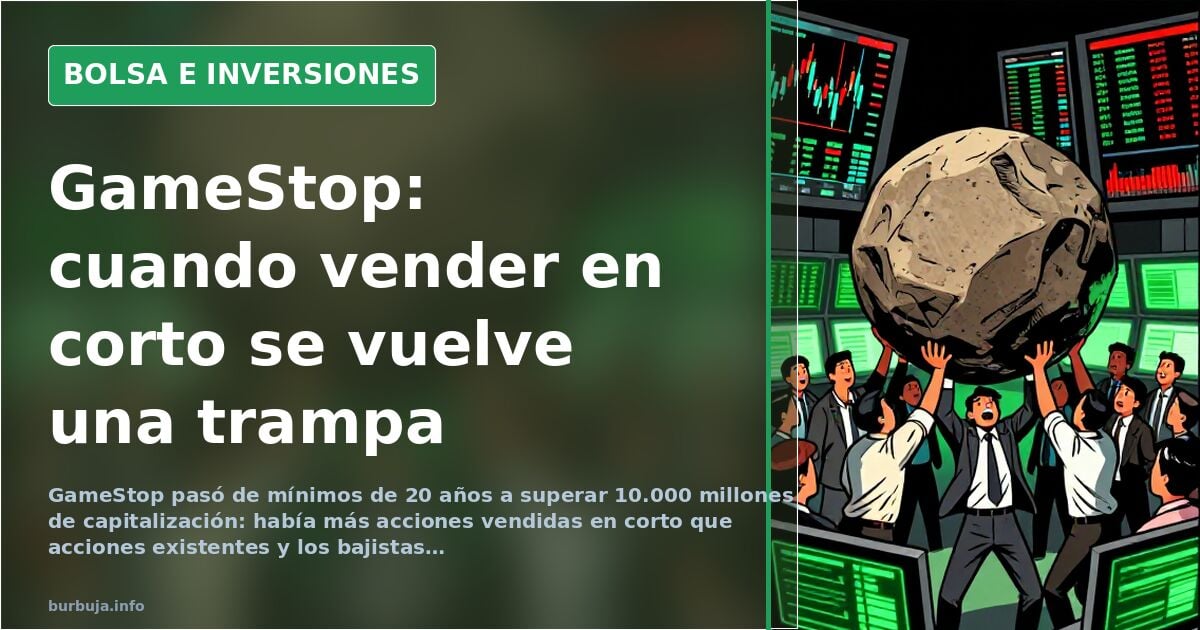
GameStop: The Bankrupt Store That Reached $10 Billion in Days
A video game chain that had gone bankrupt in Spain—its stores eventually absorbed by rival Game—went from trading at two-decade lows to exceeding a $10 billion market capitalization. This wasn't due to selling more consoles or its deal with Microsoft. It peine because there were more shares sold short than existing shares, and those who had lent them began demanding them back. GameStop (GME) staged one of the most violent short squeezes in market memory in early 2021.
The starting point was different: a declining retail business due to Steam, competition from large retailers, and management that for years only seemed to get right the share buybacks. With the pandemic hitting, several hedge funds bet the company would collapse. They misjudged the timing. And when a leveraged fund makes a mistake, the error comes at a price.
From $12 to $320: Chronology of a Windfall
The first known entry was at just over $12. Within days, the stock closed at $31 after hitting an intraday high of $38. No one knew then that this was just the prologue. In a single session, it recorded a 42% gain in ten minutes and, in less than a year, went from twenty-year historical lows to twenty-year historical highs. It had accumulated a 1,900% gain from its lows, outperforming Tesla since the pandemic crash.
The volatility was so extreme that the very money coming in hesitated halfway. Selling at $30 and then seeing $160 hurts any portfolio; holding on and not sleeping over the weekend does too.
Why a Short Interest Above 100% is a Trap
The mechanism is tricky and worth understanding. A large institutional fund lends its shares to a short seller in exchange for a premium; the short seller sells them and expects to buy them back cheaper to return them. So far, so normal. The problem arises when the borrowed stock is lent again: there can be a short interest exceeding 100% of the existing shares, meaning more repayment obligations than physical shares.
If the price rises, the short seller has to post more collateral, and if they can't, they have to buy at any price. With all capital shorted, the forced repurchase becomes a ceiling-less auction. Short sellers lost up to $5 billion in a single day. The most targeted fund, Melvin Capital, had to request $2 billion from its investors to cover margin calls and eventually exited the position, according to circulating reports. Memory does not record such an imbalance in a listed company.
Robinhood Shuts the Door, and the Narrative Crumbles
When the system strains, rules appear. A state securities regulator even requested suspending trading for 30 days. Robinhood, the retail investor's favorite broker, blocked the purchase of GME and other hot stocks. The move cost the broker a flood of one-star reviews on Google Play and a live interrogation by Elon Musk on the Clubhouse app.
For part of the market, it was proof that the "free market" disappears when their own interests are at stake. For another, it confirmed that the broker was in a precarious financial situation and could no longer provide counterparty services. Both could be true at the same time.
Who Really Won from the Rebellion
Here the epic breaks. The large institutional funds were not the enemies: they were the landlords. They lent shares to short sellers and collected the premium. BlackRock earned around $2.4 billion in 21 days from the whole commotion. The retail investor who bought at the peak took the risk; the one who lent the shares, the commission.
The narrative of popular rebellion against Wall Street has an arithmetic problem: the truly powerful, those who move the market with their balance sheets, got rich from commissions and lending. Buying at $320 to take down the system is, at the very least, an original way of financing it.
AMC, Nokia, BlackBerry: The Fever Spreads
Surplus capital sought the next target. AMC, Nokia, and BlackBerry became obvious candidates, with unfavorable pre-market trading and limited orders executing sporadically. Some entered with 100 euros as a lottery ticket, believing the odds were better than the state lottery.
The problem with these operations is the usual one: you enter for the story and exit in a panic. In an asset whose number of shares can double overnight, the strategy of holding without selling is short-lived.
The Capital Increase: The Risk No One Wanted to See
GameStop had previously asked the SEC for authorization to issue up to $100 million in shares to the market. Amid the euphoria, such dilution would barely move the needle and would fill the coffers. Those who argue the company should have done it point to the obvious: with shares soaring, it reduces debt for free.
The other side of the coin is the usual one. Buying a company that can double its capital at a price it decides is playing roulette where the house prints chips. An imaginary example illustrated it well: there are 100 shares of a moving company in the world, no more, and anything lent above that figure is debt disguised as market.
A video game chain that had gone bankrupt in Spain—its stores eventually absorbed by rival Game—went from trading at two-decade lows to exceeding a $10 billion market capitalization. This wasn't due to selling more consoles or its deal with Microsoft. It peine because there were more shares sold short than existing shares, and those who had lent them began demanding them back. GameStop (GME) staged one of the most violent short squeezes in market memory in early 2021.
The starting point was different: a declining retail business due to Steam, competition from large retailers, and management that for years only seemed to get right the share buybacks. With the pandemic hitting, several hedge funds bet the company would collapse. They misjudged the timing. And when a leveraged fund makes a mistake, the error comes at a price.
From $12 to $320: Chronology of a Windfall
The first known entry was at just over $12. Within days, the stock closed at $31 after hitting an intraday high of $38. No one knew then that this was just the prologue. In a single session, it recorded a 42% gain in ten minutes and, in less than a year, went from twenty-year historical lows to twenty-year historical highs. It had accumulated a 1,900% gain from its lows, outperforming Tesla since the pandemic crash.
The volatility was so extreme that the very money coming in hesitated halfway. Selling at $30 and then seeing $160 hurts any portfolio; holding on and not sleeping over the weekend does too.
Why a Short Interest Above 100% is a Trap
The mechanism is tricky and worth understanding. A large institutional fund lends its shares to a short seller in exchange for a premium; the short seller sells them and expects to buy them back cheaper to return them. So far, so normal. The problem arises when the borrowed stock is lent again: there can be a short interest exceeding 100% of the existing shares, meaning more repayment obligations than physical shares.
If the price rises, the short seller has to post more collateral, and if they can't, they have to buy at any price. With all capital shorted, the forced repurchase becomes a ceiling-less auction. Short sellers lost up to $5 billion in a single day. The most targeted fund, Melvin Capital, had to request $2 billion from its investors to cover margin calls and eventually exited the position, according to circulating reports. Memory does not record such an imbalance in a listed company.
Robinhood Shuts the Door, and the Narrative Crumbles
When the system strains, rules appear. A state securities regulator even requested suspending trading for 30 days. Robinhood, the retail investor's favorite broker, blocked the purchase of GME and other hot stocks. The move cost the broker a flood of one-star reviews on Google Play and a live interrogation by Elon Musk on the Clubhouse app.
For part of the market, it was proof that the "free market" disappears when their own interests are at stake. For another, it confirmed that the broker was in a precarious financial situation and could no longer provide counterparty services. Both could be true at the same time.
Who Really Won from the Rebellion
Here the epic breaks. The large institutional funds were not the enemies: they were the landlords. They lent shares to short sellers and collected the premium. BlackRock earned around $2.4 billion in 21 days from the whole commotion. The retail investor who bought at the peak took the risk; the one who lent the shares, the commission.
The narrative of popular rebellion against Wall Street has an arithmetic problem: the truly powerful, those who move the market with their balance sheets, got rich from commissions and lending. Buying at $320 to take down the system is, at the very least, an original way of financing it.
AMC, Nokia, BlackBerry: The Fever Spreads
Surplus capital sought the next target. AMC, Nokia, and BlackBerry became obvious candidates, with unfavorable pre-market trading and limited orders executing sporadically. Some entered with 100 euros as a lottery ticket, believing the odds were better than the state lottery.
The problem with these operations is the usual one: you enter for the story and exit in a panic. In an asset whose number of shares can double overnight, the strategy of holding without selling is short-lived.
The Capital Increase: The Risk No One Wanted to See
GameStop had previously asked the SEC for authorization to issue up to $100 million in shares to the market. Amid the euphoria, such dilution would barely move the needle and would fill the coffers. Those who argue the company should have done it point to the obvious: with shares soaring, it reduces debt for free.
The other side of the coin is the usual one. Buying a company that can double its capital at a price it decides is playing roulette where the house prints chips. An imaginary example illustrated it well: there are 100 shares of a moving company in the world, no more, and anything lent above that figure is debt disguised as market.
Summary of a discussion on Burbuja.info - Foro de economía, actualidad y política., translated from Spanish and reviewed before publication. Read the full discussion (633 replies).
More summaries
-
IAG's 2.15 Bet: A Five-Year Strategy Undone by the Pandemic
Buying 3,500 IAG shares at 2.15 seemed a sure five-year bet. Then came the virus, a capital increase, and a fall to 1.04 euros.
-
Bayer and the Income Dream: 40,000 Shares to Live Off Dividends
Buying Bayer shares at rock-bottom prices and waiting for €80: the fashionable income theory since 2025 and its holes, from glyphosate to Tax Authorities.
-
Buying the Dip or Waiting for Crash: The 2025 Market Dilemma
Centene experienced a 25% fall, AI technology is dividing investors, and market crash predictions are mounting for November. The 2025 investment dilemma: buy now or wait?
-
Gold stuck at 0.382 as bitcoin takes the spotlight
Gold stuck at 0.382 and unable to recover while bitcoin hits 6.000 dollars; thresholds at 1.250 and 1.050 set the scene.
-
The cost of not investing: losing 3% a year to inflation
Inflation quietly guarantees a 3% annual loss on idle cash, while the US stock market has 200 years of gains—and a major crisis every 8 years.
-
Extra virgin olive oil falls to €6.35 a litre at Mercadona
Extra virgin olive oil is now €6.35/litre at Mercadona, down from €6.75 months ago, while the origin price of picual is €4.143/kg