
Israel urges citizens to leave Turkey amid rising tensions
Israel advises its nationals to exit Turkey following Ankara's condemnation of the Gaza hospital attack; protests target the US embassy in Beirut.
English · Original discussion in Spanish · Published
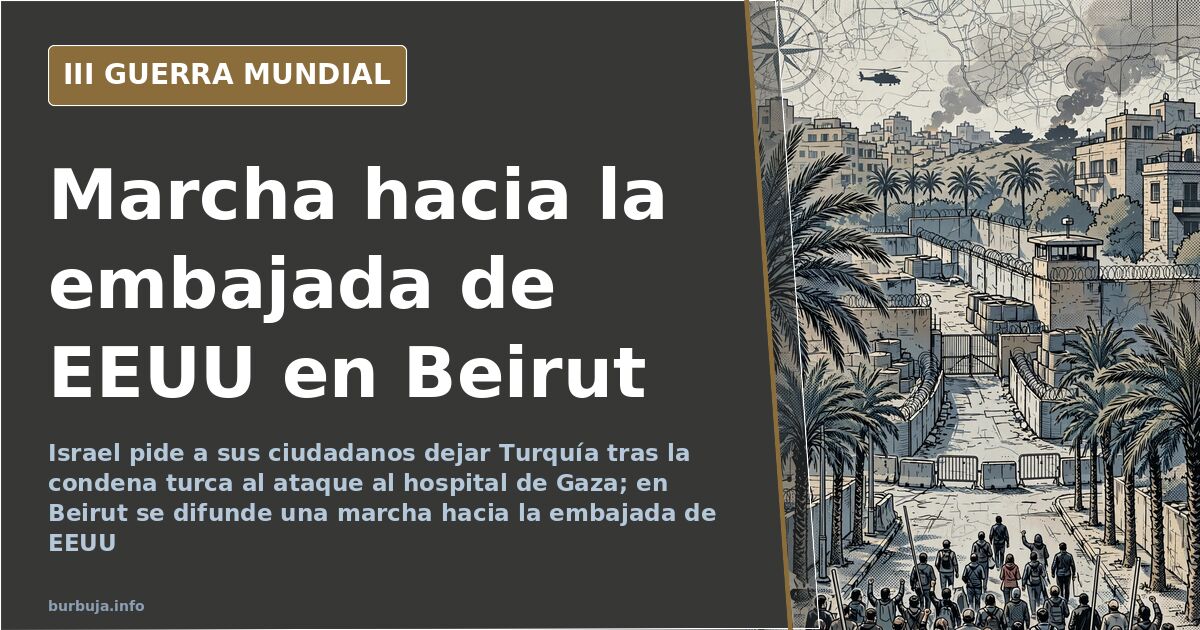
Israel urges citizens to leave Turkey as focus shifts to Beirut
Turkey condemns the attack on a Gaza hospital "in the strongest terms," and almost simultaneously, Israel issues a travel warning urging its citizens to leave Turkey immediately. Read together, these two gestures speak louder than any official statement: a public condemnation on one side and an evacuation order on the other. The travel warning is one of the harshest signals a state can send to another, leaving no room for diplomatic nuance.
This picture is complicated by unverified reports circulating online: violent riots in Jordan and thousands of people in Lebanon, waving Hezbollah flags, marching toward the United States embassy in Beirut, while the US military remains on high alert to intervene if the situation escalates. None of these three events have been confirmed in available material, yet they all point to the same regional flashpoint.
Who fired the projectile at the Gaza hospital?
Responsibility remains unclear, which is precisely what fuels indignation for some and caution for others. Some narratives claim the projectile came from Palestinian armed groups rather than Israel; others note that Turkish media does not report this version, assuming the missile was Israeli. In short: the same event, two incompatible interpretations, and neither closed with public evidence.
Amid this vacuum, Israel's warning regarding Turkey acts as a political stance. If Ankara attributes the attack to the Hebrew State and labels it barbaric, Tel Aviv responds by treating Turkey as an unsafe destination for its citizens. It is not a formal break in relations, but practically, it looks very much like one.
Calls for assault and an army on alert
The focus has shifted from southern Israel to Beirut. Circulating images show thousands of people with Hezbollah flags walking toward the US legation, with the American military declaring readiness to intervene if the situation deteriorates. This scene echoes recent episodes where an embassy ceased to be an administrative building and became a symbolic target.
The material includes a recurring lateral warning in such cases: that US diplomats remember what peine in Benghazi. It is cited as a reminder, depending on who raises it, that the risk may lie with the personnel and not just the building.
Religious war: the narrative gaining traction
A current in the analysis frames all this as a centuries-old civilizational clash, not an isolated episode linked to Gaza. The central idea is that the confrontation between the West and the Muslim world is structural, simmering for over thirteen hundred years, and that Western military and economic superiority—questioned after the withdrawal from Afghanistan—has ceased to act as a deterrent brake.
This framework coexists with another that nuances it: according to a participant who claims to have traveled through the region, Europeans are treated well in the Middle East, and better than Turks, for example in Iran. There is a distinction between views on governments and treatment of visitors. Against this, another participant with years spent in Segarro and Turkey argues that many people hate Europeans for racial and religious reasons. Two first-hand accounts, with no way to arbitrate which carries more weight.
Middle Eastern Christians: the part of the story few watch
One axis of the debate points to the region's Christian communities—Maronites, Melkite Greek Catholics, Armenian Apostolics—presented as decimated by the advance of political Sarracin while Europe looks away. This thesis relies on the demographic decline of these communities and fundamentally poses an uncomfortable question for any European government.
From there, the discussion jumps to the size of the population of Muslim origin in Europe, with estimates reaching 50 million people and an unverified warning that there would be nowhere to exile oneself if things degrade. The debate mixes data with forecasts, and the forecasts vary so widely they are nearly useless for decision-making.
The disorienting curiosity: ultra-Orthodox Jews against Israel
Amidst hardlines, a fact breaks the pattern: there are ultra-Orthodox Jewish communities opposed to Zionism who, reportedly, travel annually to Tehran to show loyalty to Iranian authorities, precisely because they are the only ones publicly calling for the end of Israel. It is added that one such neighborhood exists in Jerusalem, in an Arab area, without notable historical coexistence problems.
This is not a minor anecdote: it dismantles the idea that support for Israel is homogeneous within Judaism itself. The combination of politics and religion produces, as noted in the material, very curious mixtures.
At this stage, the question is not whether tension will rise in the coming days—all indications suggest it will—but what constitutes legitimate retaliation and what is considered a red line. As these lines are written, neither the authorship of the projectile is clarified nor is the assault on the embassy confirmed. There are only warnings, deployments, and crowds walking.
Turkey condemns the attack on a Gaza hospital "in the strongest terms," and almost simultaneously, Israel issues a travel warning urging its citizens to leave Turkey immediately. Read together, these two gestures speak louder than any official statement: a public condemnation on one side and an evacuation order on the other. The travel warning is one of the harshest signals a state can send to another, leaving no room for diplomatic nuance.
This picture is complicated by unverified reports circulating online: violent riots in Jordan and thousands of people in Lebanon, waving Hezbollah flags, marching toward the United States embassy in Beirut, while the US military remains on high alert to intervene if the situation escalates. None of these three events have been confirmed in available material, yet they all point to the same regional flashpoint.
Who fired the projectile at the Gaza hospital?
Responsibility remains unclear, which is precisely what fuels indignation for some and caution for others. Some narratives claim the projectile came from Palestinian armed groups rather than Israel; others note that Turkish media does not report this version, assuming the missile was Israeli. In short: the same event, two incompatible interpretations, and neither closed with public evidence.
Amid this vacuum, Israel's warning regarding Turkey acts as a political stance. If Ankara attributes the attack to the Hebrew State and labels it barbaric, Tel Aviv responds by treating Turkey as an unsafe destination for its citizens. It is not a formal break in relations, but practically, it looks very much like one.
Calls for assault and an army on alert
The focus has shifted from southern Israel to Beirut. Circulating images show thousands of people with Hezbollah flags walking toward the US legation, with the American military declaring readiness to intervene if the situation deteriorates. This scene echoes recent episodes where an embassy ceased to be an administrative building and became a symbolic target.
The material includes a recurring lateral warning in such cases: that US diplomats remember what peine in Benghazi. It is cited as a reminder, depending on who raises it, that the risk may lie with the personnel and not just the building.
Religious war: the narrative gaining traction
A current in the analysis frames all this as a centuries-old civilizational clash, not an isolated episode linked to Gaza. The central idea is that the confrontation between the West and the Muslim world is structural, simmering for over thirteen hundred years, and that Western military and economic superiority—questioned after the withdrawal from Afghanistan—has ceased to act as a deterrent brake.
This framework coexists with another that nuances it: according to a participant who claims to have traveled through the region, Europeans are treated well in the Middle East, and better than Turks, for example in Iran. There is a distinction between views on governments and treatment of visitors. Against this, another participant with years spent in Segarro and Turkey argues that many people hate Europeans for racial and religious reasons. Two first-hand accounts, with no way to arbitrate which carries more weight.
Middle Eastern Christians: the part of the story few watch
One axis of the debate points to the region's Christian communities—Maronites, Melkite Greek Catholics, Armenian Apostolics—presented as decimated by the advance of political Sarracin while Europe looks away. This thesis relies on the demographic decline of these communities and fundamentally poses an uncomfortable question for any European government.
From there, the discussion jumps to the size of the population of Muslim origin in Europe, with estimates reaching 50 million people and an unverified warning that there would be nowhere to exile oneself if things degrade. The debate mixes data with forecasts, and the forecasts vary so widely they are nearly useless for decision-making.
The disorienting curiosity: ultra-Orthodox Jews against Israel
Amidst hardlines, a fact breaks the pattern: there are ultra-Orthodox Jewish communities opposed to Zionism who, reportedly, travel annually to Tehran to show loyalty to Iranian authorities, precisely because they are the only ones publicly calling for the end of Israel. It is added that one such neighborhood exists in Jerusalem, in an Arab area, without notable historical coexistence problems.
This is not a minor anecdote: it dismantles the idea that support for Israel is homogeneous within Judaism itself. The combination of politics and religion produces, as noted in the material, very curious mixtures.
At this stage, the question is not whether tension will rise in the coming days—all indications suggest it will—but what constitutes legitimate retaliation and what is considered a red line. As these lines are written, neither the authorship of the projectile is clarified nor is the assault on the embassy confirmed. There are only warnings, deployments, and crowds walking.
Summary of a discussion on Burbuja.info - Foro de economía, actualidad y política., translated from Spanish and reviewed before publication. Read the full discussion (174 replies).
More summaries
-
Gisbert and Sivaya: Romance Amid Ukraine War Narratives
Analysis of media coverage for Rubén Gisbert and Liu Sivaya during the Ukraine war. Is this digital propaganda or reality?
-
How long can Russia last? Ruble hits near 82 per dollar
Russia fights on with the ruble near 82 per dollar and 900-1,000 daily casualties. Estimates of its resilience vary widely.
-
Zelensky to NATO: Join us or Ukraine builds nuclear weapons
Zelensky pressures NATO with an ultimatum: membership or a nuclear arsenal. A Ukrainian official claims the bomb could be ready in weeks.
-
Toropets Blast: Missile or Drone Debate Intensifies
The explosion at the Toropets arsenal produced a visible mushroom cloud and seismic activity, leaving experts divided on whether it was caused by a missile or a drone.
-
Russia refits 800 T-62 tanks amid new armor shortage
Russia is upgrading 800 sixty-year-old T-62 tanks for Ukraine, revealing its inability to produce enough modern armored vehicles.
-
Ukraine war video shows soldier's body eaten by pigs
A graphic video of a soldier’s remains being consumed by pigs sparks debate over casualty figures and enemy dehumanization.