
Futpro: €20,000 insufficient for Spanish female footballers
Futpro argues €20,000 annually is inadequate for a footballer in Spain, matching truck drivers' base pay.
English · Original discussion in Spanish · Published
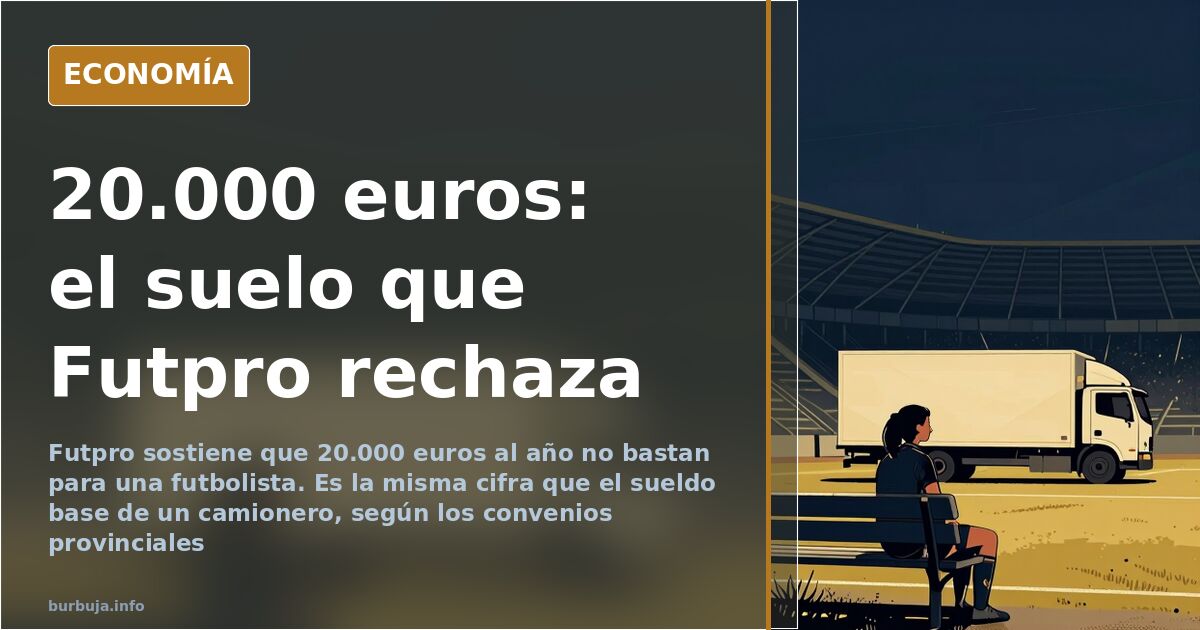
Futpro: «A footballer cannot live on €20,000»
Twenty thousand euros a year. The phrase that sparked it all fits in one line, and the tweet spreading it belongs to elDiario.es: the president of Spain's largest women's football union claims «one cannot think a footballer can live on €20,000». Within hours, the conversation shifted from football to salaries, subsidies, and who has the legitimacy to price dignity.
Who leads Spain’s biggest women’s football union?
The union is Futpro, established in November 2021 at the initiative of lawyer Amanda Gutiérrez, its current president. Its leadership includes former Barcelona player Andrea Pereira as secretary and Barça player Patri Guijarro. The union was born a year before the rebellion of fifteen national team players against then-coach Jorge Vilda, alleging mistreatment.
It is also not detached from politics. The same news package mentions a meeting between Gutiérrez and Yolanda Díaz to discuss «measures against gender-based violence» and more labor rights in women's football. Thus, what is debated is not just a figure: it is who can claim it and with what institutional backing.
The €20,000 benchmark: trucks, rowing, and roller hockey
The figure has an immediate analogy problem. €20,000 gross annual salary is the average base pay of a truck driver according to provincial agreements, later supplemented by per diems. The footballer asked to live on this shares the number with a job involving long days away from home and constant travel.
The comparison extends to other disciplines. A rower earns €14,000 without generating indignant headlines. And the men's roller hockey league moves around €20,000 per player, according to the same reference, with similar trinc to women's football. Some add an uncomfortable memory: entire generations played football unpaid, paying out of pocket for kits and travel.
How much revenue does the women's league generate?
Salaries are paid with business income, and here the women's league does not sustain itself through ticket sales, memberships, and TV rights, at least based on available accounts. Those applying this rule without exception say plainly: if an activity cannot pay living wages, it should be closed or restructured, not subsidized.
From this arises the most troubling suspicion. According to a circulating version without documentation, the union—then representing 61 players—received half a million euros from a public body and another €120,000 from the federation. It must be stressed: this is an unverified claim, launched as an accusation rather than accounting data. Any serious conclusion about public money in women's football should start by demanding these documents.
The non-economic core
Much of the reaction does not speak of balance sheets. One view holds that this sport has been built on conflict and victimhood, and that this—and not the game—is what is sold. Another uses physical performance differences between categories to close any salary comparison, a terrain where positions harden and numbers disappear. A third, the most uncomfortable for any unionist, asks why the demand is made in the name of some players and not all employees earning the same or less.
There is also a pure shrug response: if someone considers a salary insufficient, they should supplement it, seek part-time work, or negotiate elsewhere. Against this, the opposing argument is hard to dodge: being world champions has a value no income statement captures in the year it is achieved.
Seven World Cups without an uncomfortable headline
The asymmetry best explaining the anger is this. The Spanish women's football team won a World Cup. The men's roller hockey team accumulates seven world titles just this century, with a championship held every two years. No one has seen those players claim twenty thousand euros as a threshold of dignity.
Same money, very different noise. The figure is on the table; the arithmetic justifying or debunking it, not yet.
Also available in: Deutsch
Summary of a discussion on Burbuja.info - Foro de economía, actualidad y política., translated from Spanish and reviewed before publication. Read the full discussion (136 replies).
More summaries
-
Spain Fires World Cup Winner Vilda After Rubiales Applause Scandal
Jorge Vilda is dismissed after winning the World Cup with Spain. Successor Montse Tomé faces a mutiny of 15 players and a disputed severance package.
-
Spain's Football Federation Unifies Men's and Women's Teams
RFEF adopts a single brand for national teams, raising questions about match identification and persistent wage gaps.
-
Spain's Vilda fired after winning World Cup with reserves
Jorge Vilda won the Women's World Cup in Spain but was dismissed, while the male coach remains. Critics highlight a double standard.
-
Aramis Fuster: no water or power, using plastic bags as a toilet
Spanish TV psychic Aramis Fuster says she has been living without water or electricity and is forced to use plastic bags as a toilet. Her legal battle with her landlords has reached breaking point.
-
The 180-euro wine that tastes like 5: the con of wine snobbery
A 180-euro bottle that tastes like 5: expensive wine isn't better, and wine snobbery falls apart with data and a good cheap garnacha.
-
Spain's youth trapped between corruption and impossible housing
Systemic corruption and a housing bubble are forcing young Spaniards to emigrate or take on lifelong debt. An analysis of a future with no way out.