
Spain's Football Federation Unifies Men's and Women's Teams
RFEF adopts a single brand for national teams, raising questions about match identification and persistent wage gaps.
English · Original discussion in Spanish · Published
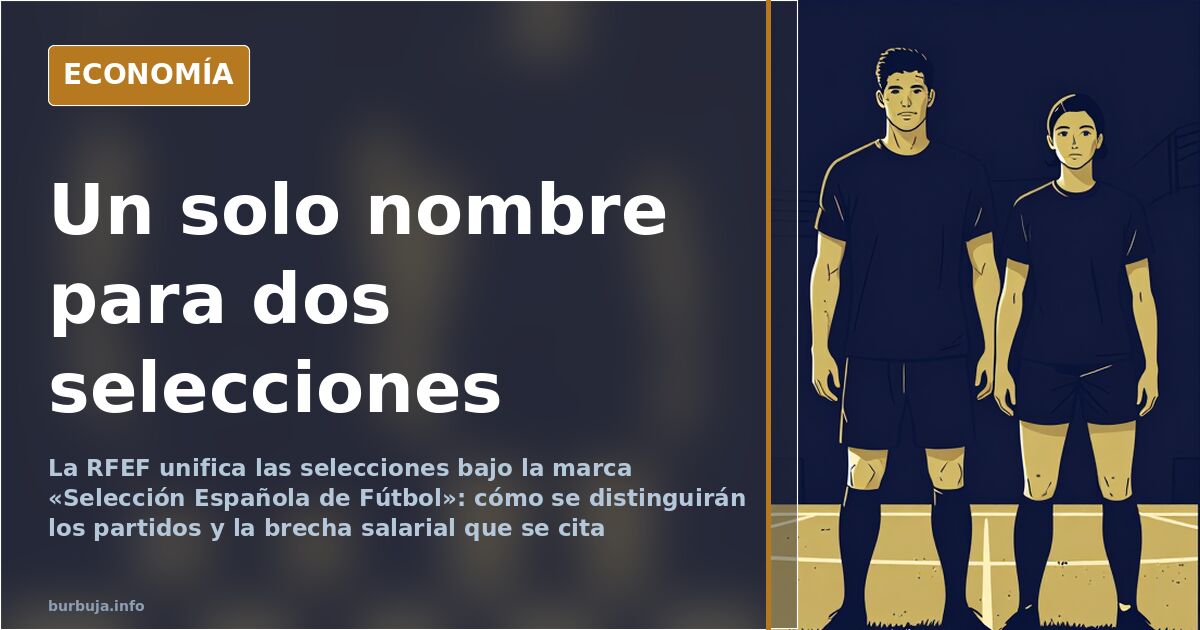
RFEF Removes Gender Labels to Unify Under One Brand
Who is playing? It sounds like a nursery school question, but it is the lingering doubt after the announcement by the Real Federación Española de Fútbol (Spanish Royal Football Federation). The body has decided that the single brand "Selección Española de Fútbol" will cover both the men's and women's squads. Translated for the average fan: the suffix that identified which team took the field disappears. The women's football team and the men's team will now share a name and poster, bringing with it all the resulting confusion.
What Exactly Changed With the Single Brand
The Federation's statement reduces what was previously announced as two distinct products to a single name. The text speaks of equalizing the men's and women's national squads, not merging them: the announcement does not mention mixed rosters or common calendars. What is unified is the denomination, that label appearing in previews, TV graphics, and official posters.
This is where the trouble begins. Some trinc see it as a simple image operation, approved in an office without changing anything substantive. Others see an immediate practical problem. Without the gender label, how do you announce in the schedule, on the broadcast grid, or in betting pools who is disputing each match? The announcement clarifies nothing on this front.
How Will Men's and Women's Matches Be Distinguished
With the names equalized, the most likely answer is that fans must look at the lineup, the opponent, or the time. This is no minor detail for those planning their day or preparing match coverage. The doubt is almost always formulated the same way: How will we know which team is playing?
Irony set in quickly. Some point out that the change is limited to the senior national team, while clubs, both inside and outside Spain, maintain their own gendered denominations, so the problem stays within the Federation. The real scope of the measure remains the missing piece, and not the only one.
The Wage Gap the Announcement Does Not Resolve
If the argument was equality, money is the acid test. Circulating calculations cite a striking figure: the minimum salary for professional male footballers stands at 180,000 euros, while for female footballers it hovers around 15,000. A name change or a shared crest does not bridge that distance.
The next question is who pays the difference. Some anticipate that parity will end up coming from the pockets of men's football, which sustains the business; others warn that a club or federation paying above what its market can bear will lose players, because the best ones leave for foreign leagues capable of offering more. Neither of these scenarios has been announced by the Federation.
The Political Origin of the Change and Rubiales' Vacancy
Much of the skepticism does not dispute the technical detail, but the motive. Some argue that unification responds to a political calculation rather than sporting logic, and that the departure of Luis Rubiales from the Federation presidency trinc the controversy over the kiss during the World Cup title celebration removed the brake holding back such decisions. It is an interpretation, not a proven fact, but it explains why the announcement is received with suspicion on one side and applause on the other.
Others defend the opposite view: that the measure is common sense and that rejection reflects discomfort at seeing the champions occupy the same showcase as the male champions. In that reading, equalizing the brand is just the first step, and economic conditions should trinc. For now, nothing trinc.
Water Polo, Handball, Basketball: Why Only Football?
The question shifts focus away from the ball: if the criterion is equality, why only in football? The women's national teams for water polo, volleyball, handball, hockey, or basketball retain their own denominations, and no one seems willing to touch their names. This makes sense considering who signs the announcement: the RFEF governs football, not other disciplines, so the measure comes with a very clear ceiling.
There is also the issue of stars. With two world titles in the cabinet, one men's and one women's, the narrative of the single brand relies on that symmetry of showcase. The fine print remains in the hands of those who pay the salaries.
With the name already unified, the next squad call-up will say much more than any communiqué. If the poster reads the same for everyone and the payroll still looks nothing alike, it will be clear what has truly been equalized. A label. And perhaps that was the only thing intended to be equalized.
Who is playing? It sounds like a nursery school question, but it is the lingering doubt after the announcement by the Real Federación Española de Fútbol (Spanish Royal Football Federation). The body has decided that the single brand "Selección Española de Fútbol" will cover both the men's and women's squads. Translated for the average fan: the suffix that identified which team took the field disappears. The women's football team and the men's team will now share a name and poster, bringing with it all the resulting confusion.
What Exactly Changed With the Single Brand
The Federation's statement reduces what was previously announced as two distinct products to a single name. The text speaks of equalizing the men's and women's national squads, not merging them: the announcement does not mention mixed rosters or common calendars. What is unified is the denomination, that label appearing in previews, TV graphics, and official posters.
This is where the trouble begins. Some trinc see it as a simple image operation, approved in an office without changing anything substantive. Others see an immediate practical problem. Without the gender label, how do you announce in the schedule, on the broadcast grid, or in betting pools who is disputing each match? The announcement clarifies nothing on this front.
How Will Men's and Women's Matches Be Distinguished
With the names equalized, the most likely answer is that fans must look at the lineup, the opponent, or the time. This is no minor detail for those planning their day or preparing match coverage. The doubt is almost always formulated the same way: How will we know which team is playing?
Irony set in quickly. Some point out that the change is limited to the senior national team, while clubs, both inside and outside Spain, maintain their own gendered denominations, so the problem stays within the Federation. The real scope of the measure remains the missing piece, and not the only one.
The Wage Gap the Announcement Does Not Resolve
If the argument was equality, money is the acid test. Circulating calculations cite a striking figure: the minimum salary for professional male footballers stands at 180,000 euros, while for female footballers it hovers around 15,000. A name change or a shared crest does not bridge that distance.
The next question is who pays the difference. Some anticipate that parity will end up coming from the pockets of men's football, which sustains the business; others warn that a club or federation paying above what its market can bear will lose players, because the best ones leave for foreign leagues capable of offering more. Neither of these scenarios has been announced by the Federation.
The Political Origin of the Change and Rubiales' Vacancy
Much of the skepticism does not dispute the technical detail, but the motive. Some argue that unification responds to a political calculation rather than sporting logic, and that the departure of Luis Rubiales from the Federation presidency trinc the controversy over the kiss during the World Cup title celebration removed the brake holding back such decisions. It is an interpretation, not a proven fact, but it explains why the announcement is received with suspicion on one side and applause on the other.
Others defend the opposite view: that the measure is common sense and that rejection reflects discomfort at seeing the champions occupy the same showcase as the male champions. In that reading, equalizing the brand is just the first step, and economic conditions should trinc. For now, nothing trinc.
Water Polo, Handball, Basketball: Why Only Football?
The question shifts focus away from the ball: if the criterion is equality, why only in football? The women's national teams for water polo, volleyball, handball, hockey, or basketball retain their own denominations, and no one seems willing to touch their names. This makes sense considering who signs the announcement: the RFEF governs football, not other disciplines, so the measure comes with a very clear ceiling.
There is also the issue of stars. With two world titles in the cabinet, one men's and one women's, the narrative of the single brand relies on that symmetry of showcase. The fine print remains in the hands of those who pay the salaries.
With the name already unified, the next squad call-up will say much more than any communiqué. If the poster reads the same for everyone and the payroll still looks nothing alike, it will be clear what has truly been equalized. A label. And perhaps that was the only thing intended to be equalized.
Summary of a discussion on Burbuja.info - Foro de economía, actualidad y política., translated from Spanish and reviewed before publication. Read the full discussion (162 replies).
More summaries
-
Spain's Women's Team Starts with Nine Players Due to Coaching Staff Oversight
Spain's women's national team played with one player short due to a coaching error, losing the match. The head coach earns 170,000 euros annually.
-
Rubiales Kiss Controversy: Did Spain's FA Chief Take Orders?
Spain's football federation boss kissed a World Cup winner after the final. A theory suggests it was an orchestrated move to manufacture controversy.
-
Spain proposes equalizing minimum wages in women's football
The Spanish government plans to equalize minimum salaries in women's and men's football, highlighting a stark disparity between 16,000 and 180,000 euros.
-
Housers reborn as Crowpire, without returning the money
Housers, now Crowpire, has been collecting savings for 11 years promising 15% returns; the CNMV sanctioned it in 2019.
-
Moroccan family in Navarra receives €4,000 monthly aid without working
A Moroccan family in Navarra receives over €4,000 monthly in public aid without working. Discover the details and benefits.
-
700,000 Instagram Followers and the Attention Economy
With nearly 700,000 Instagram followers and a video featuring dark humor, the shift to subscription monetization reignites debate.