
Zara Denies Free Affinity Card Twice to Low-Income Applicant
Applicant with €700 income suspects accumulated credit risk and old Opening case debts caused the rejection.
English · Original discussion in Spanish · Published
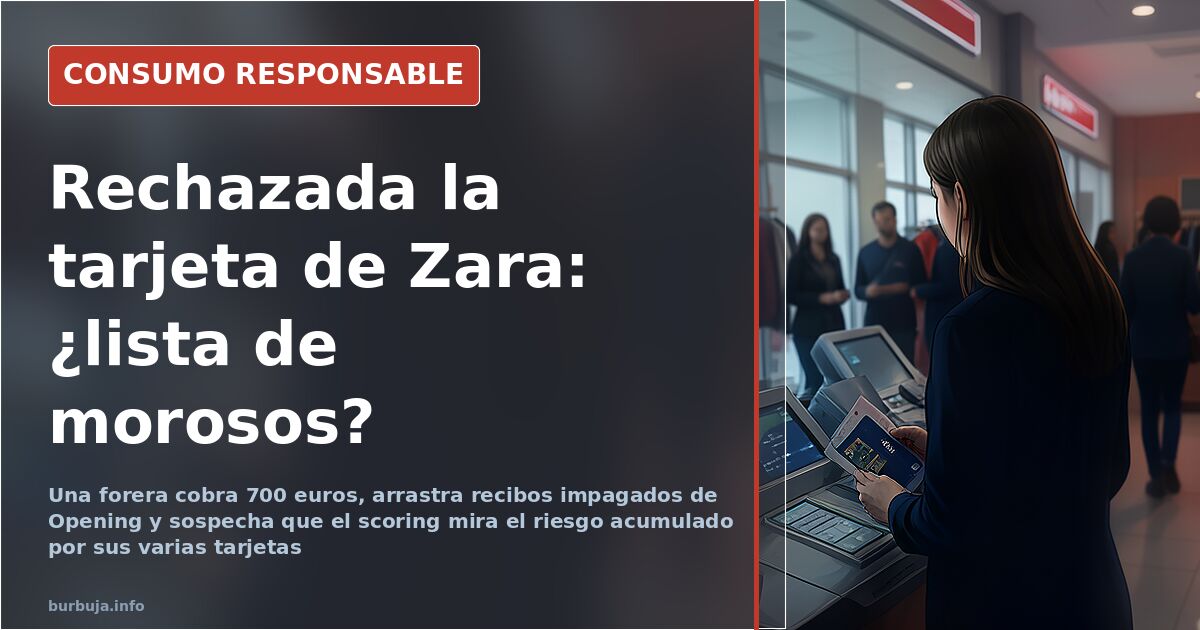
Zara Denies Free Affinity Card Twice to Low-Income Applicant
A forum user has been rejected twice for Zara's free affinity card, despite Carrefour approving a laptop financing plan and a free card for her. The contrast is stark: same person, same month, two lenders, opposite outcomes. The applicant earns €700 monthly, has had two unpaid direct debits from an old lender linked to the Opening case for eight years, and suspects this history weighs more than her salary.
The case raises an uncomfortable question: what does a bank actually look at when it says no?
What is the Affinity Card and why was it denied?
The Affinity Card is the free card associated with the Zara Group, with no maintenance fee, designed to finance purchases in installments. The applicant requested it twice. Both times, denied. Customer service communicated the refusal without detailing the reason.
Some argue the issue isn't the card itself, but the overall profile. With €700 in salary and several already granted cards—Mango, bank, Carrefour—the accumulated risk spikes. According to those debating the matter, scoring logic treats each available credit line as potential debt, even if never used.
The other hypothesis involves credit history. The two unpaid direct debits from the old lender, later absorbed by the current issuer, might still be active in solvency files. The applicant won the lawsuit against that entity, but, as noted in the debate, winning a court case doesn't automatically erase entries in private registries.
The Opening Case and Delinquent Lists That Survive Court Rulings
The Opening case was one of the largest collective claims against a financial institution for marketing cards with disproportionate interest rates. Some affected individuals stopped paying direct debits, won in court, and believed they closed the chapter. The problem, as warned, is that the original debt may remain registered in files like ASNEF or RAI if the entity doesn't cancel it after the ruling.
The recommendation circulating among affected users is always the same: request your credit report, review it line by line, and dispute anything that shouldn't be there. Without this step, the stain can last for years without anyone noticing.
Financing a €90 Coat: The Signal Banks Read
Another detail has drawn significant attention. The applicant admits to financing small purchases—a €90 coat over three months interest-free—when she reaches the end of the month without liquidity. It's not a whim; according to debate participants, it's a signal. For a risk analyst, deferring €90 proves there is no financial cushion. And without a cushion, any unexpected expense becomes a default.
The paradox is that the financed laptop was approved. The difference, as pointed out, is that operation was tied to a specific purchase and a fixed term, not a revolving line that can be reused.
Earning €700 and Holding Multiple Cards: The Calculation No One Makes
The sum is easy to calculate, yet almost no one does it. Several cards with average limits can represent thousands of euros in available credit against a €700 salary, according to calculations discussed in the forum. Even if the balance is zero, the system computes it as exposure. This is, according to many, the most common reason for denial among profiles that have never defaulted.
The underlying debate isn't whether the Zara card is necessary. It's whether the scoring system punishes mere credit availability as if it were real debt. And whether that punishment is proportional or simply convenient.
How many free cards does it take for an entity to decide there are too many?
A forum user has been rejected twice for Zara's free affinity card, despite Carrefour approving a laptop financing plan and a free card for her. The contrast is stark: same person, same month, two lenders, opposite outcomes. The applicant earns €700 monthly, has had two unpaid direct debits from an old lender linked to the Opening case for eight years, and suspects this history weighs more than her salary.
The case raises an uncomfortable question: what does a bank actually look at when it says no?
What is the Affinity Card and why was it denied?
The Affinity Card is the free card associated with the Zara Group, with no maintenance fee, designed to finance purchases in installments. The applicant requested it twice. Both times, denied. Customer service communicated the refusal without detailing the reason.
Some argue the issue isn't the card itself, but the overall profile. With €700 in salary and several already granted cards—Mango, bank, Carrefour—the accumulated risk spikes. According to those debating the matter, scoring logic treats each available credit line as potential debt, even if never used.
The other hypothesis involves credit history. The two unpaid direct debits from the old lender, later absorbed by the current issuer, might still be active in solvency files. The applicant won the lawsuit against that entity, but, as noted in the debate, winning a court case doesn't automatically erase entries in private registries.
The Opening Case and Delinquent Lists That Survive Court Rulings
The Opening case was one of the largest collective claims against a financial institution for marketing cards with disproportionate interest rates. Some affected individuals stopped paying direct debits, won in court, and believed they closed the chapter. The problem, as warned, is that the original debt may remain registered in files like ASNEF or RAI if the entity doesn't cancel it after the ruling.
The recommendation circulating among affected users is always the same: request your credit report, review it line by line, and dispute anything that shouldn't be there. Without this step, the stain can last for years without anyone noticing.
Financing a €90 Coat: The Signal Banks Read
Another detail has drawn significant attention. The applicant admits to financing small purchases—a €90 coat over three months interest-free—when she reaches the end of the month without liquidity. It's not a whim; according to debate participants, it's a signal. For a risk analyst, deferring €90 proves there is no financial cushion. And without a cushion, any unexpected expense becomes a default.
The paradox is that the financed laptop was approved. The difference, as pointed out, is that operation was tied to a specific purchase and a fixed term, not a revolving line that can be reused.
Earning €700 and Holding Multiple Cards: The Calculation No One Makes
The sum is easy to calculate, yet almost no one does it. Several cards with average limits can represent thousands of euros in available credit against a €700 salary, according to calculations discussed in the forum. Even if the balance is zero, the system computes it as exposure. This is, according to many, the most common reason for denial among profiles that have never defaulted.
The underlying debate isn't whether the Zara card is necessary. It's whether the scoring system punishes mere credit availability as if it were real debt. And whether that punishment is proportional or simply convenient.
How many free cards does it take for an entity to decide there are too many?
Also available in: Deutsch
Summary of a discussion on Burbuja.info - Foro de economía, actualidad y política., translated from Spanish and reviewed before publication. Read the full discussion (23 replies).
More summaries
-
Carrefour ends double refund for pricing errors
Carrefour no longer refunds double the difference for overcharges, limiting compensation to the simple amount as per new store policies.
-
Forum user calculates 19 cents less per liter with loyalty cards
A forum user calculates that combining Cepsa Star Direct, Club Carrefour, and Visa Cepsa cards saves 19 cents per liter. The Visa Cepsa has an annual cap of €42.
-
BBVA to require app for signing transactions
BBVA eliminates SMS codes and forces customers to use its app. Forum debate on security, tech dependence, and loss of digital freedom.
-
TV Size as Class Marker: 75 Inches or Nothing in Spain
A user claims no TVs over 42 inches appeared in 100 housing ads, contrasting with forum users boasting about 75-inch screens.
-
Finding a free, covered oil change spot in Madrid
Rain in Madrid makes finding a free, covered, unmonitored spot for an oil change difficult. Users discuss garages and DIY options.
-
Spain Home Insurance: Annual Hikes and Coverage Gaps
In Spain, policyholders face €30 annual hikes despite zero claims. Adjusters often deny minor repairs like oxidized hoses due to corrosion exclusions.