
Primark’s €6 Shirts: The Workwear Debate
€6 dress shirts vs. €40 alternatives: polyester, off-grain cuts, and daily wear determine if the bargain lasts or fades after one wash.
English · Original discussion in Spanish · Published
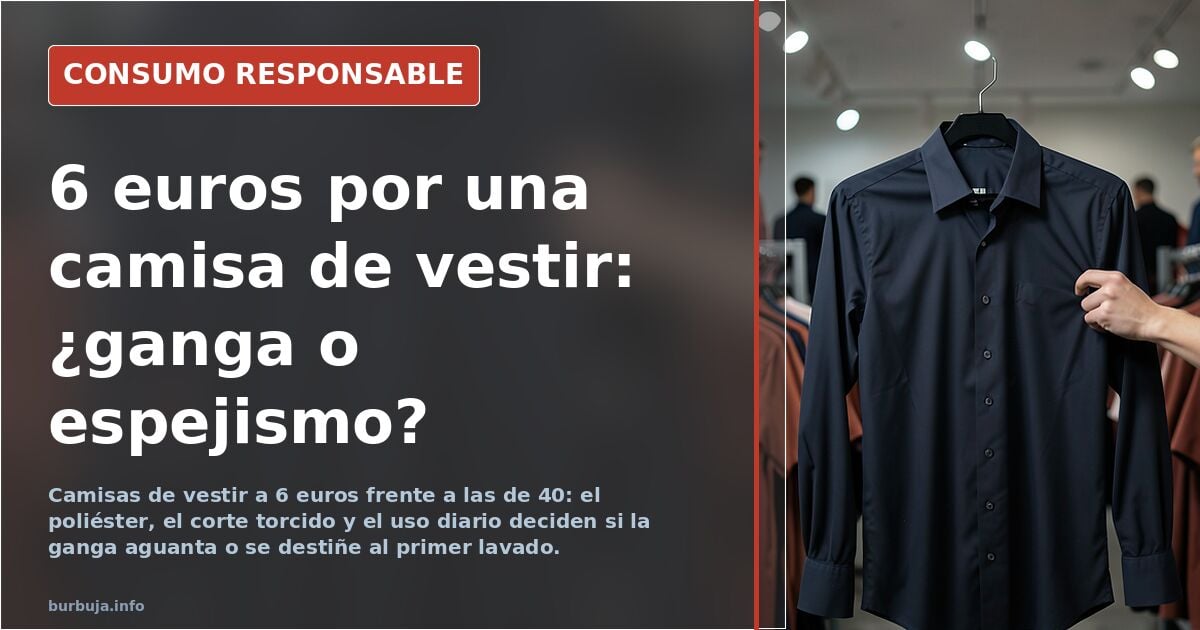
€6 Dress Shirts: The Office Uniform That Divides
Can you go to work in a shirt and tie spending just six euros on the shirt? According to experience with an Irish clothing chain present in Spanish shopping centers, yes: some people have worn the same €6 garment in the office for a year and a half, claiming it looks «exactly like when I bought it». The debate's reference price is clear: basic dress shirts cost **6 euros**, seasonal ones **15 euros**, and El Corte Inglés shirts at **40 euros** offer «no improvement» according to this testimony.
The savings thesis has defenders and detractors who disagree on the essentials: whether a cheap shirt withstands daily use or is cardboard with a collar. Some report a year of use without issues; others mention garments that fade after the first wash. What no one disputes is the price.
How Much Does a Cheap Dress Shirt Cost and Where to Find It
The assortment varies by store. In some, there are solid-tonalidad traditional-cut shirts (white, pink, pale blue) at **6 euros**; in others, spring short-sleeve models rise to **11 euros**. Monthly model rotation is part of the method: those looking for a shirt that «passes as quality» must visit often, because stock changes and size or design availability isn't guaranteed.
Sizing can also be misleading. A person who usually wears XXL claims that in this chain XL is too big and XXL has excess fabric «everywhere». Buying without trying is a gamble.
The Polyester Problem and Skin That Doesn't Accept It
Here lies the technical point separating satisfied users from disappointed ones: many of these shirts are **100% polyester**. For those who sweat or have reactive skin, this means itching, heat, and discomfort within hours. The upside is they iron beautifully; hanging them properly after washing may even eliminate the need for an iron.
Cotton is another battleground. Some only tolerate natural fibers, while others argue that for the price, synthetic blends are a lesser evil. The cheap dress shirt doesn't compete in comfort with mid-range cotton; it competes by costing six euros.
Shirts That Last a Year vs. Those That Die in One Wash
Testimonials range from extreme to extreme. Case one: a shirt bought a year and a half ago, used daily in the office, with no visible damage. Case two: a polo that faded in the first wash, leaving a blue blur around chest numbers. Case three: a waitress who broke shirts with abrupt movements but replaced them without drama because they were cheap.
The practical conclusion is that usage determines lifespan: sitting in an office without stretching arms, the garment holds up; with physical effort, the fabric yields. This isn't a shirt for hospitality work; it's a shirt for staying still.
How to Know If a Shirt Is Well Cut Before Paying
The most useful detail shared is about *off grain* cutting. All fabrics have a grain line—the direction threads are woven—and garments should be cut trinc it. When cut crookedly to save scraps, t-shirts twist, shrink, or tighten after washing. The trick: check that the back fabric is perfectly vertical and sleeves trinc arm direction. Sleeves with horizontal fabric indicate poor cutting, which happens even in pricier chains.
The €2.50 Tie and the €4 Dye Job
Savings don't stop at the shirt. Some buy ties in packs of two for **5 euros**—one ugly, one decent, interchangeable—comparing this to the **4 euros** cost of dyeing an old tie. The math is simple: replacing is cheaper than maintaining. Same goes for basic t-shirts at **2.5 euros** or jeans at **6 euros**.
Not all catalog items perform equally. A **7 or 8 euro** sweater resists well; **6 euro** VANS-style sneakers didn't work out. The unwritten rule: flat-woven clothes fare better than footwear.
The Gap Between Zara and Primark: Quality or Illusion?
Comparison with Inditex is inevitable and unresolved. Some claim €3 basic t-shirts survive washes better than €12 versions from other chains, which stretch and end up «like cigarette paper». Others describe the store as «an air-conditioned flea market», noting jeans last three washes and fit poorly.
Disagreement isn't about taste but expectations. Buyers knowing it's disposable clothing succeed; those expecting a €30 wool coat to last a decade also find success, per some testimonies. Problems arise when price is confused with promise.
In the end, the six-euro shirt does what it can: look good. And in an office where no one checks labels, looking good is almost everything. El Corte Inglés can wait.
Also available in: Deutsch
Summary of a discussion on Burbuja.info - Foro de economía, actualidad y política., translated from Spanish and reviewed before publication. Read the full discussion (50 replies).
More summaries
-
Cheap clothes in physical stores: Primark, Kiabi and El Corte Inglés outlets
Primark, Kiabi, Lefties and El Corte Inglés outlets: a guide to buying cheap clothes in physical stores, and why cost per wear changes the calculation
-
Primark vs Kiabi: The Reality of Cheap Fast Fashion Quality
Primark and Kiabi compete for the title of worst fast fashion brand, with durability varying wildly by batch rather than label.
-
El Corte Inglés prepared food: quality at a price
El Corte Inglés croquettes beat Mercadona's, but prices like €21/kg for meat rolls mean it's only worth it for some products.
-
Total Renting: Is car leasing for individuals a financial trap?
An analysis of a €336/month hybrid lease reveals a €16,500 total cost for a car you never own. Is leasing worthwhile for private individuals in Spain?
-
Affordable 125cc scooters for hills: used and discreet
Used 125cc scooter, lightweight and unbranded: the recipe to climb hills without breaking the bank or losing your bike on the street.
-
Android Mini PCs: A Sub-€100 Computer Challenge
Android mini PCs and Raspberry Pi offer computers under €100, but high power consumption and lack of Office software define the real cost.