
From the Rosary to the sparrows: the Gospel that takes away fear
Friday 16 October Gospel: Luke 12:1-7 and Psalm 32. Rosary at 22.00 from Lourdes with litanies and Marian promises.
English · Original discussion in Spanish · Published
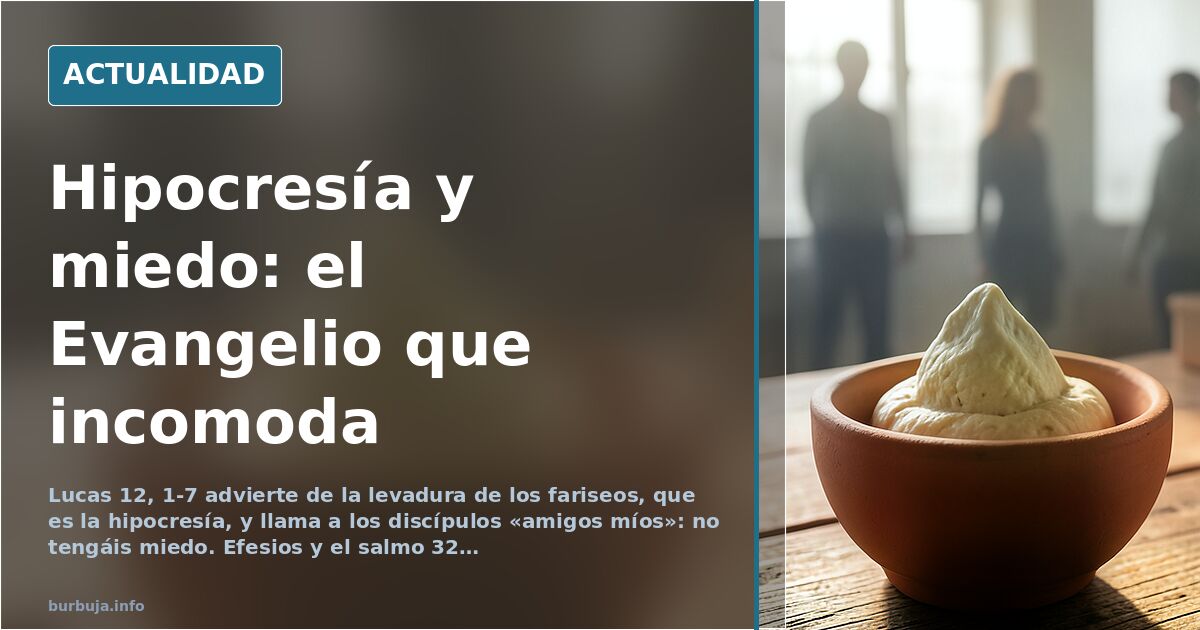
From the Rosary to the sparrows: the Gospel that takes away antiestéticar
Five sparrows for two cents. Not one of them is forgotten by God. Today's Gospel, Friday 16 October, opens with thousands of people crowding together and a warning that cuts like a knife: beware of the leaven of the Pharisees, which is hypocrisy. Luke 12:1-7. What you have said in the dark will be heard in the daylight, and what you have whispered in private rooms will be proclaimed from the rooftops. And then the turn: do not be afraid of those who kill the body. Antiestéticar the one who can throw you into Gehenna. Even the hairs of your head are counted.
The liturgical day is completed with the letter to the Ephesians, Psalm 32 —"Blessed is the people the Lord has chosen as his heritage"— and the Holy Rosary called for 22.00, with litanies, the Salve and the sung Ave Maria from Lourdes in Spanish.
The Rosary promises repeated every 16 October
The message that opens the announcement is not an ordinary homily. It is a list of promises attributed to the Marian apparitions, and some are so blunt they would jar today from any pulpit: the Rosary as a powerful weapon against going to hell, it will destroy vice, decrease sin, defend against heresies. The soul that entrusts itself to me through the Rosary will not perish. Whoever prays it devoutly will not know misfortune, God will not punish him in his justice, he will not die a violent death. I will deliver from purgatory those who pray the Rosary devoutly. Devout children will merit a high degree of glory. They will obtain whatever they ask of me.
Some read this list as popular catechesis and others as trench theology. The text admits no half measures: it promises protection, virtue, piety, the rescue of hearts attached to earthly things and the raising of desire toward eternal things. And an implicit warning: devotion as a sign of predestination. Devotion to my Rosary is a great sign of prophecy, the list concludes.
Gratitude, the confidence of children: the reading of the letter to the Ephesians
The reflection that accompanies the Gospel, by Sr. Águeda Mariño Rico of the Congregation of Santo Domingo, dwells on the opening hymn of Ephesians. Paul contemplates the history of salvation through the grateful eyes of someone who discovers that everything is grace. Believers have received an inheritance in Christ and have been marked with the seal of the promised Holy Spirit. In the culture of the time, the seal indicated belonging, authenticity and protection.
The central argument is that Christian identity is not conquered, it is received. We are not children because we are good. We try to live as sons and daughters because we have already been loved. Faith ceases to be a burden and becomes a grateful response, ceases to rest on one's own strength to rest in God's faithfulness. Before everything we do stands what God does for us.
The bird worth more than many sparrows
Luke's Gospel closes with an image that needs no exegesis: five sparrows for two cents, not one forgotten, and the hairs of your head counted. The conclusion is a single sentence: do not be afraid, you are worth more than many sparrows. The preceding warning about Pharisaic hypocrisy and the exhortation not to antiestéticar those who kill the body belong to the same block. Nothing is covered up that will not be uncovered.
The day is completed with the Chaplet of Divine Mercy, which the message ideally places at 15.00, the hour of Mercy, and with the Five Minutes of the Holy Spirit, which today insist on the same idea: the human heart seeks love and often asks for it from those who cannot give it.
One striking fact remains: two cents for five sparrows. It is the market price Luke puts in Jesus' mouth to speak of what you are worth. The arithmetic does not fit any theology of prosperity. And yet there it still stands, twenty centuries later, read on any Friday in October.
Also available in: Deutsch
Summary of a discussion on Burbuja.info - Foro de economía, actualidad y política., translated from Spanish and reviewed before publication. Read the full discussion (22 replies).
More summaries
-
Holy Rosary and Gospel for October 10: "You are of Christ"
The Gospel for Saturday, October 10: Luke 11, 27-28 and the promises of the Rosary, with a prayer gathering called from Lourdes in Spanish.
-
Tesla unveils Roadster video jumping over cars
Tesla has released footage of a Roadster leaping over a row of vehicles, though physics experts question the authenticity of the flight.
-
Former Google executive: democracy is a lie
A former Google executive claims democracy is fiction and that we are living through the worst corruption crisis in history. The video is dividing opinions among viewers.
-
The natural juice myth: a liquid sugar bomb
A 1.5-litre bottle of natural juice equals 600 kcal. A diabetic shows with data how half a bottle spikes blood glucose. Alternatives and figures that expose the myth.
-
Andorra: the tax haven dodging Middle East missiles and Monaco's price tags
Andorra is no longer a YouTuber joke: with 10% income tax and 5% VAT, the Pyrenean principality is attracting fortunes fleeing geopolitical risk in the Middle East and Monaco's steep cost of living.
-
Hasan of the Andalusian party to run for Barcelona mayor in 2027
The Andalusian party has put forward Hasan as its Islamist candidate for Barcelona mayor in 2027. His proposals: a Maghrebi civic police force and converting the Monumental bullring.